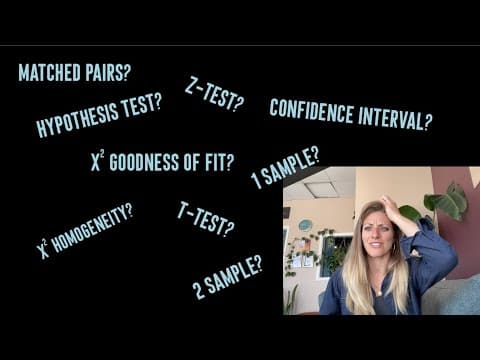
[0:00]Hello, my statusticians. I hope you're having a great day. Uh, welcome to mostly math. I'm Ashley and we mostly do math on this channel. Um, and because it is very close to AP time, we're actually just going to do some big picture reviews. So today we're going to talk about how to choose what inference procedure to use. Is it a hypothesis test? Is it a confidence interval? Are we using Z? Are we using T? Are we using proportions? Are we using means? We doing difference of means? Are we doing chi squared? Are we doing chi squared goodness of fit? Or oh my god, pulled data? Oh my god, there's so many different things. How do you choose which one, right? So, this video is not going to cover what each test does. All right, and and how to perform it and which, um, like what formulas to use, okay? If you want a review on the comparison between the different tests, um, check out that video. This is a review video. So this is assuming that you already know the difference between all of these things. If you just look at the list of inference procedures that are options for AP stats, I mean, there are more out there, but this is like what's covered in AP stats. Um, and kind of like beginning stats in college, there's a lot of them, right? You just take a look at that list there, you know. I mean, it's it's crazy. There's so many different things that you would have to choose from. Um, and if you look at this list, it's like super daunting. Um, but I have a cheat sheet. I mean, not a cheat sheet. I have a way to kind of cheat the chaos. Um, so when I'm deciding on an inference procedure, uh, I first ask myself what kind of data do I have? Is the data categorical or quantitative? Is it stuff and things and yeses and nos? Or is it, oh my goodness, it's windy out there. Or is it quantitative or numbers, numerical data? All right, as soon as you have that decision made, you've eliminated half of the tests. Okay. So, that's question one. Question two, is, are we what, what question are we trying to answer? Okay. And in this case, you want to look at there's three different things you want to be thinking about. So, one, are you looking for, um, is that, is what you're looking at a hypothesis test type of a question where you basically just get a yes or no answer, um, or mostly a no or a not a sufficient not sufficient information answer, right? If you do hypothesis test and you start with, you know, mu equals zero, and you're testing to see if mu is not equal to zero. At the end of that all, you either get, yep, mu is not zero, or, no, we don't know anything. Okay. So it depends if that's your question, then, you know, hypothesis test is great. Confidence interval gives you some information on the range of values. Um, so if you're if you're trying to kind of get like, you know, does does the data lean one direction or another, a confidence interval is typically really nice. And then the the third question is, uh, are you trying to establish a relationship? And if you are trying to establish a relationship, that's when we get into kind of those funky tests, the the tests for, uh, the slope of a least squares regression line, or, um, the chi squared tests. So, um, if if it's asking about a relationship, that's going to be your next question. And then last but not least, if we're dealing with hypothesis tests or confidence intervals, we want to know is it one sample or is it two samples? Are you are you comparing one sample to a claim? Um, or are you trying to find information about a single sample? Or are you trying to compare two samples together? And, uh, there is a special case. There's actually a couple special cases, but the two special cases that I think are important to refresh yourself on, because the AP stats they love to ask these questions. So, is the, uh, difference, um, a mean of the differences? So, this would be paired data where you're like lining up the data and you're finding the difference and then finding the mean of the differences. If you're not sure about that, I've got another video that I just did. It's like five minutes. You can go watch that. Right up there. And then, uh, God, where was I?
[5:27]Yes, difference. Okay, so that is a special case where you have two sets of data, you would think that you're doing two sample. But because you're finding the difference between the two of them, you're actually only doing a single test, um, a single, you're only dealing with a single sample, which is the difference between the two samples. And then, uh, the other special case is with pooled data. Um, this only happens with proportions and it's only if you're doing a hypothesis test where you assume that P1 is equal to P2.
[6:06]And you do all of the calculations, you're still doing two samples, but you do all of the calculations assuming that P1 is equal to P2. Um, and so you can actually pull the data to to combine and get a larger sample size, basically. Uh, so, those are your special cases, but other than that, those three questions is it categorical or quantitative? Are you looking at a hypothesis test, a confidence interval or a relationship? And is it one or two samples? If you can get those three questions answered, you should be good to go. All right. So, that's the general overview. Um, and I have if you're good with that and ready to move on, great. Love you. Have a great day. If you want to see a couple examples, I have some lovely little examples over here. And we're just going to kind of talk about how to make the decision of which test to use for these guys. So, uh, let's just jump right in. Number one, which brand of AA batteries lasts longer, Duracell or Energizer? You should pause the video before we do the examples. Pause the video, try these problems first, okay?
[7:33]That's the best way to learn is to try it first, see where you messed up. Don't just like watch me talk and go through it. All right, pause it. Do your own thing. Okay, now come back. All right, question one. Which brand of AA batteries lasts longer? Duracell or Energizer? All right, our question one, is it quantitative or qualitative data? Well, it's asking about how long a battery lasts, so that's going to be measured in probably minutes or hours or days. So that's definitely quantitative, numbers. So, question one, quantitative for sure. Question two, are we trying to establish a relationship between these two things? Um, no, definitely not. It's asking which one lasts longer, but it's not asking like, is there a relationship between Duracell and Energizer? That's not a thing. It's just that's like a weird question to ask.
[8:34]So, that brings us to, is it a hypothesis test or are we going to do a confidence interval?
[8:52]Now, a hypothesis test, if you were to set up your null hypothesis and alternative hypothesis, you would have your null is that they last the same amount of time.
[9:36]So mu1 equals mu2, and then your, your alternative hypothesis would be that they're either not equal or that one is greater than the other. But if you try to prove that one is greater than the other, and then you kind of get down to the bottom, and then, you know, you can only conclude what you tested. So, if you test the wrong thing, then you kind of like put yourself in a bind. Um, and if you just prove that they're not equal, that doesn't tell you which one lasts longer. So, in this case, it's actually best to do a confidence interval, because what you can do is find this, you know, if you're testing Duracell minus Energizer, uh, and how long they last, right? If the difference between the two of them is positive, if you do Duracell minus Energizer, D minus E, if it's positive, that means Duracell tends to last longer. If it's negative, then Energizer tends to last longer. It usually helps to think about like where you want to go. Like where do you want to end up? Okay. All right. So, confidence interval, two sample confidence interval for mu1 minus mu2.
[11:41]All right, number two, according to a recent survey, a typical senior has 250 contacts in their phone. Is this true at your school? All right, quantitative or qualitative? Well, we're counting contacts. So, quantitative, which means we're doing means. Um, and it's asking there's like a claim, and then we want to test whether or not your school is in alignment with the with the test, or with the claim, or is it different than the claim, right? There's no, there's nothing leaning one direction or the other. They're not asking, um, does your school tend to have more, like, do the students at your school tend to have more contacts in their phone? That's not what they're asking. They're just asking, is it different or the same? So, this is going to be, um, quantitative data. We've got, uh, we're just at this point deciding between a hypothesis test and a confidence interval. Um, and just because we're asking, is it this thing, or is it not this thing? It's pretty straightforward to do a one sample T test for the mean. Because your result if you if you, uh, reject the null hypothesis, then you say, yeah, we have enough evidence to say that it is different at our school. Or you don't have enough evidence to say that it's different and so you kind of have to go with that. That's all it's really asking. So, that's number two. Number three, what percent of your students at your school are on Tik Tok? All right. So, this, if you think about like the study that you'd have to do, you'd probably send out a survey and you'd ask people, are you on Tik Tok or not? Right? You do a sample, do a little random sample, ask people, are you on Tik Tok or not? The data that you're collecting is either a yes or a no. Okay. So, is that quantitative or qualitative? That's our first question. It is definitely qualitative. You cannot measure, yes. Um, or no, except with proportions or percentages. Um, so, this is qualitative data. And we want to know, the next question is, are we doing a hypothesis test? Are we doing a confidence interval? Or are we doing like a relationship test? And it's not asking anything about a relationship. We just want to find an approximate estimate of what, how many people at your school are on Tik Tok, or what percent of the people at school are on Tik Tok? Um, to answer this question, you have you have no claim to compare to. So a hypothesis test doesn't actually make sense in this case. Um, and we're doing qualitative data. The other option other than a confidence interval would be the chi squared test.
[15:53]Um, and in this case, it asks who is more likely to own an iPod.
[22:08]Because it's asking for a direction without information about like which way it should lean.
[22:19]So if the question had said something like, um, it's been thought that Millennials are more likely to have an iPod than Gen Zers. Then you could do a hypothesis test with Millennials being having a proportion greater than the Gen Z. Um, but that's not what the question is asking. It's asking, we don't know and we want to know who is more likely to own one. So, the confidence interval actually is the best option here because when you do a confidence interval, again, you're going to do, um, your Gen Z's minus your Millennials, if you end up with a confidence interval that's all positive, then you know the Gen Z's have tend to have more iPods. And if it comes out negative, all negative, then you know that the Millennials tend to have more. Right? It just depends on which one you subtract from which. But that leads us to our third question, which I've already kind of answered, is it one or two samples? And obviously, this is going to be two samples because you're going to have to ask both Gen Z and both and Millennials and then compare the two proportions to each other. So, this is a two sample Z interval for P1 minus P2. is how you'd calculate that one. How you'd answer that question. All right, seven. How long do 16 to 18 year olds spend doom scrolling each day? All right, this is another survey we send out and we ask, hey, how long do you spend doom scrolling each day? Uh, and how much does that affect your heart? Because it hurts my heart really bad. I hate it so much. I'm definitely a millennial. I'm sorry. I'm sorry if I'm not cool. I got my side part. I got my skinny jeans. But I can do math. So I hope you can too after these videos. All right. Anyway, moving on. Um, all right, so, how long do they spend doom scrolling each day?
[24:31]Question one is a quantitative or qualitative. Well, we're looking at time. So, we're measuring in minutes, hours, whatever. So, definitely quantitative. Uh, is it a relationship question? Nope, not at all. And so now we just have to decide, is it one or two sample? And are we doing a confidence interval or a hypothesis test? So, there's nothing, we're not comparing two groups. So, this is definitely one sample. And the question asks, how long do they spend?
[25:07]You can't get that information with a hypothesis test. All you can answer is the question, do 16 to 18 year olds doom scroll? Yes or no? So, a hypothesis test is not appropriate in this situation. So, confidence interval is the way to go. So, for number seven, we have a one sample T interval for mu.
[25:30]All right, eight. Are the colors of Skittles equally distributed?
[25:37]What is that question asking? Well, are all of the Skittles colors like, will you have the same proportion of reds as greens, as yellows, as blues? Um, or are they different? Do they, you know, for whatever reason, make more reds than greens, or make more blues than oranges? So, we go back to question one. Is it quantitative or qualitative? I know I sound like a broken record and you probably already stopped watching the video, but that's fine. Is it quantitative or qualitative? Well, we're talking about the colors of Skittles. So, we're doing qualitative. And so, this is a classic case for a chi squared test. We just have to decide, is it goodness of fit, homogeneity or association independence? So, goodness of fit will, will always be, you know, oh, Skittles claims that they do, you know, 20% red and 30% blue and 40% orange. And then you have to test, like you have, you know, your bag of Skittles and you have to test, you know, is this actually accurate? Is their claim accurate or not? Um, for your bag of Skittles. So, this is not that situation. We don't have that information. Um, and it is not asking about an association between the colors. All it's asking is are the colors evenly distributed. And that is a classic case of the chi squared test for homogeneity because homogeneous means the same. Yay. When math and words meet. Okay. Anywho, moving on. Um, all right, so, number eight, chi squared test for homogeneity. And then last but not least, we have number nine, which brand of razor gives a closer shave? Researchers recruited 25 men to shave one side of their face with razor A, and then the other side of their face with razor B. Give you a second to think about it. Pause it if you got to think about it. This one's a little bit trickier.
[27:55]So, this one is not terribly straightforward. The reason why is they haven't told you how you're measuring, uh, the closeness of the shave. Right? So, if they're measuring, for example, um, the length of the hair after a full shave, um, and you can like measure how long the little stubble is after they shave. Then we're doing quantitative data. But if we're like, having their partner come and like touch their face and be like, oh, this side is smoother than this side. Um, or like a smoothness level, smoothness level. This is on a scale of 1 to 10. This side is, okay, but a scale of 1 to 10 being it's still categories. It's not really numeric on a scale of totally smooth to a little rough to ow. Then we're talking qualitative data. So, depending on, um, how you measure it is how you would answer this question. Um, and then let's just for shits and giggles, we'll do quantitative, measuring the length of the hair. Um, and now we have one person shaving half of their face with one razor and shaving half of their face with another razor. Okay. In this situation, you could do a two sample, uh, a two sample, probably confidence interval, because you want to find out which one shaves closer than the other. But because you're doing it on the same person and you're randomly, you probably randomly assigning which side of the face you use each razor on. That's where the random assignment comes in. Um, you can actually do a paired test on this one because you can do length of the hair on this face minus on this face, this face.
[30:11]This side of the face with, uh, and subtract the length of the hair on the other side of the face. And so what you would actually be calculating and what you'd be testing is the difference between razor A and razor B. So, even though you think you kind of have two samples, a better situation because you can actually pair the data in this situation, if you can pair the data, you should because it it often makes a much better study. Um, when you do the difference, you're actually, you only have one set of data. You have the differences and then you have a single mean of the differences. And so if you do it that way, you would actually end up doing a one sample T interval for mean, uh, the mean of the differences.
[31:07]So, um, because you have a paired test, paired data. You can do it with a two sample, but guaranteed on the AP stats test, you'll lose points if you didn't do a matched pairs design on that one, guaranteed. All right, that is it, folks. Man, that was a lot. I mean, you probably didn't watch all of it, but that's okay. Um, hopefully you got out of it what you needed to. And I hope it helps you, uh, pick the right test for problem number six. On your AP stats exam. That's coming up. Good luck, friends. All right, bye.