[0:00]Humanoid robots have big plans for 2026. They will be showing up in more people's homes, they'll log more hours in factories and warehouses, and yes, there will likely be more robot-on-robot real steel style slugfest in competitions.
[0:14]But for humanoid robots to reach their full potential and deliver on the big promises made by their creators, there are some major hurdles that need to be overcome so that we don't find ourselves in some sci-fi dystopia.
[0:25]We'll start with the biggest challenge and what should always come first, safety. Right now, if a humanoid robot can do some of its work autonomously, it's common for companies to just have the bots do that work in a separate area, fenced off from their human co-workers.
[0:38]Usually, there's some kind of dedicated robot zone, sometimes called a work cell, as we see in this example of digit from Agility Robotics.
[0:46]But performing tasks safely around living people is a different engineering challenge. Step one, before a robot can leave its zone, it needs to be able to know how to recognize and steer clear of its fleshy co-workers.
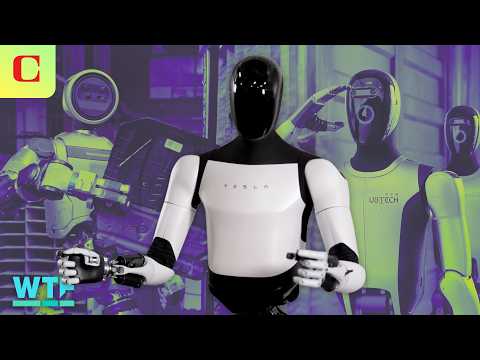
[0:58]A lot of robots designed for working in factories, like Digit, Tesla Bot, or Atlas from Boston Dynamics, all have something in common. They're made of hard plastic and metal bodies.
[1:09]This is fine for a warehouse environment, but it could seriously hurt somebody in the event of a collision, and good luck to you if you get a finger caught in one of those robot joints, sometimes called pinch points.
[1:19]Humanoids designed for the home are hoping some padding and clothing can help avoid such accidents. Here the Neo from 1X wears this machine-washable nylon turtleneck bodysuit with gloves and shoes.
[1:29]Meanwhile, the Figure 3 bot from Figure also has a type of soft fabric bodysuit, all of which is said to be durable and cut resistant.
[1:36]The clothing might make them safer and softer to work around pets and families, but a fresh robot fit isn't going to help with two other major challenges facing the industry: privacy and trust.
[1:47]The Neo humanoid home helper is a prime example. It's designed to assist with laundry, dishes, and cleaning up, but the first models arriving in 2026 will not be able to do all of that autonomously out of the box.
[2:00]For most tasks, Neo will have to be teleoperated by what 1X calls a quote expert. Essentially, a stranger who remote controls the robot, seeing what the robot sees and controlling the hands and arms to accomplish household chores.
[2:12]The promise is that the robot would someday learn from its remote control pilots and eventually be able to do these tasks autonomously.
[2:19]To be clear, anything with cameras, microphones, or other sensors that gather data and can connect to the internet inherently poses some privacy risk.
[2:27]Vacuums, smart home assistants, home security cameras, and smartphones have all faced privacy concerns, although your robot mop isn't piloted by a customer service rep in a VR helmet.
[2:38]But having a 5'4" inch walking structure that can grasp sharp objects adds another layer of distrust, like a mix of stranger danger and surveillance state heebie-jeebies.
[2:47]So how do you make a humanoid robot look less threatening? It's all in the eyes. 1X spaces out its two cameras at the same distance on the face as human eyes.
[2:55]Light rings on each side also let people nearby know what mode the robot is in, including a blue color indicating it's being remote controlled, and a progress bar for when it's charging.
[3:05]For added privacy, 1X says owners can set no go zones inside their home or opt out of sharing data with 1X for improving the robot.
[3:11]The company also says its cameras can blur human faces, though there are still other ways cameras and related software can identify individuals.
[3:19]Agility Robotics also added eyes to its digital robot, but not to see. Digit's animated LED eyes communicate to people nearby where it's planning to move, and for good measure, the robot also features a cute chirpy digital language where it narrates every action it's taking so you're not left wondering what your robot is up to.
[3:39]Moving to stand-off. Some companies have made it their explicit goal to create robots that look as human as possible. Realbotix uses silicone skin humanoids with expressive faces and eyes that follow you, all to mimic emotion and build trust.
[3:53]The company is not afraid to march right into the unsettling feeling known as the uncanny valley, a zone in which people can tell something is trying to pass as human, but it isn't quite passing yet, which may make some people uncomfortable.
[4:04]That is, at least until these robots become advanced enough that they start actually passing as real people, in which case some folks may get uncomfortable for a whole different set of reasons.
[4:14]In my view, the best way companies can generate trust with their robots is by putting privacy controls in the hands of people working with these robots, both in homes and in workplaces.
[4:23]Trust can also be built with more transparency in promotional videos. Companies need to clearly label every video to explain if the tasks being shown are performed autonomously, via teleoperation, or something in between.
[4:35]These companies should also bring these robots into real-world settings where the public can meet them face to artificial face.
[4:41]But all the trust in the world won't mean much if these robots can't do what their developers are promising. That's where the problems of autonomy and training come in.
[4:48]Teaching a robot to operate in the world and do basic tasks, even something as simple as walking along a bumpy floor, requires a lot of data.
[4:55]And it requires owners to be willing to share that data with other robots to help build a better knowledge base across the board.
[5:05]The more robots you have sharing data, the better they can do these jobs. And then there's the issue that goes beyond the walls of your home or office.
[5:08]How will these humanoid robots change the labor market itself? It's hard not to look at Neo or other humanoids and think, why not just hire a person who could use that money for their family instead of pouring thousands and thousands of dollars into a robot?
[5:21]The sales pitch presents robots as the answer to some labor shortage, but one could also characterize this moment as a shortage of well-paying jobs.
[5:30]Overwhelmingly, these robot manufacturers make the case that the machines are taking on jobs that humans generally don't want to do.
[5:39]So what happens to the humans that still do these jobs? I asked Foundation CEO Sanket Patak about this, and his optimistic viewpoint is that robots will be a net positive for society by making goods more affordable.
[5:49]But he also said that if that doesn't work out, The second scenario, um, is that doesn't happen. I think that is probably the most, um, concerning outcome, which I think starts taking shape in some kind of universal basic income.
[6:05]Meanwhile, China is also investing heavily in developing humanoid robots, and the machines displayed so far have vastly increased their capabilities in just one year's time.
[6:14]So this space is changing fast. I'm fascinated to see how the same disruptive technology, humanoid robots, developed simultaneously within two competing political and economic systems, will ultimately fit into and transform each of these societies.
[6:28]Time will tell and we'll be covering it every step of the way. Would you feel comfortable with a robot like this at home or at your workplace? Let us know your thoughts, dreams, and sci-fi nightmares down in the comments, and subscribe for more stories every Sunday that make you say what the future.


