[0:16]the course of microwave engineering in today's class we will be learning about measurement of quality factor of a cavity resonator or the measurement of Q of a cavity, okay?
[0:27]So, initially what is this quality factor or the Q factor? Q factor is nothing but the ratio of resonant frequency and the bandwidth of the signal, okay?
[0:37]So, whenever a microwave signal is passed through this particular cavity resonator or a cavity or a circuit, okay, how this circuit or the setup or a cavity responds to that particular frequency is what matters.
[0:51]So, we will be using a microwave source, we will be transmitting several microwave frequencies through this particular cavity resonator and we will observe or measure the readings of these particular cavity resonator
[1:04]uh through a power indicator, okay? And we will be seeing how this particular cavity resonator or the circuit responds to each and every particular frequency, okay?
[1:17]Now, so there are several methods for measuring the quality of a or Q of a cavity resonator, they are transmission method, decrement method, impediment measurement method.
[1:28]So, among these transmission method is much more easier compared to other methods.
[1:33]So, in this method, cavity resonator as I already said, a cavity resonator is used as a transmission device and the output signal is measured using a power indicator and based on all these readings, it will be resulting in the resonance curve.
[1:50]So, we will be seeing what is this resonance curve, uh resonance curve and how this particular uh bandwidth and the the cavity resonator is calculated.
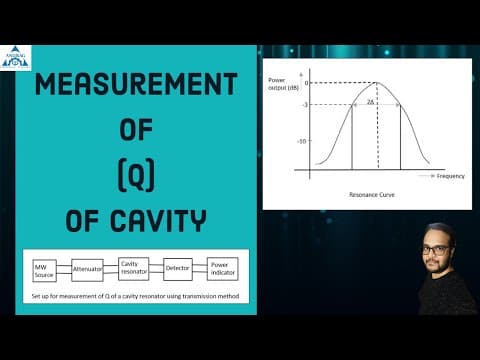
[2:02]So, if you see the uh setup of a transmission method, okay, we will be having a microwave source connected to an attenuator, connected to a cavity resonator and this cavity resonator is connected to a detector and this detector is connected to a power indicator.
[2:18]So, this microwave source will be keep on generating microwave signals which will be passing through the attenuator and the cavity resonator as well and this particular microwave source, as it keep on generating these microwave signals,
[2:34]it will be keep on varying the frequency. So, at what frequency how this particular circuit or a cavity resonator behaves and what is the power altered from it, okay?
[2:46]Will be calculated using this particular power indicator. This is how we are going to uh calculate the quality factor of this particular cavity resonator using transmission method.
[2:56]So, based on this power indicator measurements as well as the frequency measurements, okay, we will be uh drawing a graphical representation or we will be drawing a graph out of it.
[3:09]Uh we will be calculating the resonant frequency as well as the bandwidth of a particular signal, okay?
[3:12]So, if you see here, this is a graph. So, from the above setup, the signal frequency of the microwave source is very.
[3:20]So, as the process is going on, the microwave source or the signal frequency of a microwave source will be varied such that we will be having different types of frequencies from this particular microwave signals, okay?
[3:49]Now, at every particular microwave signal, okay, or the at every particular microwave frequency, okay, the power is measured, okay?
[4:05]Now, let us see the graphical representation. This X-axis is a frequency and this Y-axis is the power which is calculated in dB, right?
[4:14]Okay? Now, the output of based on this power measurements as well as the frequencies, okay, uh this graph is drawn.
[4:21]So, as the frequency is varying from zero to several range, okay, the power also varies. So, at a point at 0 dB, it keeps on uh falling down.
[4:35]So, uh throughout the whole process if you see as the frequency of a microwave signal is getting varied, okay, there is a fall of a signal from 0 dB to a particular uh dB such that there will be a form of curve, okay?
[4:51]So, in order to calculate the particular bandwidth, we will be calculating two different points below the 3 dB of the maximum value.
[5:00]So, if you see this particular 0 dB is the maximum value, below that 3 dB, we will be taking two points or the two differences from which we will be calculating the bandwidth of a particular signal, okay?
[5:13]And the maximum point will be considered as our resonance frequency, okay?
[5:30]So, this bandwidth, half power bandwidth 2 Delta values are given by 2 Delta is equal to plus or minus 1 by QL, where QL is the loaded value, okay?
[5:40]Or QL can also be given as plus or minus 1 by 2 Delta, which is equal to plus or minus omega by 2 into omega minus omega naught, okay?
[5:51]Where omega is an angular frequency and omega naught is the operating frequency.
[5:57]Thank You !!


