[0:07]Hey, what is up, guys? MKBHD here and this is a virtual reality headset. It's a pretty simple one, obviously, but that's what it is. And the idea of virtual reality is just that. It's to replace your reality with something, some new virtual computer-generated environment. And it could be some game or some environment you walk around or some video that's playing all around you when you look around. But the idea is to trick your brain into thinking that that's your new reality. So, VR started with the Air Force, actually, as part of their flight training program. And it's flight sim. Now, obviously, that's much easier and cheaper to have new pilots practicing stuff like fighting maneuvers and shooting things and ejecting and crashing, all without shooting and ejecting and crashing actual million-dollar planes. So, that's where VR makes perfect sense. Now, in 2015, companies are making these personal VR experiences that you can just buy and use for your own entertainment. All you have to do is just put it on your face. So, they do this by taking over your sight. So, just like we use headphones to completely take over our sense of sound, this headset totally takes over your vision. Inside this one, Google Cardboard, is a pair of lenses and a place to hold your smartphone, which becomes your screen and your VR engine. Now, there are actually two kinds of VR headsets. Type one is the accessory that you plug your smartphone into that becomes the screen, so something like Google Cardboard or Samsung's Gear VR. And then, type two is the stand-alone unit that does everything. It has a gyroscope and the screen and everything built in. So, that would be something like Oculus Rift or HTC's Vive. Both types, of course, have these lenses that help your eyes focus on the stereoscopic image that's right up against your face, which isn't great for your eyes, by the way, but whatever. And they all have this gyroscope and accelerometer that help track your head movement, and that's what helps put you in your own little world. So, I got to take a closer look at one of the second type at Mobile World Congress this year, the new HTC Vive. And this is something people were getting really pumped about. It's a prototype for now, and the final version might not look exactly like this, but it's an entirely self-contained VR headset that you can just pick up and put on your face and be immersed. Of course, it's a little more complicated than that, but you have all these little dots around it for sensors. So, you actually need to set up little sensors around you to track your head in 3D space. Oculus Rift also has some similar looking sensors for the same reason. It's tracking your head. So, on one hand, that's going to be awesome for immersion. The more accurate these sensors can be, the more closely it'll mirror your head movement. So, since you're in 3D space, you can literally move your head forward and peek around a corner, which is pretty awesome. But on the downside, that does require having a little bit more space to actually set up your VR experience, which sounds kind of like a pain. And also, the thing people forget is you also need a set of cables to connect this VR headset to your computer. So, plenty of people did demos without plugging it in, but you're not exactly untethered when you're really using it. Now, that first type of VR headset that uses your phone as the VR engine and the screen is actually a little bit more simple. It, your phone already has a gyroscope and an accelerometer built in. So, all of your movements around that 3D world will come from that. But these don't have the advantage of sculpting the optimal VR experience. I mean, it's kind of like an accessory, and it's a little bit weird to like clip your smartphone into some crazy, basically oversized case and then strap it onto your head. But the experience can often be almost as good as one of the dedicated headsets, at least to a VR noob like me. But look, making a VR headset right now, at least a good one, is really hard. Uh, there are so many things you have to consider, the the pixels per inch of the display since it's right up against your face and it's magnified, and then there's the field of view since you want it to be as immersive as possible, and the pixels per degree since everything's magnified and so close to your face. Uh, there is good hope, though. I've never seen an industry go so fast from zero, like almost nothing, to five or six major players so fast. You've got Oculus Rift, you have Samsung Gear VR, you have Google Cardboard's been out for a year. HTC Vive is on its way, it's coming. Sony Project Morpheus is also coming. I would actually even say that Microsoft HoloLens, although that headset from Microsoft that everyone's talking about the experience of is not virtual reality. That's actually augmented reality. So, virtual reality and augmented reality are two slightly different things. So, to clarify, virtual reality is replacing your entire reality. So, you're immersed in this new world with nothing left from the real world. Augmented reality is just that. It's augmenting your reality a little bit. It's adding some things and combining it with the real world, and oftentimes that'll be in the the form of an overlay or seeing something on top of a real-world object. Google Glass also does this same thing, so you can have useful information sort of in the corner of your vision, not totally virtual reality, but some neat augmented reality tricks. But what really separates VR and what makes it so impressive, uh, is the immersion factor, the fact that you're totally in this world. So, just like with headphones on, when you can't really hear anything else other than the music you're listening to, with a VR headset, you're essentially blindfolded and put into this entire new world with whatever the artist makes. Uh, virtual reality content will take off when there is a lot of virtual reality stuff to look at. Like 3D TV would have only made it if people everywhere started making 3D videos. Now, obviously, that didn't happen, and there's a risk that virtual reality might not ever happen, too, because of that. But I think there's at least something special here that 3D TV might not have had. I think the first time someone sees a 3D TV that works really well, their reaction might be, huh, wow. But the first time someone sees like Oculus Rift or gets a really good virtual reality demo, they're like, wow, this is impressive. And that's what makes it so cool. So, uh, yeah, the next time you're considering whether or not virtual reality will become a thing or not, think about what would you do with it? So, thanks for watching. I'll talk to you guys in the next one. Peace.
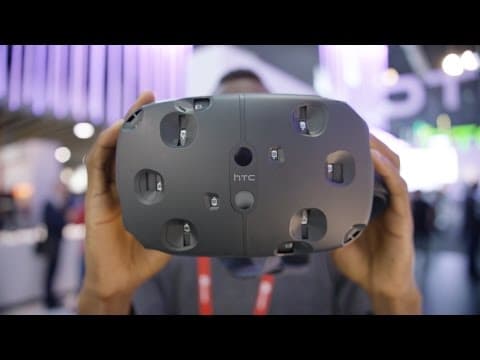
Virtual Reality: Explained!
Marques Brownlee
6m 15s1,209 words~7 min read
AI audio transcription
Transcript source
AI audio transcription
This transcript was generated from the video's audio because no usable YouTube caption track was available. The transcript below is server-rendered so it can be read, searched, cited, and shared without opening the original YouTube player.
Pull quotes
[0:07]It's to replace your reality with something, some new virtual computer-generated environment.
[0:07]And it could be some game or some environment you walk around or some video that's playing all around you when you look around.
[0:07]So, VR started with the Air Force, actually, as part of their flight training program.
[0:07]Now, in 2015, companies are making these personal VR experiences that you can just buy and use for your own entertainment.
Use this transcript
Related transcript hubs
Watch on YouTube
Share
MORE TRANSCRIPTS


