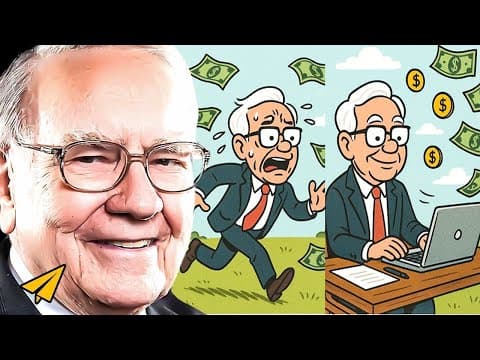
[0:00]He was the single most successful investor of the 20th century. Time Magazine named him one of the most influential people in the world. He's worth over 70 billion dollars. He's Warren Buffett, and here are his top 10 rules for success.
[0:19]How can other people tap dance to work? What's the secret of that? You find your passion. You find your passion. I was very, very lucky. To find a you know, when I was uh, seven or eight years old and, you know, and fortunately, my children have found their passion. My, you know, one son loves farming like nothing else, one son loves music like everything else and, and all three of them love philanthropy and what they get to do. You're lucky in life when you you find it. And I, you can't guarantee you're going to find it, you know, first job out, but I always tell the college students that come out. I said, take the job that you would take if you were independently wealthy, you know, that's, you're going to do well at it. If you think you're going to be a lot happier if you've got 2x instead of x, you're probably making a mistake. I mean it uh, you ought to, you ought to find something you like that's that works with that and if and you'll get in trouble if if you think that making 10x or 20x is the answer to everything in life, because then you will do things like borrow money when you shouldn't, or, or maybe cut corners on on things that your employer wants you to cut corners on or, it just doesn't make any sense. You won't like it when you look back on it. Three things in hiring people, look for integrity, intelligence, and energy. And he said if the, if the person didn't have the first two, that the latter two would kill him. Because if they don't have integrity, you want them dumb and lazy. You don't want them smart and energetic. It never bothered me if people disagreed with what I thought uh, as long as I felt I knew the facts. I mean, there's a whole bunch of things I don't know to think about. I just stay away from those. So, I stay within what I call my circle of competence, you know, it it uh, and Tom Watson said it best, he said, you know, he said, he said, I'm no genius but I'm smart in spots and I stay around those spots. Well, I try and stay around those spots and I I just don't have a problem if if uh if somebody says, you know, you're wrong on something. I just, I go back and look at the facts and and and it I think that I think that really is much more important, frankly, than than having a few points of IQ or, or having an extra course or two in in school or anything of the sort. You need emotional stability. I just read and read and read. I probably read five to six hours a day. I don't read as fast now as as when I was younger, but I read five daily newspapers, I read a fair number of of magazines, I read 10 Ks, I read annual reports and I read a lot of other things too. So I, I I've always enjoyed reading. I love reading biographies. famous lesson about a margin of safety that you don't drive a truck that weighs 9900 pounds across a bridge that says limit 10,000 pounds, because you can't be that sure about it. If you see something like that, you go down a little further down the road and you find one that says limit 20,000 pounds and that's the one you drive across. The nature of capitalism is that people want to come in and take your castle. It's perfectly understandable. I mean if I'm selling television sets or something, there's going to be 10 other people going to try and sell a better television set. If I have a restaurant here in Omaha, people are going to try and copy my menu and give more parking and take my chef and so on. So, capitalism's all about somebody coming in trying to take the castle. Now, what you need is you need a castle that has some durable competitive advantage, some castle that has a moat around it. And that moat, one of the best moats in many respects is to be a low-cost producer, but sometimes the moat is just having more talent. I mean if you're the heavyweight champion of the world and you keep knocking out people, you've got a competitive advantage, as long as you can keep doing it. And it's very profitable, uh, if you're the one that happens to be able to do it. If you can turn out great motion pictures, yeah, I mean, you know, Steven Spielberg, I mean, he, he, he's a fellow to bet on, and, and it has enormous economic value. You'd be surprised at at my days. I mean, they are, they're very unstructured, uh, no meetings. Uh, none. I mean, we don't, I don't like meetings. Uh, and, uh, I read a lot. Uh, I wish I were a faster reader. I know I'd get more done, but I I, but I do read a lot, and I, I, I'm on the phone a moderate amount. Uh, our businesses run themselves, basically, out there. My job is allocating capital, and, and I that's what I'm thinking about.
[4:29]Um, but I don't like to have things all packed hour to hour to hour, and, and Bill and I are both extraordinarily lucky. I mean, we really get to do what we what we like to do, the way we want to do it, with people that we choose to be around, and that are terrific. I mean, we, we've really got everything, uh, our way, and it's, it, it, we're very fortunate, and, in his world, he has some, he has a different kind of pace than I have. But we both love it the way we do it, and, and, uh, uh, my guess is that we're each the most productive in that particular mode too, because it, it it, it fits our personalities and, and aptitudes. What kills great businesses. If you look at, I do, I do believe in looking at history, and I I, and I try to, I I like to study failure actually. And my, my partner says all I want to know is where I'll die, so I'll never go there. And, and we want to see what has caused businesses to go bad. And, the biggest thing that kills them is complacency. I mean you, you want a a restlessness, a feeling that, you know, that that somebody's always after you, but you're going to stay ahead of them, you, you always want to be on the move. And, and, uh, uh, when you've got a great business, you know, like Coca-Cola, which is, there aren't any like Coca-Cola, but, but it you really, the danger would always be that you rest on your laurels, but I see none of that obviously at Coca-Cola, but that that that is the key. You know to compete the same way when you've got 1.8 billion servings being sold daily as when you were selling you know 10 a day. And, and that restlessness, that belief that that tomorrow's more exciting than today, you know, you just have to have it permeate the organization. Who was, Ben Graham? He he was your primary mentor, model. He was a wonderful man, and he was my professor at Columbia. I'd read his book. When I was 19 at the University of Nebraska and, I'd started investing when I was 11, and I started reading about it when I was like seven. So I'd go on through all, I'd read every book in the Omaha public library that there was on by the time I was 12 on on investing and stock market. And I had a lot of fun, but I never really found out, I never got grounded in anything. And and it it was, it was entertaining, but it wasn't going to be profitable. And then I read Graham's book, the Intelligent Investor, when I was at the University of Nebraska and and That just opened the whole thing up to me. Yeah. And I and I named my my oldest son, his name's Howard after my dad, Graham Buffett, and then he was a marvelous man, never expected anything from me in return. Graham in his low in his low teens looked around and he looked at the people he admired, and he said, you know, I want to be admired, so why don't I just behave like them? And he found there was nothing impossible about behaving like them. And similarly, he he did the same thing on on the reverse side in terms of getting rid of those qualities. You have given, um, a lot of fabulous advice, but what's the best advice that you've ever received? Well, I I received it in a variety of forms, particularly from my father when I was very young, but I mean he he basically, I think taught me how to live, not that I did it perfectly or anything like that, but I mean he was giving me lessons, but he wasn't doing it by preaching to me. He was doing it by example. But basically, uh, well, the biggest lesson in a sense I got is the power of unconditional love. I mean, I think there is no power on Earth like unconditional love, and I think that if you offer that to your child, I mean, you're 90% of the way home, and maybe days when you don't feel like it, it's not uncritical love. That's a different animal, but, but to know you always can come back. I mean, that is that is huge in life. That takes you a long, long way, and I would say that every parent out there that that can extend that to their child at a very young age, it's going to make for a better human being. And you felt like you got that kind of unconditional love from your dad? I absolutely did. Yeah. That is a powerful thing. It is a powerful thing. Thank you for watching. I'd love to know what you think of Warren Buffett as an entrepreneur. Let me know your thoughts by leaving it in the comments below. I made this video because Ray Carter asked me to. So if there's a famous entrepreneur that you want me to profile, leave it again in the comments below, and I'll see what I can do for you. Thank you for watching. Continue to believe, and I'll see you soon.


