[0:13]We will move now on to our first plenary session on migration, displacement, and multilingualism. Language assessment for a world on the move. This will be given by Dr. Tony Capstick, Associate Professor of Language and Migration, University of Reading. Dr. Tony Capstick has carried out critical ethnographic research on language use and language education in resource role environments for over 20 years. His main focus is multilingualism and migration, particular in refugee setting in the Middle East. He has worked on language policy with the UN, the Department for Communities, UK, and British Council. He co-authored the report, Language for Resilience, for the British Council in 2016, and his textbook Language and Migration was published in 2020. Everyone, please join me in welcoming Dr. Tony Capstick. Good morning everybody. Swati club. And a very, very big thank you to the British Council for inviting me to speak to you today. And a big thank you to University for such a warm welcome and being fantastic hosts. A third thank you to our wonderful ensemble. And that's quite a tough act to follow, those musicians, but what a what a wonderful way to open the ceremony. And thank you to our esteemed speakers as well for their opening remarks. So, as the title of my talk suggests, I'm going to be looking at migration and displacement and multilingualism. So it's the big picture. What do we know about human mobility? How is it impacting our interactions at the level of the classroom, but also what does it mean for assessment and test takers? So,
[2:42]Oh, there we go. There's a little bit of a delay. Um, So, I'm a sociolinguist, which is a remarkable idea to keep in mind when we think about today we're talking about assessment.
[3:00]So what can sociolinguistics bring to this understanding of the relationship between language and society and what happens in people's lives when they take tests in order to move around the world? Whether that's for study, whether that's because of conflict, whether that's because of climate change. So what does it mean to take a sociolinguistic approach? And I've really taken the conference organizers at their word when I looked at the title, the main theme for the conference. Um because social linguistics are obsessed with power. We want to know where the power is, how is power mediated in these really complex multilingual settings. So I'm going to come back to power quite a lot over the next 30, 40 minutes. I will also talk about individuals. what does it mean at the individual level for teachers and for learners? Um but I will also talk about societies. What what do we know happens when large numbers of people move across the world for all sorts of different reasons. I should set out my stall a little bit to start with and just say a little bit about how I understand social linguistics can help us understand some of these contemporary phenomena. So first of all, we look at language diversity as an outcome of migration. So looking at the way that different language varieties have emerged over centuries. Migration is not a contemporary phenomenon. We live in very mixed societies.
[4:37]And one of the outcomes of these this mixture is we now understand a lot more about how different varieties of big global languages such as English, how they interact and mix with smaller local languages or other global languages. So I'll be talking a little bit about language varieties today. You will no doubt come across this term multilingualism frequently throughout the next couple of days. How do social linguists approach this very complex phenomenon of multilingualism? Well, we look at this through the lens of repertoires. People are constantly moving across the different varieties in their repertoire and that can be an individual repertoire that you will all have access to. You'll all use bits of English as well as other languages. So we need to understand how these impact our opportunities for migration.
[5:45]And secondly, I don't just look at classroom settings, but I'm also interested in how what we do outside of institutions such as school, how does that impact what we do at home and vice versa.
[6:04]So we believe, many social linguists believe, there are multiple paths to acquisition.
[6:17]We learn languages in in classrooms. We also very much develop our linguistic capacities, skills, abilities and values about those skills and abilities in other non-educational settings.
[6:43]And finally, language ideologies, so important when we think about all the times we express our beliefs about a particular language variety, we're quite often saying a lot more than how we feel about that particular variety, but we're also talking about identity, and we're also talking about the particular values that we attach to those different varieties. Thirdly, I can't really talk about migration without talking about how we understand the contemporary era of migration. And this overarching term of transnationalism has emerged over the last few years. So people rarely move country and settle in a new country and completely cut all ties with with their home country, with their families and with their social networks back at home. But rather what we find now is that people live across lots of different settings. They may be based in one particular nation state, but they maintain these transnational relationships with all these other people in their networks. Obviously, we do this through communication technologies, but we also do it through other forms of interaction.
[7:41]So it's by understanding these transnational connections that we can start to unpick how people continue to be sons, daughters, fathers, friends, whilst having very distributed networks. So this is what my talk will look like with all of with all of that in mind. I'll try to draw on this idea of diversity and multilingualism and transnationalism in in each of my slides. Firstly, by looking specifically at economic migration and how tests really work as de facto language policy in many situations. By taking up this idea of linguistic health. Applied linguists really love a metaphor. And so this metaphor of health really does work really quite well when we think about how are people being positioned in terms of their in terms of their language capacities.
[8:50]Now because, excuse me, because tests are part of lots of other non-educational practices. I've had to cast my net quite widely when it comes to some of the literature that I'm going to talk about today.
[9:15]So we're not just talking to test takers and test producers or teachers, but we're all also thinking of the wider infrastructure that migration is part of. And so I'll try to position where tests come and assessment can be understood in some of these wider practices with examples um relating to mediation. And then the second part of my talk, I'll look more at forced migration, and what we can learn from refugee settings. If we take this idea that we are all living in a world on the move, then we can see that very much reflected in current displacement, whether that's from conflict or climate change.
[9:59]And so what can we learn from that kind of setting, what what do we know already about what is happening in classrooms where teachers are having to cope with situations where their learners may have faced trauma or or other forms of disadvantage. So I look at some humanitarian responses. Um I will come back to assessment and how some of what's happening in the CEFR can be of use to understanding more intercultural practices um in this world that's on the move. And I'll I'll end by um some thoughts on mediation.
[10:37]We're all sitting here in Bangkok. Um we're all part of these very diverse networks already, T-SOUL networks, um examination networks, classroom teachers are constantly coming up against all of these different um forms of migration. Uh but this isn't a this isn't a recent phenomenon. This is very much something that's been happening for centuries. So what I wanted to do is to kick off with this idea that when we un try to understand globalization, we we're not just trying to understand what's happening today. But we're trying to look back at how things like colonialism, independence, and other massive world-changing phenomena have have gotten us to where we are today. So however you feel about a global language such as as English and the different varieties of English that you are coming across in your teaching or in your work, trying to understand the flows that have brought us to where we are today is such a significant part of understanding the relationship between language and migration.
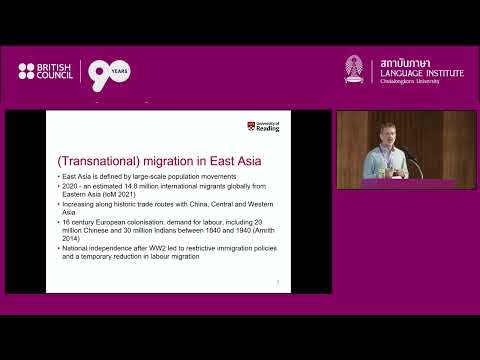
[11:54]And one of the reasons for this is this item that I mentioned earlier that we now live in in very multi-ethnic societies. Barry was talking yesterday about how his hometown has changed significantly throughout his lifetime. Um similarly, the part of England that I'm from has seen massive migration and obviously, we live in a world where migration is now very politicized. How has testing become part of one of the ways of managing migration? So we need to look back throughout history, um and we also need to be very careful that when we talk about migration, we try to say a little bit about some of the nuance, about the kind of migration that we're referring to. So whether it is economic migration or more forced kind of migration. It it's interesting to look across these different periods in East Asia's migratory past and try to tease out the changes over centuries. This last point here, we can see how there's been a significant shift in in the gendered migratory paths um across parts of this region. So what has happened over the last few years? Well, some of you may be familiar with the literature on language testing as language policy. I want to touch on it here because as we all know, they're very powerful the idea of tests as gatekeepers. Again, another metaphor, um but really the gate is either open or closed and and you will all be very familiar with your individual students responses to whether they felt their test has provided opportunities for them to progress in their studies or on occasion, we've all come across these kind of closed doors when it comes to language requirements.
[14:10]I've been very fortunate to work in in in many different parts of the world over the last sort of 20 years working with migrants and refugees and different agencies. And I've had a whole range of different testing experiences, some of which have been very positive, some of which less so. So what what how does that work when it comes to designing tests? This this metaphor of health, I find particularly useful because if you think of your own health, that will obviously change over time. I'm sure after our passive ensemble piece, you were all feeling invigorated, wide awake. That's not necessarily going to be sustained throughout the day. I hope it will do and I hope you find ways of continuing to maintain those energy levels, but as you as we all know, our our health fluctuates. And I'll say a little bit more about this later on when we look at ability and competence in language testing. So if we say we're going to give value to an individual's entire linguistic repertoire, Dr. Jerada yesterday mentioned or ended the session with the importance of home languages. And everybody everybody agreed with, seemed to agree with her on that point, if we take that position, then what does that mean when it comes to the bureaucratic processes of of being a test taker, as well as being a student? So we come across a lot of literature in the in the field which talks about this deficit view of understanding the relationship between target languages, whether they be important global languages such as English, or other local languages. If I was to come and work in Bangkok, I would hope to learn some tie. So how how would I find the appropriate language lessons and how would I use some of my pre-existing uh linguistic resources to to develop that new target language? Into the kinds of citizenship procedures that people value and really want to embrace, whether they're settling in a new country or they're bringing family from another country. So how do you demonstrate that? And most importantly, um for social linguists, is what does that then mean for these other social and cultural phenomena such as belonging, and um developing new identities? Identities that may be a more hybrid. So I'm I'm I might be British, but if I'm going to live live in another part of the world, how how do I get to know that those particular national identities and how do I sustain my existing belongings? So these these are significant concerns of anybody who's really addressing those power relationships in language language learning, but also in in language use. And a lot of our research now tries to understand just what what are people doing in their homes, in their neighborhoods, as well as in their classrooms. And and where do those different um settings, where do they overlap? So I've saved the title, the theme for for the next couple of days. I've saved it for this slide, the power of language assessment. Because I think this is the kind of crux of what we're talking about here, that when we're involved in any kind of um trying to understand the relationship between the tests and the wider learning setting and people's desires to migrate, how how are those decisions made by the people who have power? And so, as I said earlier, we're we're really focusing in on what it means to interpret the specific constructs that are tested in certain language tests and how that relates to what we then want those tests to provide access to. Whether it's a good place at a university or whether it's um a citizenship test which tries to establish a relationship between language and belonging. So, um in a a view from East Asia, we can look ahead to what might be happening in other parts of the region. And what we know now is that three out of five international students in Australia seeking permanent residency after their studies. So we heard a lot yesterday about how incoming students into a university such as this one, need to find the means, the resources to pass certain levels and acquire a certain level of proficiency to be able to cope with their studies. But once those students have have gained access to that university education, what are they doing after? And what we know from quite a lot of literature coming out of East East Asian students settling in Australia is that they're moving on to these post-study work visas. So as you can see, over 50% increase after 2016.
[20:01]So we are seeing now these quite large population shifts in new directions and they're very much related to test takers opportunity for taking certain kinds of of tests. So what does this mean for the societal level? What what does this tell us about how migration is now being managed? Well, there's quite an emerging literature on migration infrastructure. So this idea that our assessment and our classroom teaching is very much linked to these other governance procedures. So these flows of migrants aren't just being managed at the sort of interactional level of those family decisions and and interactions with their migration agents, but we're also seeing a much wider societal level of infrastructure made made up of authorities, agents, and other people who have an investment in testing. So you can see in the figures from 2010, 2011 that China surpassed the UK as Australia's primary source of permanent migrants at that time. So we are seeing now a very significant shift in where people are moving from and where they're moving to and and how language and dominant languages, world languages such as English, are where they're positioned in people's opportunities. So obviously, this relates to aspects of people's social class and again, identity. Who who feels as though they belong in these new country settings and how do they demonstrate these affiliations? And how is that mediated by lots of other decisions when people may be coming from quite resource low settings. Barry mentioned yesterday, poorer background students who may not have access to the kinds of technologies or the kinds of language learning opportunities that we see currently in in some of these trends. So we have this idea of a two-step migration from Asia to Australia. People are arriving on temporary visas and then seeking eligibility for other kinds of visas to stay in country. And to go back to this idea of social networks, that isn't just an individual choice, but we need to take a step back and think about well what does that mean then for the for the wider family? And how are then other generations then provided with opportunities?
[22:56]And we see how politicized migration becomes in the current era when that kind of family reunion situation is far more difficult to negotiate nowadays than it was just one generation ago.
[23:16]So we've established that language tests can act as uh as policy as a de facto policy um when regulating mobilities across these nation states.
[23:30]But then we can also think of the sort of tension between that and these transnational identities that people are generating and sustaining as they move across the world. So it's not purely a regulatory apparatus that we see tests part of, but we also see them implicated in these other aspects of the infrastructure, technology, commercial, regulatory, non-governmental and social. So the social networks, people feel as though they have kinship responsibilities with other members of their family, either in their own immediate family or wider family who they may wish to be part of their migration. And that will bring them them into contact with governmental, as well as non-governmental. Um in a moment, I'll talk a little bit about um refugee settings, and how again, the agencies there range from more governmental or UN level agencies to the more non-governmental.
[24:36]So before I move to my case study about um these humanitarian contexts, if we could just contrast some of that migratory infrastructure work. What we know now about regulation and the role of language in regulating migration. And contrast that with some of the learning needs of migrants pre-departure and post-arrival.
[25:10]So there isn't a great deal of research on what low-skilled migrants really need linguistically if you're working on a construction site or you've moved to work as a as a domestic worker or as a care worker, which we see increasing now in this part of the world. Then then what are the language requirements for you in that particular role and are those language requirements necessarily dealt with in some of the language learning opportunities that you have prior to departure as well as post departure? The idea of transnationalism, obviously, is isn't one way, so we really need to think about what it means for welcoming migrants back into their home setting. Reintegration and potentially re-migration. So, again, this idea that we're this worldwide interconnectedness isn't just a one-way flow, but really requires us to think quite creatively about how our language learning opportunities need to adapt and be shaped by what we know people are doing. And what we know is that people migration trajectory are quite messy. They're they're not unidirectional. So people might need to understand their contract, their work contract, and the literacies that go with understanding the bureaucratic discourses of migration. So how do we prepare um our learners for these kinds of um contemporary skills? Um things like T-vet, vocational education and training. Where do we put our resources if we know that migrants are going to be working in a very multilingual construction site setting where people have come from different parts of the world and they're using perhaps English as a lingua franca? What kinds of English are needed in those very, very multilingual, hybrid transnational settings? And I've looked a little bit about this um with migrants from South Asia going to work in construction in the Middle East. And what we see is wonderful opportunities for all of this uh linguistic diversity, tapping into all of this kind of linguistic diversity, but again, how how might we help those particular learners to gain some kind of formal qualification? Um and therefore have their multilingualism as well as their sort of dominant languages recognized. So I'm very quickly going to move into the second part. Um I will say a little bit about how looking forward, what can we learn from these humanitarian settings? The number of refugees and internally displaced people continues to rise dramatically. We see it every day in the news across all regions, conflict, climate change, et cetera. So what does that mean? So this idea of a post-humanist applied linguistics is trying to grapple with some of these complex social and cultural changes, but it's not only in linguistics that we're doing this. We also have um non-fiction, very popular, non-fiction texts. You may have come across sapiens by Yuval Noah Harari, Nomad century by Gaia Vince. These are big best sellers now, but when you read them, they really treat language as still a a sort of discrete, very carefully bounded phenomenon. Far from this idea of of different varieties and and really quite far from this idea of people's mixed repertoires. And so I believe that that that the non-fiction uh literature is is lagging quite behind when it comes to some of the language mixing that we're all familiar with. I believe that we've we've got quite a lot to learn from some of these conflict and post-conflict settings. When people arrive having left everything behind, having lost most of what they own as as well as members of their families, what we find is that they become extremely resourceful. And one of the key resources for many of the refugees and displaced people that I've been working with in in Jordan, Iraq, Lebanon, and Turkey is their their multilingualism. The resources that they've carried with them, the linguistic resources that they bring with them that are absolutely fundamental to who they are, how they learn, but also how they settle into their new country settings. So they may speak a completely different language to that um that's used in their arrival destination country. Or and what's really interesting when you look at countries such as Syria and neighboring countries that are also Arabic speaking, just what the difference in variety can do. Lebanese speaking, I'm speakers of Lebanese Arabic, and speakers of Syrian Arabic mutually intellible, and yet we see all of the points that I made earlier about ideologies around what it means to use certain varieties in certain settings, and what that tells us about about people's identities. So, what we saw in in many of these refugee camp settings was this emphasis on core skills, life skills. Often language courses were a vehicle for some of these other skills-based uh curricular. But the one that I want to focus on is the psychosocial competencies. We heard the President of the university about an hour ago, less than that, speaking very passionately about the importance of affect, emotion. He used the word power many, many times, but he also counted some of these dominant discourses about technology and AI and talked about intelligence and human intelligence. And I think that that speaks to what we see going on in humanitarian settings where people are forced to draw on the skills that they brought with them and and enhance these psychosocial competencies. So, whether it's around self-esteem, empathy, self-regulation, these are at the core of helping people who are displaced bounce back from their adversity. And we worked on this uh piece of research across four different countries looking at, well trying to recognize that that refugees are already extremely resilient people because of what they've been through to varying degrees. But how do we help them through language learning initiatives? How do we help them to enhance that resilience? And the flip side, how do we make sure that we aren't doing harm to displaced people when they arrive in a new country? So if we don't provide them with opportunities to continue to develop literacy in their home languages, which we recognized yesterday is a really important part of who we are, then then how are we damaging their opportunities to, um, grow at school and and grow at home? So the example that I'm drawing from here is with a um an international NGO that works with um refugee learners on their post-stress achievement. And trying to use language as a way of helping them regulate some of their emotions. Now, what what can we learn from this and how do we bring this back to what's happening in in the the region that we're all in at the moment? I don't need to tell you about all of the very large numbers of people that are moving across the region for all sorts of different reasons. But what I do need to emphasize is that's only going to increase as we see climate change impact the region significantly as we go forward, and we've seen that very much in parts of the region this year. Um Bangkok, I learned from my guide book, not from the academic literature, but from my guide book, I learned that Bangkok is sinking at a rate of over two centimeters per year. I don't know if anybody else has come across that particular nugget of information, but the these are significant, these are going to have significant impacts on on all of our lives, whether it's our current generation or our children's generation, but we're all going to be impacted by by displacement through not only through um increase levels of conflict, but also climate mobility. How's this impacted uh sorry, how is this uh relevant to the CEFR? Well, I think there are opportunities in the 2020 version of the CEFR when it talks about mediation to really think through some of this mobility and how those aspects of mediation that language users draw on in interactional moments, um how can how can we think about that alongside all of this mobility? Um most of you will be familiar with aspects of the CEFR. This this is just one section that deals with mediating communication. And what's at the core here are these and I think they're I think they're new to the 2020 version are these other um often abilities um around intercultural competence or interculturality or plurality of these of these um different kinds of experiences. So for mediation, we're looking at harnessing our wider repertoire, our wider set of cultural resources when we mediate with other people.
[36:47]So it's very an interactional approach, which I would argue is a little bit of a contrast with the 2001 CFR, which seems to orient more towards that sort of psychometric way of understanding how people's language abilities perhaps reside in their head a little bit more than they reside in the dynamic interaction with other people. So ability does not equal invariant manifestation in conduct intive, non-routine, interactionally contingent, adaptive meaning making and taking cross linguistically and transculturally malleable resources. Constant Leung, um who is a scholar at Kings in London, writes and speaks very eloquently about this in terms of what what it means to be agentive, and how we might harness that when we're testing.
[37:50]So I'm coming towards the end of my talk. What does this mean for um assessment? How can we put it back into um some of the ideas that I mentioned at the beginning of the talk? Well, I think that idea of mediation co-construction of meaning in interactional settings speaks very much to this idea of of transcultural competence.
[38:41]So these are some of the questions I'd like to pose. This hopefully will be something to stay with you over the next couple of days. What does it mean for language proficiency if we're thinking about situated social interaction, uh how do we understand the concept of proficiency as well as classroom teaching and materials design, um if we're looking at these these um aspects of mediation. Test producers, how do we operationalize construct and construct validity in assessment, um and also these other aspects of the CEFR, which are mentioned emotional intelligent intelligence. I've been a classroom teacher for many years. It's not something I've ever been able to teach, but it's there. So I'll leave the stage in a moment, but I'd like my last slide to be It's the text is quite small, but what we have here um it was a remarkable language lesson in um in Kurdistan, in Northern Iraq where there were three different groups of displaced learners and refugees with very, very low levels of English.
[40:04]The classroom teacher had very low levels of English. Oh, I timed out. Is that a big hint? Um, I am at I am at the end now. Uh, so the classroom teacher that you saw up there, who was a remarkable teacher doing remarkable things in very, very low resource setting. Um my question would be, keeping in mind this idea of mediation, it's there now. We we can expand how we incorporate that into the way we assess learners in this very, very fluid, uh era that we're experiencing of globalization. But as you can see from Huda, the teacher, she's using her entire semiotic repertoire. She's using body language. She's using gaze. She's using a little bit of Arabic, quite a lot of English. She uses some Kurdish. So, how do we make sure that all of these different resources be drawn on when they are absolutely so central to people's migrations? And I will end there. Thank you.