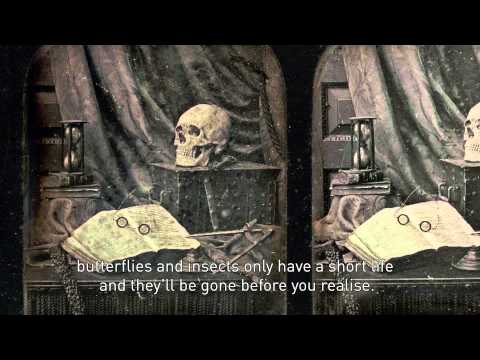
[0:05]The Art of Arrangement is an exhibition which is about still life photography. Still life is a very traditional form of artistic representation. Long before photography appeared, in the 17th and 18th century, artists would make paintings of fruit and flowers and various objects and there were conventions, these were established conventions and which had very specific meanings. On the surface it might look as if that painting is really a very decorative piece and has no deep meaning at all, but actually what the painter, or the artist was trying to say when he painted that knife balanced on the edge of the table, the idea is that at any moment it might drop, it might fall, that's our life and our life might come to an end at any moment. When photography came along, in the 19th century, photographers began to use the same format and so it's quite interesting that photographers would use something that has been going on for hundreds of years before photography was even invented. The next time you look at a photograph of some flowers, or some fruit arranged on a tabletop, then maybe you should take some time to think about what that photograph, or what that arrangement might mean. There could be some underlying theme there which is all about mortality and death. Flowers will fade, fruit will decay, butterflies and insects only have a short life and they'll be gone before you realise. If there's one photograph in the entire exhibition that sums up what this exhibition is all about, it's Edward Steichen's 'Diagram of Doom'. It's getting close to the end of the day, the butterfly casts a long shadow across the papers that are scattered on his desk. Steichen, when he took the photograph, he wasn't a young man so maybe he was thinking about his own mortality. That photograph, it's one of the most beautiful photographs in the exhibition, it's a simple composition and yet it's heavy with all these hidden meanings.
[2:22]Photojournalism's an area where people wouldn't normally associate still life photography. But again, many photojournalists perhaps use conventions of still life without realising it. When Don McCullin took the photograph of a dead soldier whose body he had come across when he was in Vietnam, photographing the conflict in Vietnam. He found this soldier's, this dead soldier's belongings scattered around and his personal belongings including his wallet, the contents of his wallet and bullets from his gun. He arranged those belongings around that soldier before he took that photograph and in doing so, he added another layer of meaning to what that photograph is about which is about the horrors of war and about how the real cost of war is that people lose their lives. So he's giving it a deeper, a much much deeper meaning that maybe works on a level that we don't realise, when we see it, but which harks back to all of those conventions that were established by artists before.


