[0:04]Hey friends, before we start today's episode, I have an important message to share with you. As you must be aware, due to certain new policies, you are not able to comment on our videos. But don't you worry, my friends, you can still share your valuable feedback, comments, views, and love at our email ID. peekabookidzfeedback@gmail.com. Similarly, you can also visit our Instagram and Facebook page and continue to engage with us. We are looking forward to hearing from you.
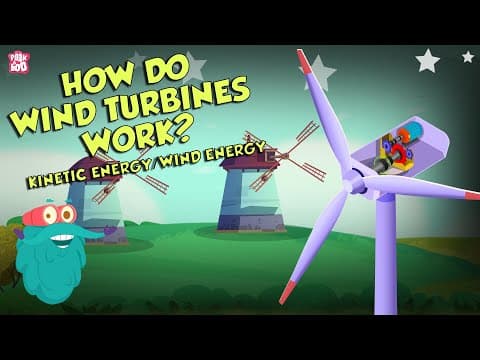
[0:53]Fan, fan. Wait, little Kitty, this isn't the fan fan. But a fan to run the fan and other devices. What? Let me explain. Hey friends, so in today's episode, let us explore these mechanical forces we call wind turbines and blow our minds by answering a windy question. How do wind turbines work? Zoom in! The world runs on sources of energy like coal, oil, natural gas, etc. And we keep using them as if there is no tomorrow, despite their limited supply and availability. So, because of our excessive usage of these energies, there will come a time when they will go out of stock forever, bringing our world to a standstill. Hence, for the past few decades, governments around the world have started taking energy-saving initiatives that include the use of renewable sources of energy, like solar panels, atomic energy, hydrothermal energy, wind energy, etc. And out of these alternatives, using wind turned out to be the most favorable source due to the abundance of air in the environment, which could be renewed every day. Plus, humans have been taming wind power since we started sailing boats and ships. And, architects have used wind-driven natural ventilation in buildings since ancient times. Later, traditional windmills were commonly used to pump water and grind grains. Now, the only question was to convert this free-flowing resource into electric energy. So, in the late 19th century, a Scottish electric engineer, Professor James Blyth, took this challenge. And in July 1887, he built a cloth-sailed wind turbine in his garden that generated current to power lights in his cottage, which thus became the first house in the world to be powered by wind-generated electricity. Let me explain how. You see, when the wind moves, the kinetic energy contained in the air currents rotates the turbine's blades. The blades are then attached with a low-speed shaft, located in the nacelle, and box-like structure at the top of a wind turbine. But to produce electricity, it's essential to increase the speed of the low-shift shaft. And that's when the gearbox comes into play, which accelerates the speed over hundred times and transfers it to the high-speed shaft, which is connected to a generator that converts the kinetic energy into electricity. This electrical energy then passes through a transformer that steps up the voltage to be transported on the national grid or used by the local sites to light up the world around us. Trivia time! Did you know the largest wind turbine in the world is located in the US in Hawaii? Yes, it stands 20 stories tall and has blades the length of a football field. That's huge, really huge! Hope you learned something new today. Until next time, it's me, Dr. Binocs, zooming out!
[5:21]Ah, nevermind!