[0:00]Often when we see atrocities around the world, when we see individuals harmed, we see minority groups that have been targeted or vulnerable populations that are targeted. We think about, hear about and read about rights, human rights and human rights violations. We hear this in the media or in our social groups when people talk about human rights violations, but this is all discussions taking place in abstract. These discussions are happening more theoretically and at the most you may see a reference or read a reference to the Universal Declaration of Human Rights. Or you may read about a treaty that would protect or provide some kind of protection for human rights. But it is still not telling us what how does protection of human rights become reality. International law, if we think about it, really falls still falls short when it comes to protection of human rights. It still is an obligation of the government to protect human rights, and treaties, even though there have been many that have been signed, are still reliant on the government. So treaties have not been able to stop massacres in places like Rwanda, Syria, in Sudan, in Argentina, in Myanmar, as as we hear today. There are two covenants, the International Covenant on Economic, Social, and Cultural Cultural Rights, and the International Covenant on Civil and Political Rights. That were both created, that were both went into force in 1976. These two covenants were to provide some teeth, some strength to the the the Universal Declaration of Human Rights. Uh, which was written in 1948 and uh the two covenants also provided uh two different perspectives of the West and the um, the Communist ideology. Uh, within these, for these two covenants, there are two monitoring bodies. Um, one on ICCPR is the Human Rights Committee to oversee the implementation of of ICCPR, and the Committee on Economic, Social, and Cultural Rights to oversee the implementation of ICESCR. But both of these can provide opinions, but the opinions are not binding. So where does that leave us? Non-binding opinions on states and um, individual rights that are not protected. There are some institutions that provide support, that provide protections against human rights. One of the the stronger institutions is the European Court of Human Rights where individuals can petition the court um, if their rights have been uh, have been violated or if they have been victims. Um, the rights that are that um, the rights and freedoms that are protected under the um, the European Court of Human Rights and EC HR, uh, are the right to life, prohibition of torture, slavery, forced labor, protection of habeas corpus and fair trial. Of course, also the classic freedoms, freedom of religion, freedom of expression, uh, freedom of assembly, uh, freedom for a private and family life. There are other institutions, uh, Inter-American Court of Human Rights uh, hears interstate complaints and individual cases in cases where state has ratified and accepted the right of individual petitions. The African Court of Human Rights, um, which was established by the Banjul Charter, also hears uh, cases of human rights violations and uh cases by individuals. But all of these institutions, now, institutionalization of human rights is extremely important, is a step, and we are still fresh, we're still moving forward. I mean we, we have come a long way from where individuals were just objects of international law to individuals becoming subjects of international law. So historically, it was the states and the relationship of states that was subject of international law, but now we have, uh, individuals who are subjects of international law. Now, this is, uh, this was of course, uh, initiated and um, uh, started by the 1885 General Act of the um, the Berlin conference. And and the League of Nations condemning of slave trade, this was where there was the move away from state and uh, engagement and involvement of individuals. But still when we think about and we talk about uh, protection of human rights, we are still talking about the state's responsibility towards its citizens. So the state still plays a very strong role. Um, of course we do have um, multinational corporations and and international organizations that are also subject to international law. But it, the, uh, the role of state remains quite central to this process. And that's where challenges arise, as we have seen uh in in Myanmar, there have been um in in uh, there have been many steps taken to try to provide protection against human rights violations that are taking place in um, in Myanmar, there has been a UN independent investigation mechanism that has been established uh in in 2018 to collect evidence on uh violations of international law and crimes. multiple states in Myanmar in June of 2021, the UN General Assembly called for a stop to the flow of arms into Myanmar. But again there is still state responsibility. Um, the US has been able to impose sanctions on Myanmar and um and and the military regime. And the European Commission similarly has also imposed sanctions to stop uh the violations against citizens. But you see where it is where state fall fails. That's where we see violations of human rights or human rights violations continuing. So it is important to think about states and state responsibility and institutional protections that can be placed in uh, in countries. That's where the discussion about and and I always emphasize it, that's where the discussion about the importance of rule of law, advancement of rule of law within countries comes in. Where we have strength in the um, the institutions, where we have of course, accountability and separation of institutions from government. That's where we can see advancements in protections of uh, human rights and protections against human rights violations. So the state responsibility remains central and we want to find, we want to arrive at a point where we see that institutions are stronger than states within even within authoritarian regimes. So, so that relationship between a citizen and state is extremely important and um, I I just wanted to very briefly in this video talk about institution and and institutionalization of human rights. But in a next video, I will go into citizens and the importance of citizenship and rights of citizens, rights of refugees, um, and displaced individuals.
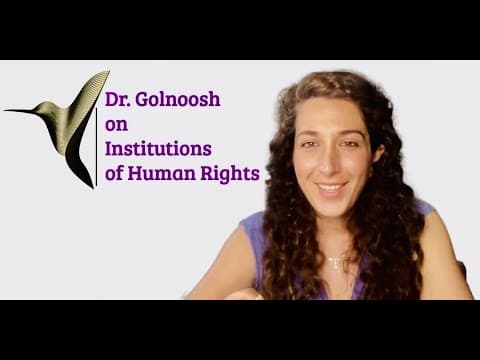
Institutionalization of Human Rights & State Responsibility | Human Rights Violation | Protection
gogo Xakim
8m 23s1,073 words~6 min read
YouTube auto captions
Transcript source
YouTube auto captions
This transcript was extracted from YouTube's auto-generated caption track. The transcript below is server-rendered so it can be read, searched, cited, and shared without opening the original YouTube player.
Pull quotes
[0:00]Often when we see atrocities around the world, when we see individuals harmed, we see minority groups that have been targeted or vulnerable populations that are targeted.
[0:00]We think about, hear about and read about rights, human rights and human rights violations.
[0:00]We hear this in the media or in our social groups when people talk about human rights violations, but this is all discussions taking place in abstract.
[0:00]These discussions are happening more theoretically and at the most you may see a reference or read a reference to the Universal Declaration of Human Rights.
Use this transcript
Related transcript hubs
Watch on YouTube
Share
MORE TRANSCRIPTS


