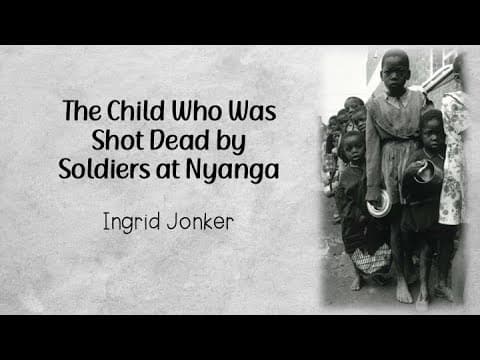
[0:02]Hi everyone. The following presentation is on the poem The Child Who Was Shot Dead by Soldiers at Nyanga by Ingrid Jonker. This poem is a part of the newly prescribed Grade 12 English Home Language poetry for 2023 and the next few years to come.
[0:25]Before we go into the analysis of the poem, let us consider Ingrid Jonker's background, as it will provide some context to the poem itself. Ingrid Jonker was an Afrikaans poet who was born in the Northern Cape in 1933. She started writing poetry at the age of six and by the time she was sixteen, her poems were regularly published in Die Huisgenoot. She reflected her views against the apartheid regime in her writing. After living through a difficult childhood and early adulthood, in 1965 she took her own life by purposefully drowning in the ocean at Green Point, Cape Town. In his inaugural address on 25 May 1994, Nelson Mandela honoured Ingrid Jonker by reciting this poem as a part of his speech.
[1:35]I would like to provide a bit more background context to the event that led up to the writing of this poem. Jonker wrote this poem in response to the shooting of a child in his mother's arms during protest against the pass laws. Remember that in the apartheid era, all black people were required to carry a specific identity document known as a pass or a dompas. This shooting happened in Nyanga, a Black township near Cape Town in 1960. Jonker wrote about the poem in Drum magazine. She said, "I saw the mother as every mother in the world. I saw her as myself.
[2:24]I saw Simone (Jonker's daughter) as the baby. I could not sleep. I thought of what the child might have been had he been allowed to live. I thought, what could be reached? What could be gained by his death? The child wanted no part in the circumstances in which our country is grasped. He only wanted to play in the sun at Nyanga. The poem grew out of my sense of bereavement.
[2:57]The title, The Child Who Was Shot Dead by Soldiers at Nyanga is outright and frank. It thus provokes a sympathetic response from the reader. It also describes a child who is helpless against armed soldiers and for the reader, creates a perception of cruelty and that the child's death was senseless.
[3:24]Let us read through the poem. The child is not dead. The child raises his fists against his mother who screams Africa, screams the smell of freedom and heather in the locations of the heart under siege. The child raises his fists against his father in the march of the generations who scream Africa, scream the smell of justice and blood in the streets of his armed pride. The child is not dead, neither at Langa nor at Nyanga, nor at Orlando nor at Sharpeville, nor at the police station in Philippi, where he lies with a bullet in his head. The child is the shadow of the soldiers on guard with guns, saracens and batons. The child is present at all meetings and legislations, the child peeps through the windows of houses and into the hearts of mothers. The child who just wanted to play in the sun at Nyanga is everywhere. The child who became a man treks through all of Africa. The child who became a giant travels through the whole world without a pass.
[4:42]The first line states the child is not dead. You will notice that throughout the poem the words, The Child are repeated. This literary device is called anaphora, which is the repetition of a word or phrase at the beginning of a number of lines. We can say the purpose of repeating the words the child emphasizes the age and just how innocent the child was. It also emphasizes how many children were killed because of the apartheid regime. Even though this child was shot and killed, the child is described as not dead. This is because the child is metaphorically still alive because he has become a symbol of resistance, freedom and hope. Lines 2 and 3 state the child raises his fists against his mother who screams Africa. Consider the words, raises his fists and screams. These words indicate a sense of anger. The phrase screams the smell contains an idea known as synesthesia. This is a figure of speech in which one sense is described in terms of another. The child is described as screaming the smell of freedom and heather in line 4. Heather refers to a type of plant with small flowers. Line 5 states that all of this takes place in locations of the heart under siege. These locations are the areas of South Africa in which people are oppressed, such as places like townships. These lines suggest that the parents of the youth have fought, but it is now time for the youth to begin an even more brutal resistance.
[6:50]Line 6 reads, The child raises his fists against his father. Note the anaphora in the repetition of the words the child. The child raises his fists against his father in the march of the generations. This march could be a reference to the protests against the pass laws, but it could also refer to a generation gap. The child's parents may have passively accepted their circumstances under the apartheid regime, but it will now be the youth who will really fight for change. The youth are the ones who scream Africa, scream the smell of justice and blood. This suggests that the youth will have a desire to correct the wrongs of the past, even if it means violence. The blood mentioned here could also refer to the bloodshed that has already occurred at the hands of the apartheid government. This march for justice and blood will take place in the streets of his armed pride. There could be two interpretations of the phrase armed pride. The first interpretation is that the speaker refers to the proud soldiers who were armed against the people protesting peacefully. The second interpretation of armed pride is the speaker's reference to the child and other fellow freedom fighters who are proud and determined in their struggle for freedom.
[8:31]Note the anaphora and that this line, line 11, which states the child is not dead, is a refrain.
[8:43]This child is not dead, neither at Langa nor at Nyanga, nor at Orlando nor at Sharpeville, nor at the police station in Philippi. These are some places at which uprising and conflict occurred during the apartheid era. Line 15 is quite explicit as it states that the child is not dead, where he lies with a bullet in his head. This is a shocking image, because the speaker does not use any euphemisms in mentioning the violence, but rather the speaker shows the violence in a very candid and forthright manner. In this stanza, which is stanza 3, the speaker refers to the police officers who killed protesters, which included children. However, the child who has literally died is figuratively not dead, because he is still alive in the hearts of those who are a part of the resistance and struggle for freedom. What the child symbolizes can never be killed. The tone in these lines is courageous, determined, passionate and inspired.
[10:03]Note the anaphora in line 16. Here the child is described as the shadow of the soldiers. This can be interpreted as wherever the soldiers/police gather, the memory of the child will always be there. In other words, the police and soldiers' violent and horrific acts will remain with them forever. They cannot be allowed to forget what they have done. A second interpretation could be that the child will be what inspires other youth to walk the same brutal path as the police to avenge the deaths of others like him.
[10:50]In line 17, these soldiers are described as being on guard with guns, saracens and batons. A saracen is an armored vehicle or an army tank. These lines suggest the police's preparedness in stopping the anti-pass protests. It almost seems as if they are preparing for war. Ironically, the apartheid police used these violent guns, saracens and batons against many peaceful protesters. Lines 18 to 19 read, the child is present at all meetings and legislations, the child peeps through the windows of houses and into the hearts of mothers. These highlighted words, present, peeps through the windows, and the hearts of mothers, suggest that the child is omnipresent, which means that his spirit and memory is present everywhere at all times. His spirit and memory will inform or inspire the future actions of resistance and the fight for freedom. Because of the child's omnipresence, people will remember the senseless deaths at the hands of the apartheid government and will be determined not to let these atrocities happen again. In line 18, it states that the child will be present at all meetings and legislations. Of course, this is still figurative, as his death and what he represents will be discussed at anti-apartheid gatherings and at meetings where the apartheid government themselves introduce new laws to further oppress people. In line 19, the child is described as peeping into the hearts of mothers. Behind all of the politics, people's lives would have been directly and intimately affected. By stating that this child would peep into the hearts of mothers, creates a sense of realness and intimacy by revealing the emotional and nurturing side of the matter. Mothers in general would not want the same fate for their children as the child who was shot. Lines 20 to 23 all begin with the anaphora the child. In line 20, the child is described as just wanting to play. This line is quite poignant and particularly moving because it highlights the innocence of the child and just how senseless his death was. The child is described as being everywhere. As previously stated, the child has become omnipresent or omnipotent. Meaning his presence is everywhere all the time. Because of what he symbolizes, the whole country is now his playground. Lines 21 to 23 read, The child who became a man treks through all of Africa. The child who became a giant travels through the whole world without a pass. The child has become a man and a giant. This suggests that a growing sense of freedom and justice has been accomplished. The significance of this child's death has allowed him figuratively to track through Africa and travel across the whole world. The child has become a man whose message and symbolism of freedom from oppression reaches across Africa and the whole world. He is able to move through Africa and the world without a pass. A pass makes reference to the dompas, an ID document used to restrict movement of black people in South Africa. The sense of freedom the child embodies has no limitations. This line gives hope that those who are living will eventually also experience this freedom, and that apartheid and all its atrocities will come to an end.
[15:19]Let us take a look at the form and structure of this poem. It is written in free verse. This just means that there is no specific rhyme scheme or rhythm. The poem ends with a single line. This could emphasize the message that attaining freedom is essential. There are multiple uses of enjambment. These are lines that have no punctuation marks at the end of them. This creates a free flow of thought and could also symbolize the idea that freedom will come one day. The lack of punctuation throughout the poem in general could symbolize that the child's influence is never ending. The tone, which is the speaker's attitude or feelings towards the subject matter at hand, is bold, passionate, inspired and determined. There are also feelings of outrage and loss. However, even though the innocent child's death is heartbreaking, the tone of the poem is not sympathetic or sad. One of the themes in this poem is the idea of freedom. The speaker dreams of a time when all people will be free. This freedom includes the freedom of speech, movement and equal human rights. The other theme evident in this poem is resistance. Remember that the child is not a physical person, but he is a symbol of the ideas of freedom, protest and equal rights. Thank you for watching this presentation on Ingrid Jonker's The Child Who Was Shot Dead by Soldiers at Nyanga. My goal is to upload more Grade 12 poetry from the new set of poems. So please subscribe to my YouTube channel and give my Instagram and TikTok account a follow for more English content.


