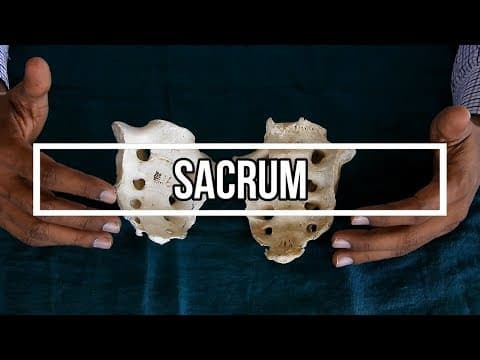
[0:10]Hello friends, welcome to the Viva Boss of Anatomy. Today we discuss a sacrum. The sacrum is a large flat triangular bone forming the postero superior boundary of a bony pelvis. Now, being a triangular in the shape, it is having a base or upper surface and apex and three surfaces. The pelvic surface, a dorsal surface and the lateral surface. Laterally the sacrum articulated with the two hip bone on the each side to form the sacroiliac joint. Now, you can see the sacrum is divided by a row of a foramen on the both the side into the median portion and the lateral portion. The median portion is traversed by a sacral canal here. We will discuss later on about sacral canal and the laterally there is a mass of a sacrum which is known as a lateral mass, which is formed by the fusion of a transverse process posteriorly and the costal element anteriorly. Now, first we discuss about its anatomical position. How to keep the sacrum in the anatomical position? The first thing this concave pelvic surface is facing forward and downward, so you should keep this pelvic surface like this, downward and forward. Second, upward surface of a body of the first sacral vertebra is tilted forward and make an angle of 30 degree with the horizontal. It slopes forward. Means it's facing upwards and the forwards. This is second point. And the third upper end of a sacral canal is directly directed almost directly upwards. So this is the anatomical position of a sacrum. Now, we see the feature of a sacrum. The sacrum is having a base, apex, pelvic surface, dorsal surface and right and the left lateral surface. We see one by one. The first a base. Base is known as upper surface of the sacrum. It is directed upwards and the forwards. The base will present the feature of a body of a first sacral vertebra but in the modified form. The first thing in the base, the body, the body is of a lumbar intact. It is a large and the kidney shape. Now, the body it slopes forward making an angle of the 30 degree with the horizontal in anatomical position. Now, the anterior margin, this one, anterior margin of the body is jutting forward, projecting forward, which is known as a sacral promontory. Now, second, the pedicle. Pedicles are short and directed backward and later. Third, lamina, which is lies obliquely, directed backwards and medially and meet in the midline. Now next thing is a spinous tubercle. The first spinous process is in the form of a tubercle, which is modified and from the first spinous tubercle. Then the superior articular process. Superior articular process directed upwards and it presents the concave superior articular facet, which is directed backwards and medially. The last one is a transverse process.
[4:16]Now, the transverse process is highly modified in the form. The transverse process fuse with the coastal element anteriorly and form the massive mass on the upper surface of a lateral mass of a sacrum. Which is known as a ala of the sacrum, which is spreading fan wise from the side of the body. So this part is known as a ala of the sacrum, which is a upper surface or a base of a lateral mass of a sacrum. Ala of the sacrum. Now the ala of the sacrum is a smooth medially and the rough laterally. So this is about the base of the sacrum. Now, the apex. The apex is formed by the inferior surface of the body of the fifth sacral vertebra. It articulate with the coccyx to form sacrococcygeal joint. Now, the third thing is a pelvic surface. The pelvic surface is overall smooth and concave and in the anatomical position, it is directed forward and downward. Now, in the median portion, the pelvic surface presents the four transverse ridges, which indicate the fusion of a body of a five sacral vertebra. Lateral to this four transverse ridges, there is a row of a four foramina, which is known as a pelvic sacral foramina. Now, this pelvic sacral foramina communicate with the sacral canal through the intervertebral foramina. Lateral to the pelvic sacral foramina, there is a lateral mass, which is formed by the fusion of the transverse process posteriorly with the costal element anteriorly. And in between this pelvic sacral foramina also there is a bar of a costal element.
[6:20]So this is about a pelvic surface. Now, the posterior to it is a dorsal surface. The dorsal surface is a rough, irregular and the convex. The dorsal surface is directed backwards and the upwards. Now, we see the feature. Starting from the median region and we go laterally. In the median region, it present the median sacral crest, which is formed by the three to four spinous tubercle. Three to four spinous tubercle, which is formed by the fusion of the four spinous process of the upper for sacral vertebra. Now, below the fourth or the third spinous tubercle, you can see the inverted U-shaped gap. This is known as a sacral hiatus. Now, this U-shaped gap is formed because the lamina of a fifth sacral vertebra is failed to fuse in the midline and from the inverted U-shaped gap, sacral hiatus. Okay. Now, the lateral to the median sacral crest, there is a oblique lamina. This is the oblique lamina. Lateral to the oblique lamina in the line with the superior articular process, there is a articular tubercle. This articular tubercle is formed by the fusion of a superior and the inferior articular process of the adjacent sacral vertebra. And below the inferior articular process of the fifth sacral vertebra is free, which is known as a sacral corn, which lies on the either side of the sacral hiatus. Going laterally, lateral to this articular tubercle, which is also known as a intermediate sacral crest, there is a for dorsal sacral foramina. Now, this for dorsal sacral foramina also communicate with the sacral canal through the intervertebral foramina. Lateral to the dorsal sacral foramina, there is a small tubercles, which is known as a transverse tubercle and this will form a line, which is known as a lateral sacral crest. And this is formed by the fusion of a transverse process of the five sacral vertebra. So this is about a dorsal surface. Now, we see the last surface, last part of the sacrum, that is a lateral surface. The lateral surface is wider in the upper part and the narrow in the lower part. The wider upper part present the L-shaped articular area anteriorly and the large rough pitted area posteriorly. This articular surface articulate with the ilium of the hip bone to form the sacroiliac joint, which is a plain variety of a joint. And this is formed by the fusion of the costal element. This large rough posterior area is formed by the fusion of the transverse process. Okay. Now, in the lower end of a lateral surface, there is a abrupt medial bend. This is known as a inferior lateral angle of a sacrum. So this is the feature of a sacrum. Now, we see in detail about the sacral canal. The sacral canal lies behind the body of the sacrum. It is triangular on the cross-section. It is formed by the vertebral foramina of the all the five sacral vertebra. Superiorly it communicate or it is in the line with the spinal canal and inferiorly it leads into sacral hiatus. Now, it contains the subdual and the subarachnoid space up to the S2 level and from this level, the filum terminal and the lower sacral now will pierce and go below. So this is about a sacral canal. Now, we see the attachment of the sacrum. In the attachment, first, we see the attachment of the base. Then the pelvic surface, dorsal surface and the lateral surface. In the base, the anterior and the posterior margin of a body provides the attachment of a lowest fiber of the anterior and the posterior longitudinal ligament respectively. The lamina, upper margin of the lamina provides the attachment of the lowest fiber of a ligamentum flavum. Now, the lateral rough surface of a ala provides the origin of a iliacus muscle anteriorly and the lumbosacral ligament posteriorly. These are the attachment of a base. Now, the pelvic surface, the pelvic surface lateral to the body of a middle three piece gives the origin to the pyriformis muscle here. And the origin also extend into the area between this pelvic sacral foramina, so the origin is in the form of a East on the both the side, pyriformis muscle. Now, on the dorsal surface, the dorsal surface provides the origin of the erector spinae muscle in the shape of a U along the median sacral crest and a lateral sacral crest. This is origin of a erector spinae and in the concavity of a U-shaped erector spinae, there is a origin of a multifidus muscle. So these are the important attachment of a dorsal surface. Now, on the lateral surface. On the lateral surface, the rough pitted area posterior to the articular surface, this one, provides the attachment of a introus sacral ligament. Sacroiliac ligament. The lower narrow region of a lateral surface provides the attachment of a gluteus maximus, sacrotuberous sacra spinous ligament and the coccygeus muscle from before behind forward. Last one, inferior lateral angle gives the attachment of a sacrococcygeal ligament, lateral sacrococcygeal ligament. So these are the important attachment of the sacrum. Now, we see the important relation of the sacrum. Starting from the ala. Now, the smooth medial part of the ala is related to from lateral to medial, remember, lateral to the medial, for structure, that is, obturator nerve, iliolumbar artery, lumbosacral trunk and the sympathetic chain. If you take a first spelling of this for letter, it gives a mnemonic oils. O, I, L, S. Obturator nerve, iliolumbar artery, artery, lumbosacral trunk and sympathetic chain. So these are the relation of a medial part of the ala. The pelvic surface in the midline is related to the median sacral vessels. Just medial to the pelvic sacral foramina it is related to the sympathetic chain. Now, the upper two and a half piece of a body of a sacral vertebra is related to the peritoneum. And the lower two and a half of a body of the sacral vertebra related to the rectum. So these are the relation of the sacrum. Now, we see the structure passing through the foramen. All the foramina. The first a pelvic sacral foramina. The pelvic sacral foramina transmit the lateral sacral artery and the ventral ramie of upper four sacral nerve. The dorsal sacral foramina transmit the dorsal ramie of upper four sacral nerve. Now, the most important, the sacral hiatus. Structure passes through the sacral hiatus. The first structure is a filum terminal, which passes through the sacral hiatus and attach to the periosteum on the posterior surface of the body of the first coccygeal vertebra. Filum terminal. Then the pair of a fifth sacral nerve and the pair of a coccygeal nerve. Only coccygeal nerve. These are the structure passing through the sacral hiatus. Now, we see in the last the sex difference of a sacrum. How to differentiate the sacrum is of a male or a female? For that there is one sacral index. The sacral index is the breadth across the base into 100 upon the length from the sacral promontory up to the apex. This is called the sacral index. Now, remember one thing. The male sacrum is overall narrower and longer. Whereas the female sacrum is broader and shorter. So sacral index in case of the male is less and that of the female is high. The male is 105 sacral index, female is 115. So this is the first point. The second, you can see at the base. This is the male sacrum, this is the female sacrum. Now, the width of a body of a first sacral degree is larger than the ala of the sacrum in case of the male.
[17:11]And these two are equal in case of female. The third thing, this dorsal concavity of a articular surface. The dorsal concavity is more marked in the female because the female sacrum is a shorter, so the concavity become the more marked. Whereas in the male, the concavity in the articular surface is less marked. The last one, this pelvic surface, the concavity of the pelvic surface is uniform and shallower. Whereas in the female, it is deeper. So these are the important feature differentiating the male sacrum from the female sacrum. So this is all about the sacrum. Thank you. If you like this video, like it and share with your friends. And to get the regular update on the anatomy videos, please subscribe to our channel and click on the bell icon.


