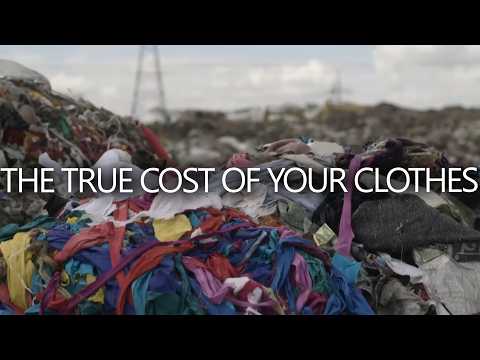
[0:56]This is a story about clothing. It's about the clothes we wear, the people who make these clothes, and the impact that it's having on our world. It's a story about greed and fear, power and poverty. It's complex as it extends all the way around the world. But it's also simple, revealing just how connected we are to the many hearts and hands behind our clothes. I came into this story with no background in fashion at all, beginning with nothing more than a few simple questions. What I've discovered has forever changed the way I think about the things I wear, and my hope is that it might just do the same for you.
[2:04]My name is Lucy Siegle, I am a journalist and broadcaster based in the UK, and I have been obsessed consumed with the environmental and social impacts of the fashion industry for about a decade. Well, I love everything about clothes. You know, I love, I love the poetry, I love the fabric, I love the colors, I love the textures, I love the way that they make you feel. You know, they are our chosen skin. Well, I had the classic massive closet, clothes everywhere, bags constantly coming into my house, you know, every day, every other day with some other item in, and never had anything to wear. I could never put together a coherent outfit. We communicate who we are to a certain extent through clothing, and this is, this is again, throughout history. You know, you have the trends that come to you. Again, Marie Antoinette making these huge hats. It's always been it's our personal communication in many ways. That's what interests me that it is fundamentally a part of what we wish to communicate about ourselves.
[3:22]And we used to have a system, a fashion system where people would go to the shows, so they would do spring, summer, autumn, winter. And those kind of run like clockwork from very many years. Okay, rip that up, throw it out the window. That has absolutely nothing to do with the fashion industry today. It has been reinvented. The shift is moving ruthlessly towards a way of producing which only really looks after big business interest. Growing up, I never gave much thought to anything other than the price of the clothes that I bought. Usually making choices based on style or a good deal. Looking back, I learned that for a long time, most of our clothing was actually made right here in America. As recently as the 1960s, we were still making 95% of our clothes. Today, we only make about 3%. And the other 97% is outsourced to developing countries around the world. I've been in the business for over 9 years. In terms of scale, we've got about 25,000 people just on garment manufacturing side. We produce one in six treasures sold in the US. If you actually go to the store and you benchmark the price of a a garment over the last 20 years, you will find that it's actually a deflationary product. I mean, the price has gone down over time. Now, has our cost gone down? Absolutely not. Our cost has gone up. The more production we've outsourced, the cheaper prices have become on the clothing we buy, making way for a whole new model known as fast fashion, almost overnight, transforming the way clothing is bought and sold. The newest H&M store on 5th Avenue in Manhattan is the company's largest ever and just one of many new stores it's planning around the country. It's all part of a high street revolution, fast fashion. Instead of two seasons a year, we practically have 52 seasons a year. So we have something new coming in every week. And fast fashion has created this so that it can essentially shift more product.
[5:46]You can get this fringe metallic skirt for $39 at Joe Fresh, a brand new store in town. With price tags that might look a little bit more appealing to budget conscious shoppers. American consumers, they really have grasped the fashion park of H&M, and we know from before that American consumers are very value oriented. If you match these two together with fashion and value, then you have the recipe. One Japanese clothing retailer, it's making a fast and furious march here in the US. The price has dropped, the way of making that product has completely, completely changed. And you have to ask yourself at some point, where does it end? The global marketplace is some place where we export work to have happen in whatever conditions we want, and then the products come back to me cheap enough to throw away without thinking about it. Well, globalized production basically means that all of the making of goods has been outsourced to low-cost economies, particularly where wages are very low and kept low. And what that means is that those at the top of the value chain, they get to choose where the products are being made, and they get to switch if, for example, one factory says, we can't make it that cheap anymore. The brand will say, we're not going to come to you anymore, we're going to switch to another place which is cheaper.
[7:15]In the West, they're using everyday low price, so everyday, they're hampering me and I'm hampering my workers. This is how it is. They're competing, the stores are competing in there. When the stores are coming to us for order and negotiating, they're telling, look, that particular store is selling this shirt with like $5. So I need it to sell it in the $4. So you better squeeze your price, so we are squeezing. Then other stores are coming and selling, hey, they're selling it in the $4. So the target price is $3. If you can meet the $3, you are getting business, otherwise you are not getting. Because we want that business so badly, and we don't have other options, okay. Every time we are trying to, you know, okay, survive actually. Ultimately, something's going to give. Either the price of the product has to go up, or manufacturers have to shut down, or cut corners to make it work. Cutting corners and disregarding safety measures had become an accepted part of doing business in this new model. Until an early morning in April when an event just outside of Dhaka, Bangladesh, brought a hidden side of fashion to front page news. State media in Bangladesh say an eight-story building has collapsed near the capital of Dhaka, killing more than 70 people.
[8:40]Rescue workers are racing against time searching through the rubble trying to find as many survivors as they can. Hundreds are dead, hundreds more might still be buried alive after officials in Bangladesh say factory owners ignored an order to evacuate. Some 400 dead, hundreds still believed to be missing. Garment workers in Bangladesh paying the price for cheap clothing. A huge crowd has gathered near the building side, many of them family members, looking for loved ones. And they say they can still hear people screaming from underneath the rubble, crying out for help. Many are simply losing hope. From where I was working, I moved close to the stairs. As I reached them, the building collapsed and both my legs got trapped. The side walls fell on my legs.
[9:39]I realized that I could not get my legs out, so I gave up. Hundreds of thoughts came into my mind. I couldn't even cry.
[9:55]Anybody who like me had written about problems in the supply chain, particularly for fast fashion, and tried to articulate how the risk was being carried by those who are most vulnerable and the worst paid. You tried to articulate that, but you could never have been envisaged that there would be such a catastrophic illustration of what you were trying to say. And Rana Plaza to me was like some horror story. Two weeks after the catastrophe, and the death toll now stands at a staggering 931, making it the worst garment industry disaster in history. I think one of the, the, the most profoundly impressing things about the Rana Plaza disaster was that news that the workers had already pointed out to the management the cracks in the building. They they'd already pointed out that the building was structurally unsafe, and yet they've been forced back in. Many survivors are asking how they could have been forced to return to work when management already was aware of the cracks in the building and workers concerns on the very day of the collapse. A lot of clothes in American stores are made in Bangladesh by workers who earn about $2 a day. Last month there, a garment factory collapsed, killing more than 1,000, and a few months before that, a factory fire killed more than 100. And as bodies are still being pulled out of the rubble, another factory in Bangladesh called fire early this morning, killing eight more people. As story after story of clothing factory disasters kept filling the news, it was now the case that three of the four worst tragedies in the history of fashion had all happened in the last year. As the death toll rose, so did the profits generated. The year following the disaster at Rana Plaza was the industry's most profitable of all time. The global fashion industry is now an almost 3 trillion dollar annual industry. Bangladesh is now the second largest apparel exporter after China. How? Well, unlike some of its competitors, Bangladeshi manufacturing remains dirt cheap, and unions have limited power. The country cornered the absolute bottom of the value chain. Those 1,000 poor girls lost their life because everybody didn't bother, didn't give them should, and they just wanted the cheap price and a good profit. It shouldn't be like that. Everybody should take the responsibility for those kids.
[12:42]That's how it is, and it might come coming more. Sorry, but yeah, you know that it's not only the price pressure. It's something ignoring other people's life. It's it's not, it's not right. It's 21st century. It's a global world we are living, and we just ignore other people's life. How come? This enormous rapacious industry that is generating so much profit for a handful of people. Why is it that it is unable to support millions of its workers properly? Why is it that it is not able to guarantee their safety? We're talking about essential human rights. Why is it unable to guarantee that whilst generating these tremendous profits, is it because it doesn't work properly? That is my question. Lucy's question sounds like the obvious one. But instead of answering it, everywhere I looked, I found people who were constantly justifying the cost because of the economic benefits being generated. So this low-wage manufacturing or so-called sweatshops, they're not just the least bad option workers have today. They're part of the very process that raises living standards and leads to higher wages and better working conditions over time. Your approximate causes of development are physical capital, technology, and human capital or skills of the workers. When sweatshops come to these countries, they bring all three of those to these workers and start getting that process going. Is it possible that sweatshops are actually good? Yes, horrible, awful sweatshops, the word itself sweatshop, it evokes terrible images of poor people and children suffering in third world countries, slaving away in awful conditions to make products for us selfish Americans.
[15:26]Well, I mean, there's nothing intrinsically dangerous with sewing clothes. So, so we're kind of starting out with, you know, with a a relatively safe industry. It's not like coal mining or natural gas mining or, you know, a lot of things that you can that are much more dangerous. So sweatshops' jobs look like horrible working conditions and wages to anybody in the West who's wealthy enough to own a TV and watch your video. But we have to keep in mind that the alternatives available for these workers aren't our own alternatives. They're much worse than our alternatives and they're usually much worse than the factory job that the worker has. Low wages, unsafe conditions, and factory disasters are all excused because of the needed jobs they create for people with no alternatives. This story has become the narrative, used to explain the way the fashion industry now operates all over the world. But there are those who believe that there must be a better way of making and selling clothing that does generate economic growth, but without taking such an enormous toll. So we don't know yet how long this embroidery is taking. Do you think you could ask Chan Too just just roughly how long that whole panel is taking? Because I guess we'll see it later on in the FP price breakdown, but it would be great to know, wouldn't it? So I'm Safia Minney. I'm founder and CEO of People Tree. And People Tree is a fair trade fashion brand that started over 20 years ago in Japan. You were worried that we had a bit too much navy. What what are you feeling now? Because we did put more black into SS14, and that has worked really, really well with, um, all, uh, all of the designer collaboration. Have we got enough black print in the collection? Uh, well we've lost that abstract dust print this one here, and the black. But I think this print could be really, I think it's one of those prints that everyone's a bit nervous off, but actually will do well. I think most fashion brands start with a concept of a collection or a look. Um, they don't tend to think, uh, you know, who's going to make the product and, um, how can I ensure that producers or or suppliers, um, are going to eat? Um, so what what we're trying to do at People Tree is really start with, uh, the skills that we have at each producer group, and then design the collection up, whilst also looking at the integrity of the collection in its aesthetic. I worked originally with freelance designers, and went into Bangladesh, Zimbabwe, India, Nepal, the Philippines, and bit by bit, we put together, you know, an amazing network of like-minded fair trade organizations that put women's development, you know, the workers, social development and environment absolutely central to everything they do.
[18:32]Today is the 15th anniversary of World Fair Trade.
[18:38]We organize this kind of event in over 60 countries as a fair trade movement, and 10 to 60 organizations per country are involved in it.
[18:54]Today, just like what we are doing here, fashion shows and seminars are being held in over 3,000 places all over the world.
[19:56]Fair trade is a citizen's response to correcting the social injustice in an international trading system that is largely dysfunctional where workers and farmers are not paid a living wage, and where the environment is is not considered at all to make the products that we buy every day.
[20:31]My name is Shima. I'm 23 years old. When I came to Dhaka, I was 12.
[21:13]When I first started working in a garment factory, my salary was $10 a month.
[21:38]What's her name? My daughter's name? Nadia Akhter.
[21:49]I take her with me to the factory some days, but it's terribly hot inside the factory. And there are chemicals inside the factory, which are very harmful for children. So I can't keep her here in Dhaka with me because I don't have anyone to take care of her.
[29:23]Will you feel bad leaving Nadia? Of course I feel bad, but there is nothing to do. With a job here, I am forced to leave her in the village. In the last two months, she never sat with her books. She only watches TV & cartoons. And Music Videos. But if she stays in the village she cannot do that.
[29:52]What do you do with Nadia now? Sometimes I leave her with the neighbor, sometimes her father used to look after her. And I took her to my factory sometimes. I took her to the factory yesterday.
[31:24]This is my dad, it's been a year since I have seen him. Sometimes I talk to him on the phone as well but I don't see her often.
[32:28]There is no limit to the struggle of Bangladeshi workers. Everyday we wake up early in the morning, we go to the factory, and work really hard all day. And with all our hard labor we make the clothing. And that's what people wear.
[32:48]People have no idea how difficult it is for us to make the clothing. They only buy it and wear it.
[32:58]I believe these clothes are produced by our blood. A lot of garment workers die in different incidents. Like a year ago there was a collapse in Rana Plaza. A lot of workers died there. It's very painful for us. I don't want anyone wearing anything, which is produced by our blood.
[33:26]We want better working conditions. So that everyone becomes aware, I don't want another owner like the owner of Rana Plaza to take such a risk and force the workers to work in such conditions.
[33:41]So that no more workers die like this. So that no more mothers lose their child like this. I never want this. I want the owners to be a little more aware and look after us.