[0:04]What's up? Mediate here. And in this video, we're going to go through the anatomy of the small intestine. So in the last video, we went through the anatomy of the stomach. Now, the next step after the stomach is the small intestine, as you see here. So in this video, we're first going to look at the components that make up the small intestine. Then we're going to look at the topography and go through how the small intestine is fixated to the posterior abdominal wall. After that, we're going to look at some important anatomical structures related to the three parts of the small intestine. Then we're going to go through the layers that make up the small intestinal wall. All right. So here we see the anterior view of the abdominal cavity. The whole small intestine is highlighted here in blue. It reaches from the stomach all the way to the larger intestine, as you see here. Or to be specific, it goes from the pylorus of the stomach to the cecum of the large intestine. Now, the length of the small intestine may vary a lot, but in total, if you would stretch it out, you will see that it's approximately 7 meters long. Let's now look at the parts of the small intestine to get a better sense of its anatomy, and we will do the topography along the way as well. The first part is the duodenum, which is the shortest part of the small intestine. And not only is it the shortest part of the small intestine, but it serves different functions as well, and I'll show you why. The duodenum is between 25 to 30 centimeters long, and it's mainly responsible for iron absorption, chemical digestion, and chemical neutralization. Now let's go through that again. When you eat your food and it's been processed in the stomach, it then becomes something called chyme, which is essentially the food you ate mixed with the hydrochloric acid in the stomach. When chyme from the stomach enters the duodenum, the duodenum itself begins to secrete a mucus that neutralizes the stomach acid because the rest of the small intestine after the duodenum isn't that protected against the acid as the duodenum is. So the rest of the small intestine can be damaged over time if the acid is not neutralized. So chemical neutralization, that's the first function. The chyme is then mixed with pancreatic juices and the bile from the liver and the gallbladder, which breaks down some components so that nutritions can be easily absorbed as it passes through the intestines. Once this process is complete, the chyme is then pushed towards the jejunum to have its nutritions pulled from it. Now, let's go through the topography of the duodenum, and we'll start with the skeletopy. Skeletopy means the location of an organ in relation to bones in the body. So measurements might vary depending on the source, but essentially, the duodenum goes from the first lumbar vertebrae to the third lumbar vertebrae, as you see here. Next, we have the syntopy, meaning its relation to other organs. And I think it's better if we switch over to my 3D program to visualize it better with the duodenum here highlighted in green. So, if we start with the organs you find behind the duodenum, you will see that the aorta, the vena cava inferior and the right kidney are behind it. Above the duodenum, you will find the liver, and you will also notice the duodenum going around the pancreas, meaning at some point of the duodenum, the pancreas is going to be superior to those parts as well. And then anteriorly, you will find the transverse colon, as you see here. So that's the syntopy. Next, we have the holotopy, meaning its relation to the body as a whole. Its upper parts is in the epigastric region, while the lower level is in the umbilical region. So that's the topography of the duodenum. Now, let's do the next two parts of the small intestine, which are the jejunum and the ileum. And one thing you will notice when you study the small intestine is that there's really no strict demarcation between the jejunum and the ileum, but the functions may vary a little bit. The jejunum can stretch between two to three meters long, and its primary function is absorption. The ileum, however, is a little bit longer, and it can be everything between two to four meters long. The ileum absorbs any remaining nutritions and vitamins that did not get absorbed by the duodenum or the jejunum, particularly vitamin B12. So the jejunum and the ileum go from the second lumbar vertebrae, and the lower parts of the ileum rests inside the right iliac fossa. So approximately like this, from L2 and the ileum resting in the iliac fossa. That's actually the reason why it's called the ileum because it's found in the iliac fossa, as you see here. Now, topographically, you will notice the small intestine is actually surrounded by the cecum, the ascending colon, the transverse colon, the descending colon, and the sigmoid colon. But posteriorly, it's fixated to the posterior abdominal wall. So let's see how. First, we need to make a vertical cut of the small intestine like this, and then look at it from this perspective. You will be able to see the sagittal plane of the abdominal cavity. Now the small intestine is highlighted here in orange. And just for orientation sake, you'll find the liver up here along with the stomach, and the transverse colon, and the sigmoid colon. The duodenum is up here as well, but we will talk about this one again in a minute. The reason why I'm showing you this is because the whole small intestine is covered anteriorly by a structure called the greater omentum, which is essentially just a layer of fat. And they're fixated to the posterior abdominal wall through what is called the root of mesentery or radix mesenteri. And you will notice that it's not only going to fixate the intestines to the posterior abdominal wall, but it's also going to surround the small intestine in a layer we call the mesentery. Those are a part of what we call the peritoneum. And we will cover the peritoneum in detail in a separate video, but for now, when studying the small intestine, it's important to know that the small intestine doesn't really flap around inside of your abdomen. They're fixated to the posterior abdominal wall and the blood supply to each organ in the abdominal cavity is through the mesenteric wall. It's a very controlled process. And keep in mind that behind the peritoneum, you will find the so-called retroperitoneal organs, like the kidneys and the pancreas, located very posteriorly inside of the abdominal cavity. The last thing for the topography, before we go detailed over to the different parts of the small intestine is the holotopy, meaning its relation to the body as a whole. So if you add the lines right here, you can see that the jejunum lies in the umbilical and the left lateral regions, while the ileum lies in three different places. It lies in the pubic region, it lies in the right lateral region, and it also lies in the right inguinal region. So that was it for the topography. So up until now, you should be able to recall what the different parts of the small intestine are. They're the duodenum, the jejunum, and the ileum, and you should have an approximate idea of their topography and how they're fixated to the posterior abdominal wall. Now, we're going to go through the specific anatomical structures of the small intestine, and then briefly look at the layers of the small intestinal wall. Let's now start with the duodenum. So here we see the duodenum, but let's look at a little more realistic view of the duodenum. Now, the duodenum consists of different parts. The first part is the one right here, the superior part. The superior part is going to start at the pyloric orifice or the ostium pyloricum. Remember, we talked about this one when we talked about the structures of the stomach. So the superior part of the duodenum extends all the way to the superior duodenal flexure, also called the flexura duodeni superior. When the duodenum bends, that's where the next part is going to start, which is the descending part. The descending part of the duodenum ends at the inferior duodenal flexure or flexura duodeni inferior. And then it continues horizontally, called the inferior horizontal part. And then it ascends a little bit and forms the duodenojejunal flexure. And it's kind of a long word, but just put the duodenum and the jejunum together. You will get the duodenojejunal flexure. It's called that because at this point, at the point of this flexure, that's where the duodenum will continue as the jejunum. Remember earlier in this video, when we went through how the peritoneum covers the jejunum and the ileum, where we talked about how the root of mesentery comes from the posterior abdominal wall and grabs each part of the small intestine and completely surrounds them to form a wet, serious, fatty layer around the small intestine. Well, one thing you will notice though, as we go through the small intestine, is that the whole small intestine are completely surrounded and protected by the peritoneum, but not the whole duodenum. Only the beginning of the duodenum is completely surrounded, but the rest of the duodenum is held in position in a slightly different way. The duodenojejunal flexure is held up through a muscular ligament, which is attached to the diaphragm. So let's add the diaphragm. The ligament is this one. It goes from the right cruise of the diaphragm and then runs behind the stomach and the pancreas, and then grabs the duodenojejunal flexure. So let's do that again and I'll fade off all other structures. This is the duodenojejunal flexure. This is the diaphragm and its right cruise. This is the duodenojejunal flexure ligament. It's also called the ligament of trite. Now, there are some variations between people. It might come from the left cruise and it might come from the right cruise. You wouldn't be wrong either way. So that was the duodenum. Now, let's talk about the jejunum and the ileum. Remember I said that there's really no strict demarcation between them. Well, in reality, there are a few ways to distinguish between them. The jejunum is thicker and wider than the ileum, and it's more vascularized, which makes it look a little darker. The ileum is thinner and it's less vascularized, hence a little lighter in color. And I found this image that visualizes just that. You see the jejunum being thicker, and there are more blood vessels going there, and it's quite logical if you think about it. Most of the absorption happens in the jejunum, and you need it to be wider and thicker to increase the surface area to absorb more efficiently. And you also want it to be highly vascularized in order to absorb all the nutritions. Now, let's go through the layers of the small intestinal wall. So let's go ahead and open up a part of the small intestine, zoom in, and then take a small section of the wall. And you will notice that the whole small intestine has more or less the same characteristics, except for some minor differences. And I will highlight these differences as we go through them. Now, you will still see the same general layers as the rest of the digestive system. There's the tunica mucosa, then the tela submucosa, we have the tunica muscularis, and a tunica serosa. And remember, the tela submucosa is always towards the lumen, the meaning is always towards the GI tube's inner hollow opening. Now, let's go through each of these and then look at some histology slides to really differentiate between them. Let's now start with the tunica mucosa first. The tunica mucosa is the innermost layer and it's made up of epithelial cells, necessary for absorption. So let's highlight some important structures. The first thing you will notice here is that there are these large bumps going into the lumen, called circular folds. And if you take a look at this diagram, these circular folds are just folds that form a circle as it folds around the intestinal tube, as you see here. And they're really important anatomically because that's what you will be able to see when you look at the small intestinal tube grossly. And you will find these projections everywhere in the small intestine, except for the duodenal bulb, which is the beginning of the duodenum. These circular folds will also be different in length along various places in the small intestine. In the duodenum, the circular folds will reach up to 8 mm long, the same in the jejunum, they reach 8 mm long. But as we go further, they gradually start to disappear, then they disappear entirely at the end of the ileum. And that's a good thing in having these circular folds in the small intestine because they make it easier to absorb nutritions by increasing the surface area. Now what does that mean? Surface area is the sum of all surfaces. So this cube has six walls, and if you combine all the surfaces together, you will get the total surface area. Now, let's see if you really understood. Which of these tubes do you think has the greatest surface area? Well, they're the same length, but if you stretch tube one out, it will be longer, meaning tube one has the greatest surface area. That's why the small intestine has these circular folds, which make it easier to absorb the food by providing it with more walls to be absorbed by. They do get help with absorption though, and they get help through these small finger-like projections you see coming out of it called the intestinal villus. And they look like this. These villi are lined with highly specialized cells for absorption, called simple columnar epithelial cells. And each of them has hair-like structures on the surface supporting the absorption, called microvilli, and they help with absorption because when they come in contact with nutritions, they contract to pull the nutritions closer to the cells. And between each villi, we have these glandular depressions, called intestinal glands, which contain cells that lubricate the lumen and produces some digestive enzymes. And on the inside of each villus, remember this is still tunica mucosa, right? We're going to have some solitary lymphoid nodules, meaning small single lymphoid nodules, that's going to be a part of the immunity. But in some places in the small intestine, you will find the lymphoid nodules being aggregated together, forming aggregated lymphoid nodules. Now, when we talk about the tunica mucosa anatomically, we need to mention another structure at the duodenum, and that's the bile duct piercing the tunica mucosa for secretion of bile. So, if we go ahead and open up the duodenum and zoom in a little bit, you will see an elevation called the major duodenal papilla. A papilla is an elevation around an opening. So the major duodenal papilla borders the entrance at which the common bile duct and the pancreatic duct meet and then pierce the duodenum. This is where most parts of the bile and other enzymes that facilitate digestion are secreted out from. And a little more superior to that, you will find the minor duodenal papilla, which is the opening for the accessory pancreatic duct. So if you take a quick look into this to get a general sense of how this is done. Bile is produced by the liver, and then it's sent down through the bile ducts, which will then pierce through the duodenum, which, at this point, is going to be bordered by the major duodenal papilla. The pancreas also has an accessory duct, piercing through, forming the minor duodenal papilla, which you will find a little superior to the major duodenal papilla. But we will go through this in a little more detail when we go through the accessory organs. So that was the tunica mucosa. Now, beneath the tunica mucosa, you will find the tela submucosa. Now in the small intestine, the duodenum, ileum, and the jejunum display several histological differences. And it's easiest to differentiate between them using the tela submucosa. So if we look at a small section of the duodenum, the duodenum is distinguished from other regions of the small intestine by the presence of the submucosal Brunner's glands, which may pack the submucosa so completely that the typical submucosal connective tissue is hard to find. These Brunner's glands produce a lot of alkaline mucus to neutralize the acid content entering from the stomach. The jejunum is the longest and the most typical region of the small intestine. It doesn't really have any characteristics on its own, just that the villi are longer as you see here. The ileum, however, is distinguished by two things. One is that it has more goblet cells in the mucosa. Those are the cells that produce mucus for lubrication. And two, is that you will see that the ileum also displays an increase in the amount of the mucosal lymphoid tissue, which forms clusters of lymphoid nodules called Peyer's patches. These lymphoid nodules extend down to the tela submucosa, as you see here. They have the same functions as tonsils and are also called the gut associated lymphoid tissue or guts. So that was the tela submucosa. Then we have the tunica muscularis. Now the tunica muscularis has two parts, and you will notice that there's always going to be two muscle fiber layers throughout the whole GI tract, except for certain parts like the stomach. The inner part is nearly always going to be circular muscle fibers, while the outer part is nearly always going to be longitudinal muscle fibers. And they provide a process called the peristalsis, which is the continuous contraction moving the food forward. Let's look a little bit into that. First, contraction of the circular muscle fibers will narrow the lumen, pushing the food forward. Then the longitudinal muscle fibers will shorten the intestinal tube, and then the circular muscle fibers will contract again to pull the food forward. That's how the bolus or the food moves within the intestines. But you will notice that the circular muscle fibers have one more function, and that is that at some places throughout the GI tract, these circular muscle fibers will function as a sphincter. And remember, we had the major duodenal papilla here, where the hepatic pancreatic duct opens up. It's controlled by a sphincter called the hepatopancreatic sphincter, or also referred to as the sphincter of Oddi. And this sphincter is really important because it controls how much bile and enzymes are going to enter the duodenum of the small intestine. All right. So now the last layer of the small intestine is the tunica serosa. Remember I said that the peritoneum completely covers the small intestine by forming the mesentery. The parts that are entirely covered by the peritoneum are highlighted for you right here. We call them the intraperitoneal organs. Mainly the ileum and the jejunum, but it also goes along and grabs the superior and the ascending parts of the duodenum as well, as you see here. While the rest of the small intestine is highlighted for you right here. We call them the retroperitoneal organs because the peritoneum only covers a part of them. That means that the areas of the duodenum that are not covered by the peritoneum, have tunica adventitia instead of tunica serosa. Tunica adventitia is more of a stronger connective tissue covering instead of the typical slippery fatty covering provided by the tunica serosa. All right. So that was everything I had for the small intestine. I really hope you got a lot out of this video. The next video is going to be about the large intestine, as you see here.
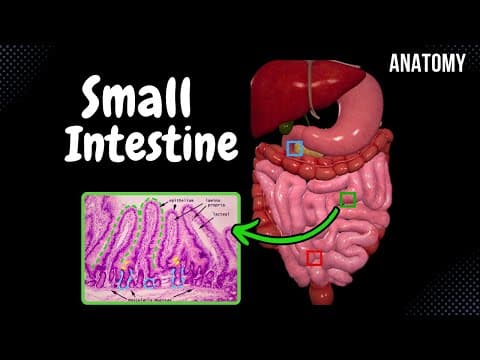
Small Intestine Anatomy (Parts, Topography, Structures, Layers)
Taim Talks Med
19m 24s3,387 words~17 min read
YouTube auto captions
Transcript source
YouTube auto captions
This transcript was extracted from YouTube's auto-generated caption track. The transcript below is server-rendered so it can be read, searched, cited, and shared without opening the original YouTube player.
Pull quotes
[0:04]And in this video, we're going to go through the anatomy of the small intestine.
[0:04]So in this video, we're first going to look at the components that make up the small intestine.
[0:04]Then we're going to look at the topography and go through how the small intestine is fixated to the posterior abdominal wall.
[0:04]After that, we're going to look at some important anatomical structures related to the three parts of the small intestine.
Use this transcript
Related transcript hubs
Watch on YouTube
Share
MORE TRANSCRIPTS


