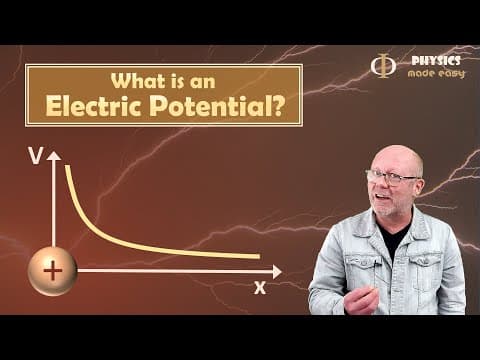
[0:00]What is an electric potential? Do you know? Can you explain it clearly? No? Then, this video is for you.
[0:10]I noticed that high school students often struggle with the notion of electric potential. So, I developed a way of explaining it that speaks to them. In this video, I will take the same approach I do with my own students. First, we will define the notion of gravitational potential. Then, we will use this concept to understand what an electric potential is and extend it to the idea of potential difference and voltage.
[0:41]Imagine a box of 2 kilograms on the ground next to a staircase. You now place the box on a step of the staircase located at a height of 2 meters. To bring it to this position from the ground, you needed to provide 2 by 10 by 2, 40 Joules of energy. Because you transferred energy to the box, the box has now a gravitational potential energy of 40 Joules. Imagine now that you decide instead to place the box 3 meters above the ground. By doing the same calculations, you realize that the box has now 60 Joules of potential energy. The potential energy of the box is directly proportional to the height it is located at. This is why we say that Potential Energy is an energy of position. You could actually label each step of the stairs with the energy the box would have if you placed it there. But what is you wanted to move a box of different mass? How should you label the steps? Just consider a box of 1 Kg when you do the calculations for the PE for each step, and then label the steps with the results. To find the energy of a box of mass m, placed on a given step, you just multiply the mass of the box by the value assigned to the step. For example, for a step at 2 meters, therefore assigned with a value of 20 Joules for 1 Kg, you can calculate the energy of a box of 3Kg that you would place there. It would be 20 by 3 is 60 Joules. The quantity we used to label the steps is called a potential. In that case it is the gravitational potential, and it is expressed in Joules per kilogram. The gravitational potential at a position is the potential energy that would hold 1 kilogram of mass placed at that position. What you see with this example, is that a potential is a property related to a position. It is not related to an object. The notion of electric potential is very similar. The only difference is that it is the electric charge of a body that is considered instead of its mass. And electric potential at a given position is the potential energy that would hold 1 Coulomb of charge when placed at that position.
[3:05]Imagine a positive charge, big Q of 5 Coulomb, located somewhere in space. I want to bring another positive charge, little q of 2 Coulombs, close to it. For that, I need to push the charge little q, because there is a repulsion between the two charges. Yes, they have the same sign. By doing so, I'm kind of doing like I did with the box. I'm applying a force that will change the position of charge little q, therefore giving it potential energy. And this time, it would be electrical potential energy. We could draw a graph that represents this energy depending on the position of little q, a little like we did when we labeled the steps of the stairs. The value on the Y axis would be the electric potential energy of little q. Now, if I want to calculate the PE that would have a body carrying any charge, I can just draw the same graph but this time for a charge q = 1 coulomb. On the Y axis, I have now the electric potential in Joules per Coulomb. To calculate the energy of any charge at a given position, I just multiply the value read on the graph for that position by the charge located at that position. The unit of the electrical potential is Joules per Coulomb. Yes, Joules per Coulomb. The definition of what it is is in the units. It is the number of Joules that would have 1 Coulomb if you placed it at a given position, thus, making an electrical potential a property of a position. Okay. Let's look at a practical understanding now. I read here, on this battery, that it has a voltage of 9 Volts. Let's see what this means.
[4:58]Again here, we are going to use gravity to illustrate. Imagine that you have an object at a height of 2 meters, you drop it, and let it land on a table which is 0.5 meters high. That means that it goes from point A, of gravitational potential 20 J/Kg to a point B of gravitational potential 5 J/Kg. This means that each 1 Kilogram of the object has lost 15 Joules of gravitational potential energy when falling from A to B. We say that there is a gravitational potential difference of 15 Joules per Kg between A and B. Oh, and note how the fall of the ball occurs naturally. Yes, nature's actions are always aimed at minimizing potential energy. Okay, so now let's look at the 9 Volt battery. 9 Volts here refer to a potential difference of 9 Joules per Coulomb. This means that on the positive side of the battery, 1 Coulomb of charge, located there, has 9 extra Joules of potential energy than the charges located on the minus side. This potential difference is called the voltage of the battery. On the + side of the battery, positive charges are stacked together. In the batteries that you can buy in shops, it is a chemical reaction that provides the energy to stack the charges together like this. Okay, so let's say that the + side has an electric potential of 9 Volts. This means that 1 Coulomb of charge present at this position holds 9 Joules of energy. If you connect the + and the - of the battery using a conducting material, the charges will fall to a position of lower potential, like the ball did. And the point of lowest potential is the other side of the battery, where you have 1 Coulomb of charge holding 0 Joules. Yeah, an electric potential of 0 Volts. And again, nature attempts to minimize potential energy by letting the positive charge flow to a point of lower potential, and this is how you get an electric current.
[7:33]In the end, you see that the notion of electric potential is actually quite simple. You just need to get used to it. It is just the number of Joules that would hold 1 Coulomb of charge when placed at a certain position. And the voltage is just the difference of electric potentials between 2 positions. If these two positions are connected, then naturally, the charges will flow from one position to the other in order to lose potential energy. Like the ball falls to lower height when it is dropped. Did you find this video useful? Yeah? So, like, subscribe and hit the notification bell. This really helps the channel and also motivates me to create more videos. And in the meantime, I'll see you soon for another episode of Physics Made Easy. Ciao.


