[0:06]Hello everyone. Welcome back. In this presentation, we are going to focus on the introduction to DES, the Data Encryption Standard. As usual, let's start the session with the outcomes. Upon the completion of this session, the learner will be able to outcome number one. Understand the basics of DES. And outcome number two, understand the encryption algorithm of DES. Let's directly dive into the topic of the day, the Data Encryption Standard. DES is actually a symmetric block cipher. What do we mean by this? Symmetric cipher means the same key is used for both encryption and decryption. Then what is a block cipher? It is not going to take a bit by bit or byte input, rather it is going to take a group of bits as an input. Input means the plain text. So, DES is actually a symmetric block cipher. Now, if you recollect in the last lecture, we saw the file structure. If you are clear with the file structure, then understanding DES is an easy job for us. And this DES is also known as Data Encryption Algorithm. So you can use interchangeably like it can be referred as DES, or even it can be referred as DEA, the Data Encryption Algorithm. DES was adopted by National Institute of Standards and Technology in the year 1977. I'm not going into the details of the history of the DES, rather I'm going to focus on the important perspectives of DES. DES is not used nowadays because of the security vulnerabilities and it is completely replaced by AES, the advanced encryption standard in the year 2001. No worries, anyway we are going to focus on the AES in this chapter for time being, you just have a note of it that the AES is almost everywhere in today's world. It's so popular because of the powerful encryption algorithm and the encryption standards. As I already mentioned, this DES is actually a block cipher. So it's clear that it's not going to take one bit or one byte as an input, rather it is going to take a group of bits. Now how many bits it is going to take? Like what is the size of the plain text, what is the size of the cipher text and what's the size of the key? What is the size of the round key? All these stuff we are going to demystify now. The input size is of 64 bits. So DES can encrypt 64 bits at a time. Input means the plain text. So the plain text size is 64 bits and obviously the output size is also 64 bits.
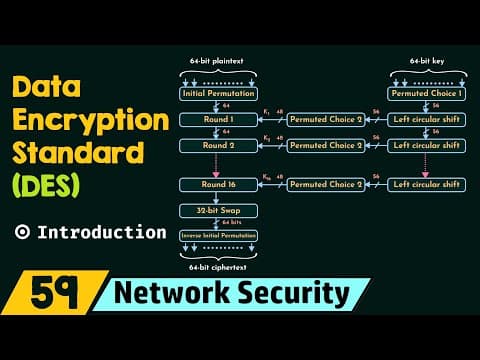
[2:37]So the 64 bit input is fed into the encryption algorithm that is the DES encryption algorithm and this DES encryption algorithm is going to convert that 64 bit plain text into 64 bit cipher text. Actually, the main key which is given as the input to the algorithm is of 64 bits. The 64 bit key is converted into 56 bits and this is the length of the key we normally referred for DES. Like we have seen in the Feistel structure, we have N number of rounds. Here also we are going to have some fixed number of rounds. Let me tell you how many rounds are there shortly. But for all these rounds, we need round key and the size of the round key is 48 bits, then how many rounds are there actually in DES? There are 16 rounds in DES. So for 16 rounds, we need 16 round keys. And how these round keys are generated? These round keys are generated using this 56 bit key length. Actually, this 56 bit key is helping the DES algorithm to generate 48 bit round keys, how many round keys? 16 48 bit round keys. So this is the actual basics that are required for understanding the DES. Let's dive into the encryption algorithm. So we are sure that DES is a block cipher and what's the size of the input and output? The plain text and the cipher text I mean. So the input is 64 bit and the output is also 64 bit. So DES is going to take a 64 bit plain text and it's going to convert this 64 bit plain text into 64 bit cipher text. And that is why this is actually called as a block cipher because it is taking a group of bits. What is happening inside this encryption algorithm? Let me unbox this. So here is the DES encryption algorithm. If you see here, this 64 bit plain text is actually going to be converted into 64 bit cipher text. And this 64 bit plain text is actually given to this initial permutation function. So 64 bits are sent to this function and after doing a permutation, it gives 64 bits as the output. So it's clear that this 64 bit plain text is given to the initial permutation function and it gives 64 bits. Now how many rounds are there? As I mentioned earlier, there are 16 rounds in DES. So here is round one, round two, up to round 16. Now if you see here, for every round 64 bits are given as the input and the output of every round is going to be another 64 bits. And what is happening in this round? That I'm not going to touch upon in this presentation. We will focus on that in the next presentation. So for now, just understand 64 bits input is given to each round and the output of each round is going to be 64 bits. So likewise, we are processing 16 rounds. At the end of 16 round, whatever we get is this cipher text. No. Just correlate this in the file structure, what we have seen. After completing the N rounds, whatever we get is the pre-output. So it needs to be swapped, right? So after 16 rounds of operation, we get 64 bits and these 64 bits are given to a 32 bit swap function. So if you take this 64 bits, we can partition this into left hand side 32 bits and the right hand side 32 bits. Just perform a swap. Once the 32 bits are swapped, again we'll be getting 64 bits only, because the left hand side 32 bits are going to be placed in the right hand side and the right hand side 32 bits are going to be placed in the left hand side. So it's clear that the output of the 32 bit swap function is going to be 64 bits and these 64 bits are given to the inverse initial permutation function.
[6:31]Which inverse and then gives 64 bits and these 64 bits are the cipher text bits. So it's clear that the 64 bit plain text is converted into 64 bit cipher text. And if you see here there are 16 rounds and as I already mentioned for each round, we need round keys and the size of the round key is 48 bits. So K1 is the round key for round one, which is 48 bits. Similarly, K2 is the round key for round two, which is also of 48 bits. Likewise we have 16 round keys and K16 is the round key for round 16, which is also of 48 bits. As I already mentioned in the previous slide, the size of round key is of 48 bits, but actually this encryption algorithm starts with the 64 bit key. But this 64 bit key is actually converted into 56 bits and this 56 bit key only is actually used for generating the round keys which is of 48 bits in nature. So the key length is 56 bits in the DES algorithm. Before we conclude, let's see what are all the things that we are going to see in the next presentation. We are going to focus on the first one, the initial permutation. So we will be understanding what happens in the initial permutation, then we'll be focusing on the round function. And then we'll be focusing on inverse initial permutation and later we will see what happens in every round. And that's it guys. I hope now you understood the basics of DES, and we also have understood the encryption algorithm of DES. I'll see you in the next presentation, and thank you for watching.


