[0:00]These machines harvest the cane by cutting it at the base.
[0:06]The heavier lengths of cane drop into the base of a conveyor, which feeds them into the transport bin that follows alongside.
[0:15]At the mill, trucks empty their load onto a receiving table. It feeds a belt conveyor that takes the cane through two separate washes. The cane must be as clean as possible for extracting the juice.
[0:37]But first, the cane's hard structure is broken down inside this crusher, where rotating hammers break the cane into small pieces. A conveyor loads it into a milling tandem designed to extract the sweet juice from the crushed cane.
[0:57]In this milling tandem, the cane passes through a series of five or more consecutive mills. Large cylinders compress the cane fiber.
[1:08]The juice pours out of the milling tandem and diverts into a channel away from the bagasse, the dry pulp that remains after extracting the juice.
[3:40]There's no waste here. The mud will fertilize the cane fields, and the bagasse leftover will be burned as fuel. The clarified juice collected from the clarifier tanks now boils in a series of evaporators. This brings the concentration of the sugar in the juice up from 15% to 60. Then the juice collects in 15 ton tanks to clarify even more. Any sediment left in the juice floats to the top. A rotating paddle skims this residue off to the sides of the tank.
[4:21]These tanks produce a type of syrup that goes on for still more processing.
[4:29]Workers now pour sucrose crystals suspended in alcohol into the syrup. This milky solution binds to the sugar present in the syrup and helps draw it out. Next, it all boils in large vacuum pans forming sugar crystals. As the water in the syrup boils away, workers regularly check to see how the sugar is crystallizing. The goal: to produce a thick crystallized paste, known as massecuite. It then goes into a high-speed centrifugal machine to remove the sugar crystals from the uncrystallized syrup. Inside, the sugar spins at 1,200 revolutions per minute. This action draws the molasses to the outer shell of the machine, while the crystals remain in the inner basket.
[5:34]Sprays of water wash the crystals. Then the water is drawn out so only the crystals remain. This centrifuge draws out moisture from the sugar, just like a washing machine on spin cycle dries its clothes.
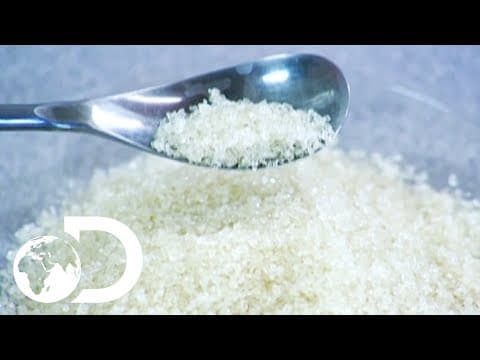
[6:08]Next, a conveyor belt carries the sugar crystals out of the centrifuge. This mill produces raw sugar, which has more molasses and is unbleached, and plantation white sugar, which has less molasses and is bleached a brilliant white.
[6:30]The sugar on the conveyor now goes into a large dryer. Hot air blows into this dryer to bring the sugar's humidity level down to 0.02%. That's standard for table sugar.
[6:49]The dried sugar pours out from the dryer into a bag on a scale. It's full when it weighs in at 1,000 kilos.
[7:03]A hoist then carries the bags to a platform at the far end of the packing facility. At 3,000 kilos, that is a heavy load.
[7:16]It lowers each bag over a chute that leads to the factory's main floor. Workers carefully open each bag in turn and pour out the sugar directly into the chute. It feeds an automated packaging machine, which fills a series of 2 kilo plastic bags, seals them, and separates them. This packing facility produces 200,000 bags every day. That means processing 400 tons of white sugar daily.


