[0:07]Hi, my name is Tony and this is a quick every frame a painting. Maybe you get this. Sometimes I'm watching a scene and I just get so bored. Instead of being staged uniquely, the scene is just this, standard coverage. Nobody moves, everybody gets a close-up and we're stuck here for 5 minutes cutting back and forth. It's like a lot of films one sees today, they are what I call photographs of people talking. It bears no relation to the art of the cinema. So here's one alternative from Akira Kurosawa. Instead of going to standard coverage, stage the scene in simple geometric shapes.
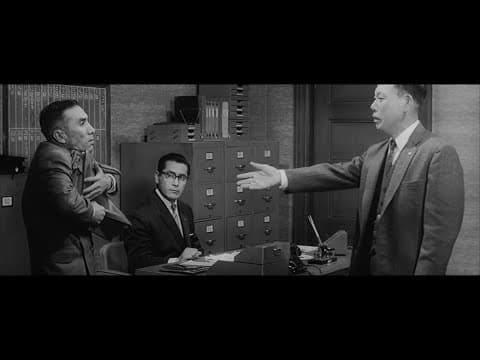
[0:46]This scene comes from The Bad Sleep Well, and it focuses on two things, squares and triangles. Here, Nishi hands the case to Shirai, and as he sits down again, we get a very simple triangle. Two sets of eyes and the bag with the stolen money. Notice that Kurosawa doesn't cut between reactions. Instead, our eyes naturally look at one person's face and then the other. As Shirai grows afraid, the triangle stretches out. Even though we're not thinking about it, notice that the door is always in frame in the background to prepare us for when As Moriyama approaches, the camera reframes to trap Shirai inside a square. -Just what are you doing? -Just what are you doing? And as the shorter man backs up, we get this great composition. Three men, three sets of eyes. -Why won't you open it? Given though the verbal drama happens between the two standing men, it's Nishi's face closest to center frame because we need to see his reaction and make sure his cover isn't blown. -Let's have a look. Kurosawa breaks the triangle with a hand and then a reveal. Notice how just by moving his eyes, we pay attention to Nishi. And the triangle has subtly changed. The two men on the left have been brought closer together, while the man on the right breaks away to focus on the money. -I don't have any idea. -Just follow me! We get one last attempt at forgiveness, but it doesn't work. Shirai hesitates for half a second and the scene ends much as it began, with one person alone planning his next move. Even though he never says a word, Toshiro Mifune owns this scene with just his posture and his eyes. And Kurosawa by staging it in triangles and squares gives our eyes multiple points to focus on and a complete story in two and a half minutes. There's even a geometric beauty about it. One person, then two, then three, two, one. It is a masterpiece of visual storytelling. If you like this exercise, try studying any other Kurosawa. In each film, he found bold, simple visual ways to tell the story. Seven Samurai has circles and groups of seven. Yojimbo has horizontal rows and diagonal lines. And The Hidden Fortress has triangles and more triangles. So the next time you have multiple characters in a scene, don't just shoot generic close-ups. Be creative and see what kind of shapes you can make. Edited & Narrated by Tony Zhou You can support the channel at www.patreon.com/everyframeapainting With footage from: Alfred Hitchcock - BBC's "Monitor" (July 5 1964) The Bad Sleep Well (1960) dir. Akira Kurosawa The Hidden Fortress (1958) dir. Akira Kurosawa The Imitation Game (2014) dir. Morten Tyldum Seven Samurai (1954) dir. Akira Kurosawa The Theory of Everything (2014) dir. James Marsh Yojimbo (1961) dir. Akira Kurosawa Music: Yoko Kanno & Seatbelts - "Too Good Too Bad"


