[0:02]Hi Guys! I'm Captain Ron. In this video, I will show you how to extract the value of TPC or Tonnes per CentimeterImmersion using a hydrostatic table. But before we will proceed, I will discuss first what is Tonnes per Centimeter Immersion or TPC is. Tonnes per Centimeter Immersion or TPC at any draught is the weight or mass that must be loaded or discharged to change the ship's mean draught by one centimeter. If we want to increase a ship's mean draught by one centimeter, we need to determine how much cargo will be loaded, or if we want to decrease the ship's mean draught by one centimeter, then we need to determine how much cargo will be discharged. And that is called TPC. There are three ways how to determine the ship's TPC. The first method is by calculating it mathematically using the formula, TPC is equal to the water plane area divided by 100 times density. This method of finding TPC is usually used for examination purposes. The second method of finding the ship's TPC is by using a deadweight scale. This is a deadweight scale that can be found in the ship's capacity plan. And the third method of finding the ship's TPC is by using the hydrostatic table. This is a hydrostatic table that can be found in the stability information manual. The second and third methods are commonly used onboard in finding the ship's TPC. In this video, I will show you the third method, which is by using a hydrostatic table. I will make a separate video of finding the ship's TPC by calculating it mathematically and by using a deadweight scale.
[1:40]This is the first example. Determine the TPC value using a hydrostatic table when the vessel is floating at a draught of 8.80 m in: a. TPC in Salt Water (SW)
[2:04]b. TPC in Fresh Water (FW) c. TPC in Dock Water (DW) with a Relative Density of 1.015 at a draught of 8.80 meters. This is a piece of hydrostatic table extracted from the stability information manual that I am going to use in this problem. The first column of this hydrostatic table is the ship's draught in meters. The second and third columns are the ship's displacement in salt water and fresh water in tons. The fourth and fifth columns are the ship's TPC in tons. In this problem, we need the first column of this table which is the draught, the fourth column which is the TPC in salt water, and the fifth column which is the TPC in fresh water. As we inspect the value of TPC in the fourth and fifth columns of this table, the value increases as the draught increases. So the value of TPC varies in the ship's draught. In order to find the value of the ship's TPC, first, we need to determine the ship's mean draught. And in this problem, the ship's mean draught is 8.80 meters. Then we go to the first column of our hydrostatic table and find the ship's draught. And this is the ship's draught, which is 8.80 meters. Along this row, in the fourth and fifth columns of this table, you can find the value of the ship's TPC in salt water and fresh water respectively. So the answer to letter a of this problem is 24.24 tons. And the answer to letter b of this problem is 23.65 tons. For letter c of this problem, when she is floating in dock water, with a relative density of 1.015 at a draught of 8.80 meters. We need to make some corrections, since the given value of TPC in the hydrostatic table is only for salt and fresh water. And the formula for the correction is: TPC in dock water is equal to TPC in salt water, times the relative density of dock water, divided by the relative density of salt water. So this is the solution. TPC in dock water with a relative density of 1.015 at a draught of 8.80 meters is equal to TPC in salt water, which is 24.24 tons. times the relative density of the dock water, which is 1.015, divided by the relative density of salt water, which is 1.025. And the answer is 24.00 tons. So the difference between the TPC of salt water and the dock water is .24 tons, about 240 kilograms. And what does a TPC of 24.00 tons means? It means that from the ship's present mean draught of 8.80 m, if you want to increase it by 1 cm to become 8.81 meters when she is floating in DW at a RD of 1.015, you must load 24.00 t of cargo. Likewise, if you want to decrease the ship's mean draught by 1 cm to become 7.79 m when she is floating in DW at a RD of 1.015, you must discharge 24.00 t of cargo.
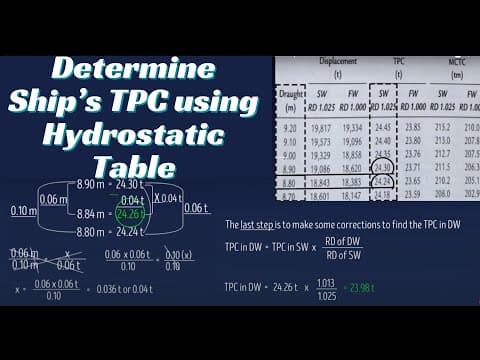
[5:32]The second example is: Determine the value of ship's TPC when she is floating in salt water at a draft of 8.84 meters. If I use the same hydrostatic table that I used in my previous example. As you look at the first column of the table, which is the ship's draughts. The given value is in every 10 centimeters. There is no draught of 8.84 meters. The next higher draught that can be found in the table is 8.90 meters, and the next lower draught is 8.80 meters. So to determine the value of TPC in salt water at a draught of 8.84 meters. We need to make some interpolation. But before I will proceed, I will show you some kind of hydrostatic table that might be available on board the ship. This is one kind of hydrostatic table that might be available on board. If you look at the table on the left side, the first column is the draughts which are given in every centimeter. Starting from the top, the given draughts are 12.00 meters, then going down to 12.01 meters, then going down again to 12.02 meters, and so on, with a draught interval of 1 centimeter. This is a very nice hydrostatic table provided by the shipbuilder, in which interpolation is not necessary to find the different values needed for trim and stability calculations. Here is another kind of hydrostatic table that might be provided by the shipbuilder onboard. In this kind of table, the interval of the ship's draught is every 2 centimeters, so by inspection, we can determine the ship's TPC easily without any interpolation. Let's go back to the second example. In this problem, I will use this kind of hydrostatic table, in which the draught interval is 10 centimeters. Just for the purpose of showing to those who are not yet familiar with the so-called interpolation. So we need the first and fourth columns of this table to find the ship's TPC in salt water. First, write down the draught of 8.90 meters, which is the next greater draught than 8.84 meters, then the corresponding value of TPC, which is 24.30 tons. Below the draught of 8.90 meters, write down the ship's draught of 8.84 meters, just leave more space between draughts because later, we will insert our unknown to find the answer to this problem. Then below the draught of 8.84 meters, write down the draught of 8.80 meters, which is the next lesser draught than 8.84 meters, and the corresponding value of TPC in salt water, which is 24.24 tons. Then get the difference of draughts 8.90 meters and 8.84 meters, the difference is .06 meter or 6 centimeters. Next get the difference of draughts 8.90 meters and 8.80 meters, the difference is .10 meter or 10 centimeters. Next, do the same on the value of TPC. Get the difference between value of TPC at a draught of 8.90 meters, which is 24.30 tons, and the value of TPC at a draught of 8.84 meters. But the value of TPC at a draught of 8.84 meters is what we are looking for.
[8:50]So let X will be the difference between the value of TPC at a draught of 8.90 meters and 8.84 meters. Then, get the difference between the value of TPC at a draught of 8.90 meters, which is 24.30 tons, and the value of TPC at a draught of 8.80 meters, which is 24.24 tons. And the difference is .06 tons, around 60 kilograms.
[9:22]We can now ratio and proportion the differences between draughts and TPCs. So .06 meter divided by .10 meter is equal to X divided by .06 ton. Then we will cancel both meter units, so the unit to our answer is tons. Then cross multiply, .06 times .06 ton is equal to .10 times X. In order for X to be left as required in this equation, we will transpose. So we will bring down .10 as a divisor of .10 times X. Then cancel both .10. We will also bring down .10 on the other side of equation. We have now X is equal to .06 times .06 ton divided by .10, which is equal to .036 ton or .04 ton, around 36 kilograms. This is a small value for big ships that can be neglected, but the purpose of this video is to show it to those who are not familiar with interpolation. So .04 ton now is the difference of TPCs between draughts 8.90 meters and 8.84 meters. We will now determine if we add or subtract .04 ton to the value of TPC at a draught of 8.90 meters, which is 24.30 tons, and the value of TPC at a draught of 8.80 meters, which is 24.24 tons. By inspection, the values TPCs are decreasing, so we will subtract our unknown X, which is .04 ton from 24.30 tons. So the value now of TPC at a draught of 8.84 meters, when the ship is floating in salt water is 24.26 tons.
[11:26]Always determine if interpolation is necessary or not. The value in this interpolation can be neglected for the bigger ships, but the purpose of this video is just to show to those who are not yet familiar on how interpolation is done. And you can use any method of interpolation in which you think easy and you are familiar with.
[11:47]I will now proceed to my third example. Determine the value of ship's TPC when she is floating in dock water with RD 1.013 at a draft of 8.84 meters. In my previous example, the ship is floating in salt water, but this time the ship is floating in dock water with relative density of 1.013 at the same draught, which is 8.84 meters.
[12:14]The first step is to determine the ship's TPC when she is floating in salt water at a draft of 8.84 m. And I have already showed you how to determine it in my previous example. And this is the procedure on how to determine the ship's TPC at a draught of 8.84 meters when she is floating in salt water. You can play the video back if you want to review how to do this procedure. The answer in the first step, which is the ship's TPC at a draught of 8.84 meters when she is floating in salt water is 24.26 tons. The second and last step in this problem, is to make some corrections to find the TPC in DW. And the formula is: TPC in dock water is equal to TPC in salt water, times relative density of dock water, divided by the relative density of salt water. So TPC in dock water with a relative density of 1.013 is equal to TPC in salt water, which is 24.26 tons, times the relative density of dock water which is 1.013, divided by the relative density of salt water, which is 1.025, is equal to 23.98 tons. So the TPC now of the ship at a draught of 8.84 meters, when she is floating in dock water with a relative density of 1.013 is 23.98 tons.
[13:41]This is for now guys. If you like this video, kindly hit the subscribe button and hit the notification bill. More videos will be coming about stability and trim soon. Thank you for watching.


