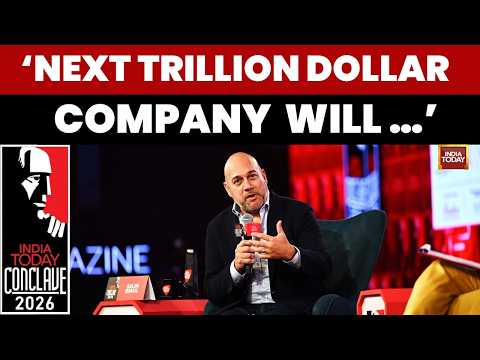
[0:00]The speaker here has spent years studying how the world's most powerful companies are built. He is a Hyderabadi who has spent a lot of time in Bandra, in Mumbai as well. Someone who has spent seven years in Silicon Valley, worked at Yahoo, and sold a company to Google. And among other developments in his life in recent years, he also did a workshop in Vatican. But today he is here as the founding Executive Director of the Singularity University, and the mind behind the idea of exponential organizations. Salim Ismail, thank you for joining us here on India today. Let's begin with the big opportunity. You have said, and I'm quoting you here, the world's biggest problems are the world's biggest opportunities. So what is the world's biggest problem right now? Well, we have, we have any number of big problems. First of all, wonderful to be here. I always love coming back to India. Um, when you look at the our grand challenges or the UN development goals, you have huge opportunities in healthcare, education, clean water, energy, etcetera. And what technology is allowing us to do is address those problems directly. And therefore those huge, huge problem spaces also become the world's biggest markets. If you can solve education, that's an eight billion person market. So it's education, health, climate change. Clean water, energy, poverty, hunger. All sorts of areas are enormously difficult. So which of these would be the next trillion dollar company? Or all of these? You'll see some in all of them, but the two I would expect the most to see in would be healthcare and education. Because those are very legacy industries that are stuck. For example, the model of a university is not changed in 450 years. It really needs an upgrade. And the way technology is accelerating, the entire secondary, post-secondary market in education is going to basically implode. You've spoken about immune system in legacy organizations. Are legacy organizations rejecting immune systems?
[2:37]And are these systems within the legacy organizations? They're within. What happens is if you try anything disruptive in a legacy environment, the antibodies attack you. Why? Because all of our organizations are designed to resist change and withstand risk, right? If you ask anybody who's the head of innovation at a big company, just turn them around, you'll see arrows in their back from all of the rejection efforts they've had from the antibodies in the company. This is why big companies have an enormous time innovating. This is why Facebook buys WhatsApp. This is why the car industry does not come up with Tesla. This is why Microsoft puts money into Open AI, rather than building it itself. A small nimble team will always outperform a big legacy organization. And as technology is accelerating, especially with what's possible with AI today, that goes 100X. So all disruptive innovation comes from individuals or small teams. And so when you try anything disruptive in a big company, you're stuck fighting the legacy, and that's bad in big companies, but it's worse in public sector where the existing policy is the immune system. So the phone call I got from the Vatican was, they called up and said, look, the Pope is trying to change the church and his immune system is 2000 years old. So can we have you come and have a conversation? So I did a half-day workshop with the Vatican, which was rather interesting. So tell us, tell us about this. A 2000-year-old immune system, how do you define that? Well, you know, this is, this is one of the oldest organizations in the world and it does not like change. Yes. Uh, yet you have the world moving quickly and moving past it. So I brought up problems like we have crisper where we can edit our own human genome. Well, what does that mean from a moral and ethical framework? We have, uh, uh, life extension coming. Where we're going to be expending, we'll be doubling human lifespan in the next 10 to 15 years. Their business model is about selling heaven. How are you going to sell heaven if people are not dying, right? That's a big challenge for in their particular case. And so you have these structural issues, uh, where they're not able to really think about that or deal with it, and most people don't see these big structural challenges. So, can I just take a quick diatribe on this? So there are two things happening in technology today that are completely unique, that we have never seen before in human history. The first is, we've seen computation accelerate via Moore's law now for 60 years. Okay? We have a dozen technologies now operating on that same platform, on that same foundational, doubling pattern. So drones are doubling every nine months in their price performance. AI today is doubling about every 10 weeks. That's the fastest moving technology we've ever seen. Now, each of these is doubling where they intersect, you add a whole other multiplier to the equation, right? So one thing that's happening that's completely unique is the fact that we have this many technologies all accelerating at the same time. But the second thing, I think, is even more important, especially important from an India context, which is the cost. So throughout human history, it's always been true that advanced technologies cost a lot. And only a government or a big corporate lab could do R&D, launch new products and services. Today, for the first time in human history, advanced technologies are cheap. Solar energy is cheap, sensors are cheap, blockchains are open source and free. So you now have what I call PDI permissionless disruptive innovation in a very profound way. Okay? I'll give I'll give you a specific example. In, uh, there's a, there's a car called the Vega. It's it's a 900 horsepower car, right? Um, uh, third fastest car ever created, designed, built, engineered in Sri Lanka, that hotbed of automotive innovation, right? Um, I love showing that example to German car executives, their brains absolutely melt. Because how is it possible on an island of fishermen and farmers, you can come up with something like that with no ecosystem, no investors, no education, no experience? And so this is what we're going to see an explosion of, and when you can do disruptive innovation at low cost, I think that fits perfectly into the Indian juggar capability, the psyche here, where if something can be done, we'll do it. And so I think we're going to see incredible things happen as a result of that. So it'll not be about capital, it'll be about coding then or disruption will be about a group of individuals coming together and ensuring that their brains and and their functionality meets. Yes, a single person using AI to write software is outperforming institutional capital today. Institutional capital. Oh, yeah. There's no way you can invest in anything like that. Look at something called open claw when you get a chance, uh, which is completely disruptive. Created by a hobbyist, and it's completely taking over the AI world right now. So then it it is, it is about speed, which matters more than size of a company. Thousand times. So in the past, all big companies are architected for two things, efficiency and predictability, right? If you're, if you're Pampers, you're trying to deliver the same diaper in a million locations, or that. But today you need to be architected for agility, flexibility, adaptably, the speed because the customer forecast that you thought you could make six months ago don't exist anymore today. So you need to be able to move with the market very, very quickly. Most big companies are not able to do this. So, um, uh, so in 1937, okay, an economist called Ronald Coase wrote a paper. And he theorized that the reason big companies exist is transaction costs inside a big company, are cheaper than outside a big company. And therefore they'll just keep getting bigger and bigger until that that equilibrium is met. He won the Nobel Prize for this paper that he wrote, okay. Uh, in the recent book that we wrote, um, we declare Koas's Law dead. Because if you try and get a website built inside your company, it's a thousand times more expensive than hiring a developer outside your company today. And today you can do it with AI for in eight minutes for at zero cost. So the transaction costs inside inside a big, any company today, are actually, uh, more expensive than the outside world. This is an existential threat. To big companies. To all companies. But especially big companies. So there is, uh, I'm, I'm writing a paper right now that I'm titling the organizational singularity. Because all our organizations, every single organization in the world pretty much dissolves now in the face of what's coming. Because today we do all of our workflows from a human to human perspective. Okay? If I a trucking delivery arrives, I have a human being signing off on it. Uh, I may digitize that, but it's still human, uh, detected. Then we take it into the warehouses, another sign off, then it makes it onto the production floor, another sign off. And we go human to human in all of our workflows. We're re-architecting our workflows to now go AI to AI, and we don't need the human in the middle. Too inefficient, and human beings are error prone, and they have politics, and they get sick, and they take vacations, and they unionize. All of that stuff. So what's going to happen is, we're going to automate all of our workflows with, especially in the knowledge work side, with AI, with the human being doing oversight, dashboard manufacturing monitoring, and exception handling. So I predict what will happen is you'll run a typical company with about one quarter of the employees that you do today, but if everybody freaks out about job loss, we'll end up creating four times more companies. So the next trillion dollar company will have perhaps 40 to 50 employees. Or less. Probably five. Just five. Yeah. There are already billion dollar companies being created with three people today. You you go back a hundred years ago, it took about 100,000 people to create a billion dollar company, okay? Then you got it down to about 10,000 people. Google did it with about a thousand people. Open AI did it with a couple of hundred people. Now we're down to about five. You have a presentation for us. I mean, I can I've talked through I've talked through a bunch of this, but I can very quickly. Uh, there's a picture of the book that I wrote. I do a podcast uh, every week or so with some interesting guests that we've had recently, where we talk about what's the latest breakthroughs in technology. Um, uh, this graph I think really shows it. Ray Kurzweil put this graph together showing Moore's Law, and he goes all the way back to 1900 and finds we've been doubling computational price performance for more than a hundred years. And the, uh, question he asked was why is that curve so smooth and so predictable? We've had wars and recessions and ups and downs in any industry, you should expect a very jagged stock market type shape. Yet you see this unbelievably predictable progression and it absolutely makes no sense. He spent 10 years researching this and came up with a very fundamental observation, which is once you take a domain, discipline, industry, area, product area, technology, you power it with information technologies, the price performance starts doubling. Most importantly, once that doubling pattern starts, it does not stop. It just keeps going. And we have a very difficult time cognitively with that. You can't have infinite growth, it has to level off. And the secret is in the different bands that you see there. Those are different technologies, like electromechanical, vacuum tubes, transistors. In computation, we've seen about five different technologies, each one is like an S curve, where a technology takes off, accelerates, reaches its upper limits. But if you have an information-based paradigm, we then design the next generation and and you keep going. So we're reaching the end of integrated circuits today, the chips are getting very hot down at the surface levels. We're down to what two nanometers wire thickness. Uh, but now we have a cluster of technologies on the edge, like 3D chip design, the matrix architecture that NVIDIA is using. Quantum computing is one candidate, which requires a lot of alcohol to discuss, so I won't, I won't get into it here. Salim, before you move on, a word on when you say end of technology, but haven't we reached a stage right now that AI is no longer a tool, it's becoming the organization itself? Yes, so what's happening is we've been using AI as a tool now, up till now. But now AIs are organizing by themselves to do things. And we're at a point of what's called recursive self-improvement, where the AIs are improving themselves to do the work. So you don't need humans in the middle anymore. What about imagination here? Imagination's still in the realm of human beings for now, but the AIs are getting really good at that. Okay. Let's move on. To the next slide. Oh, next slide. Okay. So, uh, the, um, this is the board of Xprize, where I have, where I have some rather interesting people there. Uh, these are some of the technologies that are all doubling in their price performance. So for example, in neuroscience, the speed at which we can image the human brain or the resolution is doubling every year. Drones are doubling every nine months in their price performance, etcetera, etcetera. And as I said, we've never seen this many happen at the same time. And we, uh, we wrote a book and teased out this model, saying if you want to organize for this new world, this is the model you have to follow. And so, uh, uh, hundreds and thousands of companies are using this model. Uh, you have five externalities on the right that allow you to scale very quickly, and five internal mechanisms on the left that allow you to manage the control framework and drive culture. At the, at the top, we have what's called a massive transformative purpose. What problem are you fundamentally solving? So that was the, the thesis of the book over the last 10, 12 years, but that thesis just broke. You have said that the most dangerous companies are startup that you have never heard of. Yes. Why do you say that? Because the, because of that democratization of innovation happening all over the world, people are now doing very breakthrough things in their garages at home, in their, in their office, etcetera, etcetera, and you don't hear about it until it's too late. So this is a very difficult time trying to navigate this. I referenced earlier this new, new capability called open claw, okay? It's a hobbyist Austrian developer who did this over a weekend, launched it, and now it's changing the entire AI world. Because he brought together a bunch of different capabilities into one structure, and everybody's building on it. Then should the industry not be worried about these disruptions? If a dangerous product is coming up in a garage, then shouldn't we be worried about these disruptions? Yes. You have to take on today the Bill Gates paranoia of healthy disruption or healthy paranoia where you assume you will be disrupted, okay? Because you can't see it coming. Let me give a little example of that. So over the last 20 years, if you owned a carwash in Buenos Aires, in Argentina, okay, turns out your revenues have dropped 50%. One of my I have a global community about 45,000 people all over the world following the book, etcetera. And one of my community members in Buenos Aires says this makes no sense. The middle class has exploded, we bought a ton more Mercedes and BMWs. Argentinians are very proud people, they like to keep their cars clean. Why is there a 50% drop? It should double or triple. Is there hyper competition? Are there water restrictions, or are there illegal issues? What's going on? So he looks into it and over a couple of months is able to get rid of all of the obvious factors and then he finds the answer which turns out literally to be Moore's law. Because of the increased computation ability over the last 20 years, we, we've become much better at modeling the weather. And over that 20 year period, we're exactly 50% better at knowing when it's going to rain. And when you know it's going to rain, you don't wash your car. Now, you can be the smartest carwash owner in the world and you will not see that coming, right? It doesn't matter how smart you are. And 50% drop is a pretty big number, you might consider closing up shop, right? That's the type of disruptive innovation that is going to hit us in industry after industry now. You can see what happened with Claude Code, two weeks ago, we lost hundreds of billions of off the software industry just from the release of a few plugins. Right? So this is going to start to accelerate in a very radical way. Uh, kind of a comet has hit, which is uh, or how you design for organizations around AI. The dinosaurs, which are basically all medium and large-sized companies, are now under threat. You'll see a Cambrian explosion of little furry mammals running around starting in the next little while. Among all the innovations that you've seen in recent years, what according to you is the most dangerous or the smartest? Well, AI is now by far the most disruptive technology we've ever seen. Why? Because it improves itself, and also, we're doing some surreal things right now with AI. For example, in the next year or so, we will solve all mathematics with AI. And I mean all, okay? It's already starting to happen. If you solve mathematics, it means you can solve physics. If you solve physics, it means you can solve material science. So the number, amount of breakthroughs happening is kind of incredible. I'll give you an example. There are, there are what are called dark labs right now. So imagine a lab of millions of test tubes and different compounds, and robots, uh, testing different combinations of these compounds, okay? Normally, in the past you had human beings running around testing different levels, etcetera. Now you have robots doing it. The robot is being run by AIs that are themselves coming up with the hypothesis. So this is a dark lab, it runs 24/7 with no human beings involved, and they're finding breakthrough innovation at the most unbelievable pace, and it's completely automated. So we're going to start to see a lot more of that happen, and all of the breakthroughs will start happening via these types of things. But humans would be needed for problem solving. Less, less people, but yes. Again, I'm not a, I'm not a job apocalypse person. I think we're going to be fine. You know, in the 1970s, we created bank ATM machines, right? And all, there was all sorts of hand-wringing. Oh my God, millions of bank tellers will be wandering the streets aimlessly. What will we do with all these people? Society will collapse, etcetera, much like you hear right now. What actually happened was the cost of running a bank branch dropped by about 10 times. The banks created 10 times more branches, the number of bank tellers has not changed at all. So what we found is whenever we have major automation and technology, we increase capacity, we don't lose jobs. Okay? So this is what we expect to see at the same time. However, it means you have to be unbelievably agile, innovative, uh, be willing to today, you're either the disruptor or you're disrupted. There's no middle ground, right? And doing nothing means you're disrupted. So it's a really interesting model to think about where we go next. So for any legacy organization or large corporation, what are the three, uh, big ideas according to you that will protect the immune system? Well, their immune system, you have to beat the immune system. That's we've, we've actually solved that problem. We crafted a 10-week, uh, engagement that we piloted with Procter & Gamble, and said, let's see if we can hack culture at scale. We've done it now a hundred times with big companies around the world. So you have to do something like that to solve that, that immune system response so it doesn't attack new ideas. Then what you need to do is, is on the edge of your organization, create an AI native digital twin that's completely AI-based. And little by little move workflows over to it. Do not try and fix your existing organization. It cannot be done, okay? I've seen about 400 major corporations around the world attempting innovation in all sorts of different ways. Uh, I've only ever seen one model work, which is you take your crazy people in your company to the edge, and you build at the edge into adjacent areas. Uh, a great example would be Nespresso. Nestle ran Nespresso as a line of business for three or four years, failed miserably. They finally put it on the edge of the organization, and boom, every hotel room in the world has an espresso machine. Right? So that's the model that we'll start to see emerge now. We're starting to see it already. You see Facebook buying Instagram and WhatsApp and leaving it on the edge, not trying to bring it into the mothership. If you try and bring it into the mothership, you will kill it. More such examples, please. Oh, um, uh, this is why Google built Google X. Yes. Larry Page came to me a few years ago and said, hey, your unit at Yahoo is very successful, should I do that at Google? I said, no, you'll have this immune system response, but do something like it, keep it stealth, keep it at the edge of the organization. And so they have their information capabilities at the heart, but then do disruptive things at the edge. Google car, Google Glass, contact lenses, etcetera. The master of this technique for a long time has been Apple, okay? Uh, what they do is they will form a small team that's very disruptive. They will put the team at the edge of the organization. They will keep them secret and stealth, and they will say to that team, go disrupt another industry. Whether it's watches or payments or retail or whatever. At last count, they had about 18 teams looking at different industries. Now, even Apple has completely messed it up with AI. They've not had a reasonable response to AI for the last several years. Anybody trying to use Siri today, you'll see exactly what I mean, right? A complete mess. They will get very lucky because it turns out the Mac mini hardware is perfect for running these localized AI models, so they'll get very lucky there. But in general, uh, they're they're operating on a very clunky model. But that's the only path that we see forward. It then becomes doubly important when you think about, you know, I talk about immune systems in companies, but public sector is even worse, where the existing policy is the immune system. So we do a lot of work with governments helping them get through that thinking because there you have to solve that problem, and how do you do this type of disruptive innovation in legacy organizations and public sector? So what was the advice that you gave to the Vatican that's 2000 year old immune system? Well, uh, we actually did a workshop there, and it was actually quite successful. They were much more, uh, aware of some of these ideas than I thought they would be, uh, and the outcome was actually very powerful, except they were a little freaked out. They they told me, there maybe not since Copernicus has that much disagreement with the church been presented inside the Vatican, which was quite something. I said, wow, you guys, you people need to get out more. Um, uh, so, uh, but even those legacy organizations are starting to learn how to think about this. All right, we have really come to the end of this discussion, but before I let you go, a word on, what do you think will be the next innovation order and who will be building it? Who will be building it? I just told you, we have no idea who's going to be building it, but I will give you a couple of thoughts. Um, I think we're going to use AI to make some unbelievable breakthroughs in all sorts of areas. For example, I have my degrees in theoretical physics. There's been a problem in theoretical physics called the Grand Unification Theory for the last a hundred years. People have been trying to solve it. I predict we will solve the Grand Unification Theory in the next few months. That'll be solved, finally. It will be solved. Which is kind of a big deal. And who will solve it? We do not know. We don't know. It's going to be some, uh, graduate Indian student. Maybe sitting somewhere here. Maybe sitting somewhere here. All right, Salim Ismail, thank you so much.


