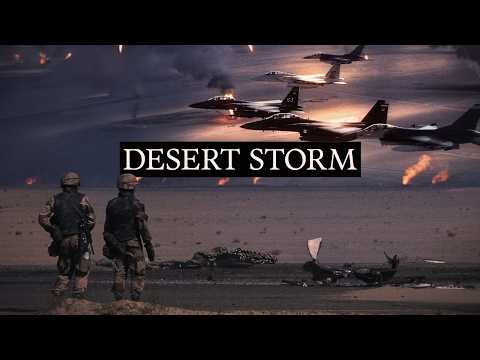
[0:00]On August 2nd, 1990, Saddam Hussein stuns the world when Iraq invades Kuwait in a surprise attack. But six months later, the Iraqi army is on the run from US-led coalition forces in the first Gulf War. So how does Saddam's victory in Kuwait unite Western, Arab, and even Soviet states against him, and lead to a crushing defeat in just 100 hours of war?
[0:30]In 1988, Iraqi President Saddam Hussein signs a ceasefire ending a bloody seven-year war with Iran. Iraq had suffered 600,000 casualties, achieved limited gains on the battlefield, and now faces crushing debt. Baghdad owes foreign creditors 80 billion dollars and it will cost 230 billion dollars to rebuild destroyed regions. His million-man army, the fourth largest in the world, costs an unsustainable 40% of annual GDP. There's high unemployment, and perhaps worst of all, oil prices are low. Saddam wants OPEC to raise them, but the United Arab Emirates and Kuwait refuse in order to protect their own profits while depressing prices. For Hussein, these are major threats to his rule. He depends on high military and social spending, and cuts might provoke unrest or lead to internal challenges. Already, throughout the 1980s, Saddam has violently repressed often Shiite minorities, such as the Feili Kurds, for their supposed support for Iran. But the solution to his security and financial woes might come from a much smaller neighbor. Kuwait holds 10 billion dollars of Iraqi debt and overproduces oil, so Saddam reasons that he can demand cash and debt cancellation to solve his financial crisis. He also pressures the Gulf states, claiming that the Iran-Iraq war protected them from radical Islam, and that Iraq therefore deserves financial compensation. In February 1990, Saddam urges Jordan and Egypt to pressure the Gulf States for 30 billion dollars in exchange for regional stability. To make his threat clear, Iraq holds military exercises on the Kuwaiti border. In May, Saddam increases the pressure even more at a Baghdad summit. For every single dollar drop in the price of a barrel of oil, our loss amounts to 1 billion a year. War is fought with soldiers, but it is also done by economic means. Therefore, we would ask our brothers who do not mean to wage war on Iraq. This is in fact a kind of war against Iraq. We have reached a point where we can no longer withstand pressure. The Amir of Kuwait calls Saddam's demands absurd. Frustrated, Saddam turns to military solutions. On July 15th, three Iraqi divisions of 35,000 troops and over 300 tanks move towards the Kuwaiti border. Saddam declares Kuwait is conspiring with quote World Imperialism and Zionism and legitimizes military action as protecting the Pan-Arab nation. The Kuwaitis reject what they call threats and extortion. The Gulf States, worried about escalation, ask the United States not to respond too strongly. On July 17th, the US confirms it will uphold the sovereignty and integrity of the Gulf states. It fears Iraqi dominance in the region will jeopardize oil security, threaten Israel, and undermine the sovereignty of other smaller, oil-rich nations. By July 27th, the Iraqis have 100,000 troops on the Kuwaiti border, but the threat is widely dismissed as pure coercion. All the assurances we got said not to worry, yes there's a bit of a problem, yes the Iraqis are posturing, but they would not attack an Arab brother, you should not worry about this. But the US and others have misjudged Saddam's intentions. On August 2nd, 1990, his troops move into Kuwait. At 2 a.m., the Iraqi Hammurabi and Medina armored divisions cross the border with 1,000 T-72 tanks, while Iraqi Republican Guards commandos land in Kuwait City by helicopter. They face minimal resistance from Kuwaiti garrison troops and the small air force. By the end of the day, the Amir of Kuwait flees, while his brother is killed protecting the royal palace. 48 hours later, Saddam fully occupies Kuwait, stealing 2 billion dollars from the Kuwaiti Central Bank and doubling Iraqi oil reserves. The UN Security Council unanimously denounces the invasion and demands Iraqi troops withdraw. Saddam hopes a rapid victory will prevent opposing forces from mobilizing, but instead it draws Western, Soviet, and Arab leaders together. By invading, Saddam loses credibility with Egyptian President Hosni Mubarak, and the overthrow of a Gulf monarchy alarms the kings of Saudi Arabia and Jordan. Above all, Iraq has disrupted the balance of Middle Eastern oil production and put national incomes at risk. In the West, Saddam's invasion is seen as blatant aggression against the friendly state. American defense officials also worry Iraq might attack Saudi Arabia, which would further threaten oil supplies. It's a stark turnaround from limited US support for Iraq during the Iran-Iraq war just a few years before. Even in Moscow, a former Iraqi ally, the invasion is a surprise. Like the Americans, the Soviets have investments in Kuwait. Soviet Premier Mikhail Gorbachev informs Saddam that the Soviets will not support him. Iraq has conquered Kuwait, but with powerful and neighboring states turning on Baghdad, Saddam's strike now looks like a reckless gamble. On August 6th, the UN imposes an embargo on Iraq, which relies on oil for 90% of its national budget. The same day, King Fahd of Saudi Arabia allows American troops to deploy in Saudi territory to deter Iraqi aggression. For the moment, it's doubtful that Saddam actually intends to invade Saudi Arabia, but the Saudis are rattled by events. On August 8th, American President Bush addresses the nation. In my direction, elements of the 82nd airborne division, as well as key units of the United States Air Force, are arriving today to take up defensive positions in Saudi Arabia. I took this action to assist the Saudi Arabian government in the defense of its homeland. First, we seek the immediate, unconditional and complete withdrawal of all Iraqi forces from Kuwait. Second, Kuwait's legitimate government must be restored to replace the puppet regime. Saudi Arabia agrees to host and supply US-led coalition forces. Jordan is opposed to Iraq's growing power and bears the brunt of refugees fleeing Iraq amid the fear of an escalating conflict. So they and other Arab states offer support and troops to the coalition as well. British Prime Minister Margaret Thatcher is eager to intervene, while France is outraged after Iraqi troops storm the French Embassy in Kuwait and also joins. As up to 200,000 Kuwaitis and other nationalities flee into Saudi Arabia, they bring with them claims of widespread looting and killing, which provides an additional moral basis for intervention. Plenty of the soldiers came to our house. They were searching for guns, anything that make us Kuwaiti, that means we are Kuwaiti. They took everything, passports, ID, everything you had. However, widely reported testimony of Iraqi troops killing babies by removing them from incubators are later exposed as fabrications of the Kuwaiti public relations campaign. Saddam tries to split the growing coalition before it can fully mobilize. First, he hopes to separate the Arab states by claiming that Israel, which most consider an enemy, controls the United States. Israel deliberately stays out of the coalition to avoid provoking the Arab members, though. Second, Saddam takes hundreds of foreign nationals from 49 different countries as hostages. He says he'll guarantee their safety if the US and its allies don't attack Iraq, but the move backfires as it pushes the coalition towards military action. Meanwhile, more countries pledge support to the coalition from single planes and ships to financial assistance and troops. In total, 42 countries join with the United States, UK, France, Saudi Arabia, Egypt, and Kuwait taking the lead. With the coalition building up forces, Saddam orders his army to build defensive positions around Kuwait, and the line in the sand is drawn. To support the coalition, a massive logistical operation is underway in Saudi Arabia, called Desert Shield. Saudi ports are at maximum capacity as American military shipments arrive 24/7. Engineers build new highways for thousands of convoys and equipment from 1,000 cargo planes. Within 90 days, the US alone ships ammunition, uniforms, medical equipment and food for 157,000 troops, along with tanks, artillery, helicopters, and combat aircraft. The US military prepares a 1,000 square kilometer training area for acclimatizing the troops. The entire operation consumes more than 75 million liters of fuel every single day. Alongside this massive American force, Egyptian, Syrian, Saudi, and British divisions also begin deployment with support from other allies. Meanwhile, 10 Iraqi divisions dig in along the front line in depth, including trenches filled with oil, large minefields, and artillery pre-sighted at choke points. Saddam's elite Republican Guards Corps provides the strategic reserve, while regular Iraqi divisions garrison the front line. Saddam, thinking of the Vietnam War, hopes that casualty-averse Western nations won't be willing to risk attacking well-fortified defenses. On December 6th, he announces the release of all remaining foreign hostages in an attempt to stop the coalition from launching an attack. Instead, the UN sets a deadline for him to withdraw by January 16th, 1991. Some coalition partners are concerned Saddam may now only partially withdraw, retaining some influence in Kuwait, but delegitimizing a coalition intervention. Secretary of Defense Dick Cheney underlines the US is ready to strike. That doesn't mean a partial withdrawal, that doesn't mean he gets to keep 10% or 20% or 30% of what he stole. It means the full, complete, total withdrawal of Iraqi forces from Kuwait, and that he needs to be aware that the President will have available to him a full spectrum of capabilities. And where Saddam Hussein foolish enough to use weapons of mass destruction, the US response would be absolutely overwhelming and it would be devastating.
[10:50]In the end, Saddam ignores the ultimatum, since he's determined to hold onto his conquests, despite the looming coalition threat of military action. The coalition now launches Operation Desert Storm. At 3 a.m. on January 17th, 1991, coalition forces begin a massive air campaign over Iraq. 2,430 coalition aircraft, including 323 American carrier-based planes, take to the skies. Iraq's air defense network of hardened bunkers, anti-aircraft guns, surface-to-air missiles, and 300 interceptor aircraft is hard pressed to stop them. First, Apache helicopters and missiles target Iraqi radar installations, blinding anti-air defenses and allowing for the main attack. In the first day, the coalition launches over 1,300 sorties, including with F-117 stealth jets. Over the first three days, they suppress the Iraqi Air Force, targeting 44 airfields and over 500 aircraft shelters. Surviving Iraqi jets flee as the coalition secures air supremacy. Lieutenant Colonel Waldo B. Cummings Jr. describes his first mission. As we penetrated Iraqi airspace, I looked down and saw the biggest light show I had ever seen. Continuous lines of red and orange tracers covered the black void below us. It seemed that every Iraqi who could put his finger on a trigger had pressed down and wouldn't let go. [...] They were surface-to-air missiles fired blindly in the hope that one would hit something. Several miles from the target, I pushed the nose of my aircraft down into a 30-degree dive as "Condor," my bombardier / navigator, picked out his aim point on the radar. [...] The target below was engulfed in flames and secondary explosions. Baghdad is hit hard with bombs and cruise missiles, including strikes on Iraq's presidential palace, government ministries, and Saddam International Airport. Confused by decoys and targeted with anti-radar bombs, Iraqi defenses down just 12 American aircraft in the entire campaign. Iraqi front-line troops are worried about what's going on at home, as one soldier from three Corps noted in his diary. One says they have destroyed Baghdad and demolished it. Others come to pacify you saying nothing has happened there - they have only bombed the military installations. Others say they have bombed the civilian buildings. You don't know who to believe and who is lying. All news reports are hallucinations. They are all lying. The truth is lost. In response to the coming coalition invasion of Kuwait, the Iraqi military sets demolition charges on hundreds of Kuwaiti oil wells to destroy Kuwait's infrastructure. Some oil wells are also hit during the aerial bombing campaign. The thick smoke covers the entire area, causes massive pollution, and darkens the sky even during the day. Iraq also unleashes its arsenal of tactical Scud missiles. On January 18th, they launched the first of 86 Scud missiles at Israeli and Saudi Arabian civilian and military targets. Saddam hopes to fracture the delicate coalition by drawing Israel into the conflict against the wishes of the US and Arab States. US Commander General Norman Schwarzkopf, though, downplays Scud's military significance and claims Israel well understood the provocation. nature because, you know, I frankly would be more afraid of standing out in a lightning storm in Southern Georgia than I would be standing out in the streets of Riyadh when the Scuds are coming down. If it's going to hit you, it's going to hit you, but the percentages are so much less. I think the State of Israel understands that the exact objective Saddam is trying to obtain by attacking them with Scuds is to bring them into this war. And if they were to come into this war, they are in fact doing exactly what Saddam wants them to do, and that's certainly not in the best interest of everyone involved. Despite the Scud's inaccuracy, the Israelis take the threat seriously and take precautions. Ultimately, they stay out of the conflict, partly because the US pledges billions of dollars of military aid and sends Patriot air defense batteries. Schwarzkopf also sends out SAS and Delta Force teams to hunt down the Scud launchers. Saddam also takes other steps to provoke the coalition into costly attacks, launching a cross-border raid into the Saudi town of Khafji on January 29th. Although the Iraqis briefly occupy the town, coalition forces backed up by overwhelming air power quickly recapture it. The Khafji battle illustrates the power of coalition air power, which now goes on a theater-wide offensive. From January 24th to February 24th, 40,000 attack sorties target command centers, naval installations, oil facilities, electric infrastructure, logistics, and Iraqi troops within so-called kill boxes. These pre-established sections of the front line are assigned to aircraft, which can rapidly respond to strike targets. Up to 80,000 Iraqi conscripts desert under the bombardment, which also destroys 1,385 Iraqi tanks, 930 other armored vehicles, and 1,155 artillery pieces. On February 24th, 500,000 coalition troops with 340 attack helicopters, 2,000 tanks, and 2,000 armored vehicles move in, supported by massive air and sea barrages. They plan a large left hook movement to cut off Kuwait and the Iraqi army from behind. American Central Command, Centcom, takes charge of the Western approaches with American, British, and French forces. Arab and American marine units focus on the east. Meanwhile, marine landing craft prepare a fake amphibious landing. The ruse keeps two Iraqi divisions on the coast when the coalition force attacks. In the West, the French Sixth Light Division and American airborne divisions push forward rapidly. The 101st Airborne alone attacks over 270 kilometers into Iraq, using over 300 helicopters. Iraqi troops on the front line are demoralized after weeks of brutal air attacks and high rates of desertion. By evening, airborne forces have already cut Highway 8 between Baghdad and Kuwait, moving so quickly that Iraqi troops offer little resistance and often surrender en masse. In the center, American and British units launch direct attacks. Their goal is to take the Iraqi logistics hub of Al Busayyah and then turn east to encircle the Iraqis. Tanks mounted with bulldozer blades push through Iraqi berms and plow tons of earth into Iraqi trenches, burying some soldiers alive. Cutting 24 routes through the minefields, they create a 16 kilometer breakthrough zone. Iraqi armor and artillery, devastated by air attacks, is unable to respond effectively. Marine divisions push through rain, fog, and the choking black smoke of Iraqi oil trenches lit by American napalm. They break through Iraqi defenses and over 3,000 Iraqis surrender almost immediately. The First Marine Expeditionary Force advances over 30 kilometers into Kuwait, takes over 10,000 prisoners, and captures Al Jabar Airfield. By the end of February 24th, coalition troops break the Iraqi front line, but the fight isn't over yet. The Iraqi Republican Guard Corps in reserve now deploys to stop the coalition from breaking into the rear. Overnight and throughout the next day, coalition forces advance across the front. Syrian, Egyptian, and Saudi forces are slower, but push forward with the support of the US First Cavalry Division. The marine divisions fight off large Iraqi counterattacks with minimal casualties. In one of many tank battles, 13 M1A1 Abrams tanks destroy 35 Iraqi tanks in just 90 seconds. American armor proves more than a match for Iraqi T-55, T-60, and T-72 tanks. With a 120 mm main gun and depleted uranium armor-piercing rounds, the US M1A1 Abrams can penetrate the armor of any Iraqi tank.
[18:58]But the fires also cause problems for coalition forces. On February 26th, as the coalition continues to encircle Kuwait, on the flank of another massive tank battle, American armor collides with forward elements of the Iraqi Republican Guards Tawakalna Division. In thick smoke from the oil fires, paired with strong desert winds, aerial reconnaissance is hampered and ground visibility is low. American Bradley APCs and Abrams tanks fight against Iraqi BMPs and T-72s at very close range. Only on the 27th is the coalition able to break through for good. Two American soldiers are killed in the battle, both by friendly fire. American armor overruns Iraqi positions, destroying 30 T-72 tanks in fortified positions. American radar also tracks Iraqi artillery positions, and US guns destroy them with counterbattery fire. The rapid pace of the advance surprises the Iraqis, who were expecting a direct assault from the south rather than the west. weapons are placed We're located about right here at this uh Northwest northeast cloverleaf. We swung up and come right through here by the airport, came around and hit them from behind. And because when we came over these these positions around here, most of them were going in towards the south right there, expecting us to come up right through the city. There was not a whole lot of resistance. We hit him at night and they they weren't able to really uh shoot at us or see us at night.
[20:26]By the end of February 26th, coalition forces have defeated 24 Iraqi divisions. As Iraqi troops retreat from Kuwait City, they're trapped on the highway to Baghdad by coalition air power. Hundreds of stolen cars and military vehicles clog the road as mostly US planes strafe and bomb the column into twisted wreckage. Images of the so-called Highway of Death make headlines around the globe. Some Iraqi soldiers have already abandoned their vehicles, but many others are killed. The next day, the 24th Division captures the Talil and Jalibaa air bases, despite Iraqi resistance. Highway 8 sees its own Highway of Death scenes as coalition aircraft ambush panicked Iraqi armor and soldiers, attempting to flee or redeploy to the West. The Iraqi army has almost completely collapsed under the coalition assault. American, Saudi, and Kuwaiti units move into Kuwait City, and the Amir of Kuwait requests his own troops enter the city as the main liberators. Before the Kuwaitis can rebuild their destroyed infrastructure, they still have to put out the oil fires, which will take months. The Iraqi army is reeling and Saddam Hussein's regime is shaken, but it's still intact. As Saddam's forces retreat into Iraq, President Bush and the coalition need to make a decision. The war isn't over, and fleeing Iraqi forces are regrouping. But the coalition's purpose is to eject Iraq from Kuwait, not pursue them into Iraq or overthrow Saddam's regime. It's likely some coalition partners, especially Arab States, oppose an invasion of Iraq. One possible solution is to support regime change. With Saddam's rule in crisis, previously repressed ethnic and religious minorities sense an opportunity, and the US encourages them. Radio station The Voice of America promotes uprisings in mid-February, which President Bush reiterates on February 24th. Partly encouraged by such statements, a diverse range of groups in Iraq begin to mobilize against Saddam. Then, on February 28th, the coalition and Iraq agree to a ceasefire. Bush now makes it clear the coalition's objectives have been achieved, and combat is over. Iraq's army is defeated. Our military objectives are met. Kuwait is once more in the hands of Kuwaitis, in control of their own destiny. I am pleased to announce that at midnight tonight, Eastern Standard Time, exactly 100 hours since ground operations commenced, and six weeks since the start of operation Desert Storm, all United States and coalition forces will suspend offensive combat operations. In early March, in Basra, disgruntled Iraqi soldiers, including many Shiites, turn against government troops, buildings, and prisons. With the support of much of the Shiite majority city. The partly spontaneous revolution soon spreads to other Shiite cities in the south. In the north, Kurdish Peshmerga militias also rise against Saddam. Helped by army defections, they seize most northern Iraqi cities often without a fight. Unlike the Basra-based revolution, the northern uprising has a more organized political agenda, including democracy for Iraq. Soon, there are revolts in 14 of Iraq's 18 provinces. The coalition members disagree, though, on how to react. The US prefers a coup but wants an intact Iraq to keep arch-enemy Iran in check, rather than have the country break up. Eventually, they send humanitarian aid, some limited ground forces in support of the Kurds, and establish two no-fly zones over Iraq. Baghdad and Sunni-majority cities in the so-called Sunni Triangle largely remain loyal, as does the well-armed and mostly intact Republican Guard. Both the northern and southern uprisings are made up of many different political organizations, interest groups, and religious and ethnic groups. Although united on the overthrow of Saddam, they can agree on little else, including a power-sharing deal offered by Saddam on March 7th. By late March, Saddam's loyalist troops are on the offensive. Against fragmented revolutionary organizations, they crush many of the uprisings by early April. They use tanks and helicopter gunships not destroyed by the coalition earlier and permitted in the ceasefire agreement to suppress the lightly armed rebels and kill fleeing civilians. There are also widespread claims of the indiscriminate use of chemical weapons. The few remaining US troops in Iraq, near the Kuwaiti border, do not interfere directly, but they destroy captured arsenals to prevent them from getting into rebel hands. Some northern Kurdish groups do hold out, eventually creating an autonomous Kurdish region under the protection of both Iran and the no-fly zone. Some revolutionaries feel betrayed by the lack of expected US support. I think we are disappointed really, not only by them, but also by the allies position. We think that during the war, everybody knew that Saddam Hussein is the cause of what happened in the Gulf, and they, even some of them, they ask Iraqi people to uprise, to go up and get rid of Saddam Hussein. But when the Iraqi people got up and had uprising in all parts of Iraq, they got away, and they say this is an internal affair, we don't interfere. The situation is made worse by the continuation of the economic embargo, which damages Iraq's economy and public health. After Saddam's victory over the rebels, some influential Iraqi exile groups will pressure the US to finish the job started in 1990. For the coalition in February 1991, the Gulf War almost seems like the perfect intervention. Casualties are low, public support remains high, its political objectives are rapidly achieved, and they built and maintained a diverse global coalition. The casualty count is a testament to the lopsided nature of the conflict. The coalition loses 292 killed and 776 wounded, roughly half through friendly fire or accidents. The Kuwaiti army loses 420 killed and 12,000 captured. Estimates for Iraqi numbers are 20 to 50,000 killed, more than 75,000 wounded, and 80 to 175,000 captured. Over 1,000 Kuwaiti civilians are killed or missing, and over 3,000 Iraqis are killed during Desert Storm and Desert Shield. A further 5,000 Iraqi troops and loyalists are killed in the Iraqi uprising, while up to 180,000 civilians and rebels are killed by government action or starvation. Coalition veterans begin to suffer from so-called Gulf War Syndrome, with symptoms similar to chronic fatigue or nerve gas poisoning. There's still debate about its causes, with theories suggesting oil well fires, depleted uranium rounds, anti-nerve agent drugs, or exposure to nerve agents on the battlefield, either via deliberate Iraqi use or the destruction of Iraqi facilities. Up to 250,000 US veterans, over a third of the combat force, report symptoms. Operation Desert Storm liberates Kuwait, but doesn't stop Saddam from cracking down on internal opposition, and leaves him with the tools to do so, killing and displacing hundreds of thousands. Most of the coalition troops leave in 1991, though a few stay behind to maintain some control over Saddam's regime and prevent Iraq's total collapse. The Gulf War has created new and complex problems, and immediately, there are voices in the US government dissatisfied with the results, which they will try to rectify in the future. Saddam's invasion of Kuwait happened just as the Cold War was ending, and it was in that moment that the superpowers of the world agreed in the UN Security Council. Something that would have been unthinkable just years earlier. Mikhail Gorbachev was trying to modernize the USSR, but ultimately failed. Some argue in part because of the economic cost from the Chernobyl disaster of 1986 and its aftermath. If you're interested in this topic, we produced an entire documentary series about it from the first Soviet atom bomb to the Atom Cities like Pripyat and beyond. And where can you watch Red Atoms? On Nebula, a streaming platform we're building together with other creators, where we don't have to worry about advertising guidelines or the Almighty algorithm. On Nebula, you can just watch Red Atoms or our other exclusive World War II series 16 Days in Berlin and Rhineland 45 in 4K resolution. You can watch all our content there ad-free and earlier than on YouTube, and that's not just in your browser. Nebula is available on smartphone, Apple TV, Roku and more. If you go to nebula.tv/realtimehistory, you can get an entire year of Nebula for just 36 dollars. And if you really want to support what we're doing on Nebula, the Nebula Lifetime Membership is available again for 300 dollars. If you sign up at nebula.tv/realtimehistory, 1/3 of this amount will directly support us here at Real Time History, and the rest will help develop bigger Nebula original documentaries in the future with bigger budgets. The lifetime membership is about supporting us and Nebula so we can realize even better history videos. By the way, this option is also available for existing Nebula subscribers. So head over to nebula.tv/realtimehistory and support us here at Real Time History directly. We want to thank Michael Adato for his help with this episode. For more Middle Eastern history, check out our video on the Six Day War. If you're watching this video on Patreon or Nebula, thank you so much for the support. We couldn't do it without you. I'm Jesse Alexander, and this is a production of Real Time History.


