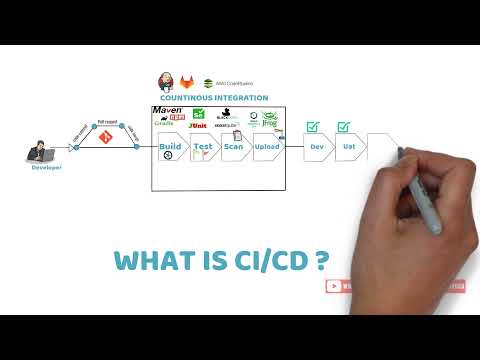
[0:00]Before understanding GitLab CI CD, let's quickly see what exactly is CI CD. Let's say you have a developer who performs code commit on one of the feature branch. A pull request is then been created for the code merge. Once it is approved, the code is merged to the deployment branch, which triggers the build creation using tools such as Maven, Gradle, NPM. Once the build is created, it triggers the test cases using tools such as Selenium, JUnit, and the test cases gets uploaded to the required tool. Then it triggers the security vulnerability checks along with the static code analysis using tools such as Black Duck, SonarQube. Then the builds gets uploaded to a build repository such as Sonatype Nexus, J Frog Artifactory. This completes the process of continuous integration. And to integrate this together, we have tools such as Jenkins, AWS Code Pipeline, GitLab CI. Then as part of deployment, it triggers the deployment to the dev server. Once the sanity is passed, the deployment gets triggered for the UAT server. Once it is reviewed and the sanity gets passed, then the prod deployment gets triggered. And once that is passed, this complete process is completed, which is called continuous deployment or delivery. And it can be done with the tools like Ansible, Helm, AWS Code Pipeline. The difference between continuous deployment and delivery is continuous deployment needs some manual trigger before the prod deployment, while continuous delivery is an automated part of the deployment life cycle. It is followed by continuous feedback and monitoring at all the stages, build, test, scan, upload, dev deployment, UAT deployment, and prod deployment. This completes one release cycle, but this is a never-ending and a continuous process.
CI CD Pipeline Explained in 2 minutes With Animation!
Tech Tutorials with Piyush
2m 1s288 words~2 min read
YouTube auto captions
Transcript source
YouTube auto captions
This transcript was extracted from YouTube's auto-generated caption track. The transcript below is server-rendered so it can be read, searched, cited, and shared without opening the original YouTube player.
Pull quotes
[0:00]Let's say you have a developer who performs code commit on one of the feature branch.
[0:00]Once it is approved, the code is merged to the deployment branch, which triggers the build creation using tools such as Maven, Gradle, NPM.
[0:00]Once the build is created, it triggers the test cases using tools such as Selenium, JUnit, and the test cases gets uploaded to the required tool.
[0:00]Then it triggers the security vulnerability checks along with the static code analysis using tools such as Black Duck, SonarQube.
Use this transcript
Related transcript hubs
Watch on YouTube
Share
MORE TRANSCRIPTS


