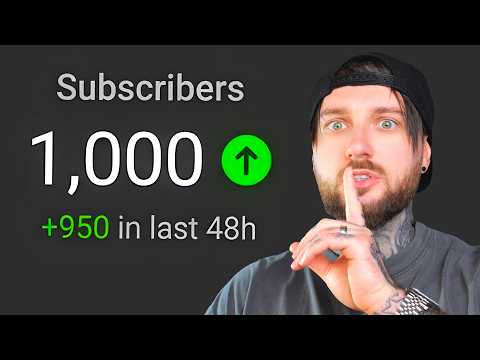
[0:00]Most people think that getting 1,000 subscribers is about convincing 1,000 people to subscribe, but that's the wrong way to think about it. Because a viewer usually doesn't subscribe just because they liked one video, they subscribe when their brain starts thinking, okay, this person keeps making videos that are for me. And that's a completely different game. The fastest way to hit 1,000 subscribers is not to beg people to subscribe. It's not to add a subscribe animation every 30 seconds, and it's not to hope one random video goes viral and fixes your channel. The fastest way to hit 1,000 subscribers is to make one viewer watch one video, then another, then another until subscribing feels like the obvious thing to do. Because the moment a viewer watches more than one video from you, something changes. You're not a random creator anymore. You become familiar. They understand what your channel is about. They understand what kind of feeling they get from you. And instead of asking, should I subscribe to this person, they start asking, why wouldn't I? This is where most people get it wrong. They keep posting random videos and hope one of them finally works. One video is one topic, the next is something else, the next one is copied from a trend, and the next one, it's something they made because they had no better idea. And yes, maybe one of those videos gets some views, but the viewer watches it, maybe enjoys it, and then leaves. Because they don't understand what they would be subscribing to. So, in this video, I'm going to show you what I would do if I had to hit 1,000 subscribers as fast as possible, no matter what kind of channel I had. Vlogging, gaming, history channel, faceless creator, cooking, comedy, fitness, anything. Because the path I'm about to show you works the same way for all of them. I would build a simple subscriber path. A path where the first video grabs attention, the second video builds trust, and the third video makes the viewer feel like, okay, I need more of this. And 1,000 subscribers is not just a random number. YouTube's partner program path uses 1,000 subscribers to get you monetized. So, if you reach 1,000 subscribers together with 4,000 valid public watch hours, you can get monetized. But here's the problem. Most people try to reach that number in the worst possible way. They refresh YouTube Studio every day. They watch one video about thumbnails, then they watch one video about how to write the best tags, another video about shorts, and then another video about the best posting time on YouTube. They keep thinking there must be one trick they are missing. But most of the time, they're not missing a trick. They're missing a path. Let me explain it with something simple. Imagine you walk in a gym for the first time and someone tells you, if you want to get in shape, just do one perfect workout. That sounds stupid, right? Because everyone knows one workout doesn't change your body. Even if it's a great workout, even if you sweat a lot, even if it feels amazing, your body changes because you come back again and again. That's a path. YouTube works the same way. One good video can help. One viral video can give you attention, but one video alone does not build trust. Trust comes when the viewer sees you again and then again, and every time they see you, they get something they wanted. That's when they start connecting your channel with a feeling. A feeling of fun, a feeling of comfort, a feeling of curiosity, a feeling of being entertained, whatever it is, your channel becomes the place they go to to get that feeling. This is why a lot of creators get confused. They say, but I had a video get 10,000 views and I barely got any subscribers. The reason it's simple. Views are not the same as trust. A view means someone gave you a chance. A subscriber means someone believes the next video from you might also be worth their time. That is a much bigger decision. And there's a simple thing about how humans behave. Once we take a small step towards something, we naturally want to take the next step. Think about how this applies to YouTube. The first time someone watches your video, it's not a big commitment. They clicked, they watched a little, maybe they liked it, but if they watch a second video, something changes. They're not just sampling random content anymore. They are starting a small relationship with your channel. By the third video, their brain starts to build a pattern. I watch this person because they make me feel something I like. That pattern is where subscribing starts to feel natural to them. So, if I had to start from zero, I would not ask, what video can go viral. I would ask, what type of person do I want to entertain, teach, or move emotionally? And what three videos would make that person trust me? That's the whole game. You don't need the whole world to care about you. You need a small group of people to feel like your channel is exactly what they were looking for. Because once you reach 1,000 subscribers on YouTube, growing becomes easier. The algorithm trusts you more, the algorithm understands your channel, the viewers understand your channel, and now you also have a group of people who will watch your next upload, which gives you a better chance at growing your video. And the fastest way to get there is to stop trying to appeal to everyone and start building a clear experience for one type of viewer. For example, don't say my channel is about gaming. That's too broad. A casual Minecraft viewer is not the same person as a World of Warcraft viewer. A vlogger filming their daily life is not the same as a travel vlogger going to extreme places. So, the first step is to pick the room. Your first 1,000 subscribers are not hiding inside the entire Internet. They are hiding inside one small room of people who share the same interest, the same feeling, or the same problem. Maybe that room is gamers who want chill commentary playthroughs. Maybe it's people who love long-form history stories, they can listen to like a podcast. Whatever it is, you need to know the room, because once you know the room, everything becomes easier. The titles become easier because you know what that viewer is hoping for. The thumbnails become easier because you know what emotion to show. The videos themselves become easier because you know what tone the person wants, and the channel becomes easier for YouTube to understand because your videos keep speaking to the same type of viewer. Now, back to the subscriber path, because if you remember, I talked about the subscriber path, you need a path to follow, because once you know the room, you need to build the videos that make the room come back. So, the path you have to create for your channel starts with three videos, not because three is magic, but because three is enough to create a pattern. One video can be luck, two videos can be interesting, three videos start to feel like a channel. Now, if you're confused and you don't understand what I'm trying to say with this path, basically, look at it like this. Instead of thinking and focusing on creating one video, you have to think about three videos, and you have to connect them. Because I'm pretty sure when you're making your YouTube videos, you're only thinking about one video. You think, okay, what video should I post? But instead of thinking about one video, think about three videos. What three videos should I post? And you have to connect those videos, just like a Netflix series. Because with three videos, you make a person watch one video, then another one, then another one, and then they subscribe. But you're probably asking yourself, what videos should I make inside this path? So, let me give you an example. The first video in the path is the pain or curiosity video. This one gets attention because it speaks to something the viewer is already feeling. If you're a gamer, this might be a video like, I tried to beat this boss 47 times before I noticed this. If you're a vlogger, it could be the trip that almost made me move to another country. If you're a history channel, it could be the soldier who saved 200 lives. The goal of the video is not to show how skilled you are. The goal is to pull the viewers into a moment they want to understand. This is where a lot of people fail. They try to deliver value before the viewer is hooked. But the viewer is not coming to your video like a student in a classroom. They are coming with emotion. They want to feel something. So, the first job of the video is to make them feel something. The second video is the proof video. This is where you show the viewer that you don't just have one good idea. You can do this again.
[7:58]For a gamer, that might be I beat the impossible level using one weird trick. For a vlogger, it might be the second weekend that completely changed my routine. For a history channel, it might be the lesser known story behind a famous war. This video proves you have more than one moment. You have a style, you have a rhythm, you can deliver again and again. This is where your channel starts earning trust, because if the first video pulled them in emotionally, the second video showed them you can do that again. And the viewer starts paying attention. They start thinking, okay, this person actually has something I like. And once they feel that, the third video becomes much more powerful. So, the third video is the identity video. This is the video that makes the viewer feel like your channel is not just enjoyable, but made for someone like them. Now, before I show you how to connect these three videos and what to do after, I need to be honest with you about something. Building these three videos sounds simple in theory, but in practice, it takes work. You need ideas, you need scripts, you need thumbnails, you need visuals, and if you're trying to do all of this alone, while still working a job or running a life, it can feel impossible. And this is where a tool like Higgsfield can save you a lot of time. Because it helps you move from idea to actual video much faster. That is why the sponsor of this video is Higgsfield. I've been using Higgsfield for months and recently they added the supercomputer, which feels like a creative assistant for any kind of creator. So, basically, what you can do with the supercomputer inside Higgsfield, you can use it to brainstorm ideas, structure your script. You can create title ideas, or you can create video ideas, and you can build thumbnails from scratch much faster. No matter what your channel is about, but the part I personally use the most is thumbnails. I can upload a photo of myself and generate different expressions, different poses, or different thumbnail looks. And this saves me a lot of time because instead of getting ready, arranging my beard, arranging my face, setting up the lights, setting up the camera, taking the photos, and then editing the photos, and then finally have the photos, I can generate them in a few seconds using Higgsfield. And I've been also using the supercomputer inside Higgsfield to help me create the videos. Basically, I can drop in my script, and then I can ask Higgsfield to generate icons and graphics for my video for each specific part of the script. And in just a few minutes, I have all the assets I need to edit my video with. I don't have to search the Internet anymore for them. I don't have to create them from zero. I literally just have them right there for each specific part of my script. This saves me hours of editing. So, if you want to write better scripts, if you want to create better thumbnails, and if you need help editing your videos, there's going to be a link down in the description where you can try Higgsfield for yourself. Link down in the description. Now, back to the path. Because once you have the three videos built, the next step is to connect them on purpose. So, basically, at the end of the first video, point people to the second one, not in a desperate way, in a useful way. So, let me give you my channel as an example. At the end of each video, I point my subscribers to another video. So, let's say inside this video, I talk about the three videos you can make. At the end of this video, I'm going to send you to another video where I teach you about the algorithm. And because inside this video, I talk about how to get 1,000 subscribers, it only makes sense that you might also want to watch a video about the algorithm.
[11:15]They basically connect with each other. And if you didn't subscribe during this video, maybe you will subscribe during the next video. And this is much better than just a random end screen. Because now, the viewer has a reason. You're not just saying, and I'm not just saying, watch this next video. You should be saying, and what I'm saying is that the next video is the next natural step for the viewer to take. This is how one view turns into two views, and two views turn into a subscriber. But now we have a problem. What happens after the viewer finishes all three videos? This is where a lot of people fail. The viewer watched your first video, then the second one, then the third one, they subscribed, they feel something, but then they come back a week later and the new upload has nothing to do with what they came for. And slowly, they start to lose trust with you, and they become inactive subscribers. That is why you probably have 200 subscribers, or 1,000 subscribers, or 800 subscribers. And when you post a video, you only get like 50 views, because most of your subscribers are inactive. They're not active because they lost the trust with you. Now, obviously, not all of your subscribers are going to be active and are going to watch all your videos, but your job as a creator is to keep as many as you can active. And here's the secret. This is what I call the loop, because a path has an ending, a loop doesn't. A path is three videos that lead the viewer somewhere, a loop is what keeps them there. And if you don't build a loop, your channel becomes a place people visit once and forget. That is why you don't have to create the path in a straight line. You have to create the path in a circle, which becomes a loop. You basically keep your viewers on a hamster wheel. Sounds weird and funny, but that's the strategy. So, here's how it works. After the third video, the viewer has crossed a small line. They are no longer a stranger. They have spent real time with you. They've learned what your channel feels like. So, now they need a new moment. Something that feels like the natural continuation of what they just experienced. So, let me show you how the path and the loop work together. And by the way, you can apply this to any type of channel, to any type of niche. But I'm going to use Minecraft as an example. So, let's say your first three video path is going to look like this. Your first video is going to be titled Surviving 10 Days in Hardcore Minecraft. Then your second video is going to be called Surviving 50 Days in Hardcore Minecraft. And then your third video is going to be called Surviving 100 Days in Hardcore Minecraft. Do you see how those three videos are basically the exact same thing? They're completely different, and it keeps the viewer on a journey. But now, how do you create a loop with this? Well, this path is going to be the first point on the circle, on the loop. Now, you need to create a new path, a new point on the loop, on the circle. And this second path is going to have videos like this. So, again, in the same Minecraft niche, let's say your first video in the second path is going to be something like Trying to Beat Minecraft With no Weapons. Then the second video is going to be Trying to Beat Minecraft With no Diamonds. The third video is going to be Trying to Beat Minecraft With 300% more Monsters. And now you have another path, another dot inside the circle, inside the loop. And now your job is to create another path, another dot on the loop, on the circle. And you just keep doing that and adding these dots, these paths on the loop, on the circle. And this is why the loop is so powerful, because the viewer is not just watching one more video. They are continuing a journey they already started with you. Now, if you want to learn more about the YouTube algorithm and how I grow on YouTube, you might want to watch this video for me over here. Because inside this video, I talk about the YouTube algorithm and how it works. So, if you want to learn more about YouTube and become a creator, click on this video.


