[0:00]This is just some regular vinegar, and I'm going to do something that I think is pretty fun. To get started, I just need to dump it into a large beaker, and I'll add about 2 L. Then into this, I'll add some regular baking soda. This reacts almost immediately with the vinegar, which is acidic acid, and it turns it into sodium acetate. However, it also releases a lot of CO2 gas, so I had to add it in a bunch of small portions to make sure that it didn't bubble over. Okay, so now with all the baking soda added, I can turn on the stirring. I'll also turn on the hot plate and I'll heat this whole thing up until it's almost boiling. What I'm trying to do now is get rid of pretty much all the water, and unfortunately, what I have is mostly water. This ended up taking even longer than I thought though, and it was only 12 hours later that it started looking like it was done. It was hard to see, but there was a very thin film of crust forming on the surface, which told me that there was very little water left. So now, all I have to do is add a small amount of vinegar, and I can finally take it off the hot plate. Then, what I have to do next is just pour it all into a smaller beaker, loosely cover the top, and wait for it to cool down. After waiting about an hour, it eventually got close to room temperature, and at this point, it should be good to go. So now, it's finally time for the fun part, and all I need is this small crystal of sodium acetate and to pour my liquid onto it. Almost immediately, it starts freezing, and it kind of looks like it's turning into ice. Then, if I keep pouring more, it continues to freeze, and it slowly starts looking more like a bunch of wax. It's all actually just sodium acetate though, and this is happening because the solution is super saturated. There's way more sodium acetate dissolved into it than it can normally hold, so the moment that it touches the solid sodium acetate, it all quickly crystallizes out. As this happens, it also generates a lot of heat, and this is why it's commonly used to make things like instant hot packs. What I think is interesting though, is that it's completely solid, and there's pretty much no water left. It's now just a bunch of solid crystals, and I think that's pretty cool.
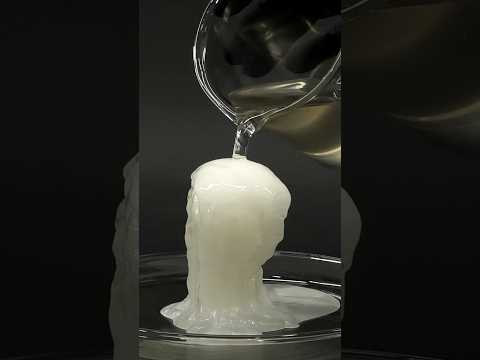
Using vinegar to grow a weird tower
NileRed
2m 34s439 words~3 min read
YouTube auto captions
Transcript source
YouTube auto captions
This transcript was extracted from YouTube's auto-generated caption track. The transcript below is server-rendered so it can be read, searched, cited, and shared without opening the original YouTube player.
Pull quotes
[0:00]This is just some regular vinegar, and I'm going to do something that I think is pretty fun.
[0:00]To get started, I just need to dump it into a large beaker, and I'll add about 2 L.
[0:00]This reacts almost immediately with the vinegar, which is acidic acid, and it turns it into sodium acetate.
[0:00]However, it also releases a lot of CO2 gas, so I had to add it in a bunch of small portions to make sure that it didn't bubble over.
Use this transcript
Related transcript hubs
Watch on YouTube
Share
MORE TRANSCRIPTS


