[0:00]What if I told you that the world's largest living organism isn't a whale or a redwood, but a massive entity hiding beneath the soil of a state in the Pacific Northwest? Or that despite its forested, mountainous and rainy reputation, this state is home to a canyon nearly 2,000 feet deeper than the Grand Canyon. From the deepest lake in America to a coastline where private property simply doesn't exist, this is a land of massive dunes, cataclysmic floods and a city named by the toss of a penny. Here are 15 incredible geography facts you never knew about my home state of Oregon.
[0:38]Formed approximately 7,700 years ago, Crater Lake is the crown jewel of the Cascade Mountains. It wasn't created by a slow glacial process, but by the violent cataclysmic eruption and subsequent collapse of Mount Mazama. This created a caldera so deep, 1,949 feet, that it stands as the deepest lake in the United States and the 11th deepest in the world. What makes its geography truly unique though is its isolation. The lake has no rivers flowing into or out of it. Instead, the water level is maintained entirely by a balance of evaporation and massive amounts of annual snowfall. Because there's no sediment runoff from tributary rivers, the water is incredibly pure, allowing sunlight to penetrate deep into the abyss. This results in an intense, indescribable blue color that has fascinated geographers and tourists for over a century. And of course, if you want to see me explore Crater Lake in person, you can do so over on my travel channel.
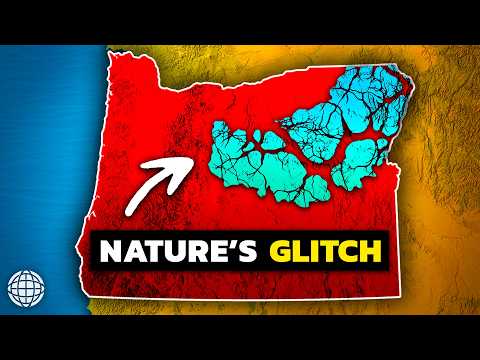
[1:34]Within the Malheur National Forest of Eastern Oregon is potentially the world's largest living organism by mass and volume. It's not a whale or a redwood tree, it's a fungus, known as the honey mushroom. This gargantuan colony covers 2,200 acres, roughly the size of 1,665 football fields. Most of the organism exists underground as a network of root-like filaments called rhizomorphs, which spread through the soil and timber. To a hiker, it might just look like a few clusters of gold-capped mushrooms, but genetically, it's one massive continuous individual. It's estimated to be at least 2,400 years old, though some geologists believe it could be as old as 8,000 years. Its sheer scale and age make it a biological wonder that reshapes our understanding of how life interacts with the Earth's crust.
[2:23]While the Grand Canyon in Arizona gets all the fame, Oregon, along with its neighbor Idaho, hosts the deepest river gorge in North America. Carved by the relentless flow of the Snake River, Hells Canyon reaches a staggering depth of 7,993 feet. To put that in perspective, it's nearly 2,000 ft deeper than the Grand Canyon. But geography here is vertical and rugged, showing off millions of years of volcanic activity and tectonic shifts. The canyon walls offer a vertical timeline of the Earth's history, revealing layers of basalt and metamorphosed rock. Because there are no bridges spanning the canyon for hundreds of miles, it remains one of the most remote and geographically isolated regions in the lower 48. Offering a glimpse into the raw, prehistoric power of river erosion on a continental scale.
[3:10]Oregon's landscape was fundamentally rewritten at the end of the last Ice Age by the Missoula floods, when a massive glacial lake in Montana repeatedly breached its ice dam, it sent walls of water 400 feet high racing across the Pacific Northwest. This water didn't just flow, it scoured. It carved out the jagged cliffs of the Columbia River Gorge and stripped away billions of tons of soil from Eastern Washington. The water eventually pulled in the Willamette Valley, depositing thick layers of nutrient rich top soil, known as alluvium. This single geographic event transformed Oregon from a potentially rocky wasteland into one of the most fertile agricultural regions on the planet. Today, the catastrophic flood path is still visible through the channeled scablands and the massive boulders, known as erratics, left behind in the middle of Valley fields.
[4:01]Stretching for 40 miles along the Central Oregon coast, the Oregon Dunes National Recreation Area represents the largest expanse of coastal sand dunes in North America. These aren't just small beach mounds, some dunes reach heights of 500 feet above sea level. Their existence is a perfect geographic storm of wind, water and geology. The sand originates from the erosion of the Coast Range Mountains, carried to the ocean by rivers, and then pushed back onto the land by the powerful Pacific currents and summer winds. Over thousands of years, these forces have created a shifting landscape of tree islands, where small forests are slowly being swallowed or revealed by the moving sand. It's a rare example of a desert-like environment occurring in a region famous for its rain, proving that Oregon's geography is far more diverse than many people realize. Speaking of Oregon's incredibly diverse physical landscape, the absolute best way to visualize the dramatic terrain of the Pacific Northwest is through a great map. Which brings us to this week's new map drop at Maps by Jeff.com. This week, I've created a highly detailed topographic map of the entire Cascadia biome region. It perfectly highlights the stunning elevation changes from the coast, across the mountains and into the high desert. But don't wait, this map is strictly limited. It's only available for 28 days until March 20th, or until exactly 100 copies are sold. So grab yours in the link below before they're gone because once they're gone, they're gone forever. Now, while the forces of nature shape the towering dunes on the coast, human migration left its own permanent scar on Oregon's inland geography. The Oregon Trail was more than just a path. It was an over 2,000 mile geographic artery that connected the settled east to the Wild West. Between the 1840s and 1860s, roughly 400,000 pioneers crossed this rugged terrain. The journey was so grueling and the wagon traffic so heavy that the geography of the state was permanently scarred. In many parts of Eastern Oregon, such as near Baker City, you can still see the swales or rutts worn into the earth by the iron-shot wheels of thousands of wagons. These physical marks serve as a geographic monument to one of the largest mass migrations in human history. The trail dictated where towns were built, where roads were eventually paved and why the majority of the state's population still lives in the Willamette Valley, the trail's ultimate destination.
[6:24]Founded in 1811 at the mouth of the Columbia River, Astoria holds the title of the oldest American settlement west of the Rocky Mountains. It was established by John Jacob Astor's Pacific Fur Company as a strategic trade hub, and its location was chosen for purely geographic reasons. It sat at the gateway between the Pacific Ocean and the vast interior of the continent via the Columbia River. The site was a contested piece of geography, shifting between American and British control during the early 19th century. Its survival ensured that the United States had a permanent presence in the Oregon country, a massive territory that once included parts of modern-day Canada. Today, Astoria's steep hills and Victorian architecture reflect its history as a rugged port town that quite literally put the American West on the map. In 1854, the site of modern-day Portland was a small clearing on the banks of the Willamette River. Two land claim owners, Asa Lovejoy of Boston and Francis Pettygrove of Portland, Maine, both wanted to name the new town after their respective homes. To settle the dispute, they resorted to a best-of-three coin toss using a copper penny. Petty Grove won the toss and the city became Portland. Had the coin landed differently, the geographic identity of the Pacific Northwest would have been vastly different, with Boston, Oregon serving as the region's major metropolis. This coin, now known as the Portland Penny, is still on display at the Oregon Historical Society. It serves as a reminder that even the most significant geographic names can sometimes be decided by a split second of pure chance. In the late 1930s and early 1940s, the geography of isolation led to a brief political rebellion. Residents of Southern Oregon and Northern California felt ignored by their distant state capitals in Salem and Sacramento. The roads were poor, and the rugged mountain terrain made communication difficult. In protest, they proposed the creation of a 49th state called Jefferson. On November 27th, 1941, a group of armed men even succeeded, appointing a governor and blocking Highway 99 to hand out proclamations of independence. The movement gained national attention and might have succeeded if not for the attack on Pearl Harbor just days later, which unified the country and ended the secessionist talk. Today, the state of Jefferson remains a cultural geographic identity in the region, often signified by a gold seal with two X's, representing being double-crossed by the two governments.
[8:50]The name Oregon is one of the most etymological mysteries of North American geography. Unlike states with clear origins like Washington or Georgia, the word Oregon appeared on maps long before it was explored. Some historians believe it comes from the French word Ouragan, meaning hurricane, referring to the fierce winds of the Columbia River. Another early theory points to the Spanish word Orejón, meaning big ear, a name Spanish explorers supposedly gave to the indigenous people of the region. A more technical geographic theory suggests it was a misspelling of the Ouisconsink River on an early 18th century map that was then copied and moved further west by later cartographers. Regardless of its origin, the name became a rallying cry for westward expansion and eventually defined the borders of the 33rd state.
[9:39]Oregon's human geography is deeply tied to its unique agricultural microclimates. The Willamette Valley provides a rare combination of mild winters and volcanic soil that is perfect for hazelnuts. Today, Oregon produces 99% of the entire U.S. supply of hazelnuts. The hazelnut trees thrive in the transition zone between the wet coast and the dry interior. Over the decades, this has created a specialized cultural landscape of vast orchards that define the rural identity of the valley. The industry is so vital that the hazelnut was designated the official state nut in 1989. For a global perspective, Oregon is one of the few places on Earth, alongside Turkey and Italy, where the geography allows for such high-quality large-scale hazelnut production.
[10:26]Human geography often involves how we define and use space. And Oregon takes this to a humorous extreme with Mill Ends Park in Portland. Located in a median strip in the middle of Southwest NATO Parkway, this park is a circle just 2 ft in diameter. It was officially recognized by the Guinness World Records as the smallest park in the world. It began in 1948 when journalist Dick Fagan planted flowers in a hole intended for a light pole, outside of his office window. He wrote whimsical stories about a colony of leprechauns living there. Over time, the city adopted it as an official park. Despite its size, it features landscaping, usually a single small tree or seasonal flowers, and has even hosted protests by local activists, proving that even the smallest point on a map can hold significant cultural weight.
[11:14]Oregon is the only state in the Union with a two-sided flag, reflecting a unique pride in its geographic and natural heritage. The front features the state seal, which depicts the mountains, the Pacific Ocean, and a covered wagon, all nods to its historic and physical geography. However, the reverse side features a single golden beaver, the state animal. This design choice highlights Oregon's origins as a beaver state, built on the fur trade. In an era where most state flags are uniform, Oregon's decision to have a front and back speaks to the human geographic identity that refuses to be simplified. It emphasizes the beaver's role in shaping the very waterways that allowed for the state's early exploration and economic development. In 1913, Governor Oswald West and the Oregon Legislature made a radical geographic decision. They declared the entire coastline a public highway. This was later reinforced by the 1967 Beach Bill. This means that unlike California or the East Coast, where private mansions often block access to the sand, the entire 363-mile Oregon coast is public land. This has shaped the human geography of the state in a profound way. It prevented privatization of the shore, ensuring that every citizen has the right to walk the entire length of the state's ocean border. It's turned the coastline into a continuous public park, fostering a culture of outdoor recreation and environmental stewardship that is central to the Oregonian identity. Oregon is home to a unique human geographic experiment called the Urban Growth Boundary. To prevent the urban sprawl seen in places like Los Angeles or Phoenix, Oregon law requires every city to draw a firm line around its metropolitan area. Inside the line, high density development is encouraged. Outside the line, the land is strictly preserved for farms and forests. If you fly over Oregon, the geographic impact is startling. You can see a residential street and abruptly, and right across the fence, a pristine orchard or forest begins. This policy has kept Oregon cities relatively compact and walkable, while protecting the very geography that makes the state beautiful. It's perhaps the most significant way Oregonians have used law to dictate the physical layout of their human environment. Oregon is my home. To me, it's so incredible in so many different and varied ways that it's hard to boil down to just 15 facts. But that just means that maybe I'll do another special edition video about Oregon in the near future. Hey, speaking of Oregon, this week I'm traveling all around Astoria to show in person what the Pacific Northwest's first settlement looks like today and why it should have become the West Coast New York City. So come join me over on my travel channel. I hope you enjoyed learning all about Oregon. If you did, be sure to check out this video all about Chile. Thanks for watching. See you next week.


