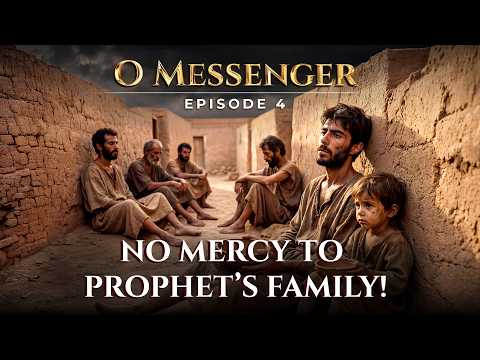
[0:00]Imagine a hunger where you and your relatives are trapped in a blockade, while people outside have no such struggle. Babies are crying from hunger, and mothers are in deep pain because they are unable to calm them down. They cannot find anything to feed themselves, nor anything to feed their children. Everywhere you look, people are exhausted. To survive, the only thing you have eaten for days is either tree leaves or a piece of animal skin you found on the ground. You cannot ease your own hunger, nor can you ease the hunger of others. Two unbearable burdens at the same time. All this hardship and oppression happened in the seventh year of the prophethood, in the valley known as Shibi Abi Talib in Mecca.
[1:09]In those days, Mecca witnessed Muslims tormented by hunger. But how long would this last? Two days? Three days? A week? A month? None of these. It would go on for three long years. For years, the Messenger of Allah Alaihi Salam and his companions endured hardships you couldn't bear for even a single day. This period would later be known as the years of boycott. So, what happened? Just when everything seemed to be getting better, how did things reach this point? Let's take a step back. It was the seventh year of prophethood, and the idol worshipers of Mecca still couldn't find a way to stop the spread of Islam. Despite all the torture and pressure, the number of Muslims continued to grow. Every tactic they tried was failing. And on top of that, they couldn't bring back the Muslims who had migrated to Abyssinia. And when Hamza and Umar embraced Islam, the Quraysh became even more anxious. They realized that at this rate, Islam would soon dominate Mecca. To put an end to all this, the leaders of the Quraysh gathered and swore an oath. Whether in secret or openly, we will definitely kill Muhammad. He is right. We agree.
[2:29]All of this made Abu Talib increasingly worried. So he gathered the clans of Banu Hashim and Banu Al-Muttalib and told them to stand by the prophet and protect him from every danger. Some of the sons of Al-Muttalib had not yet accepted Islam, but as soon as they heard Abu Talib's call, they immediately came. Because back then, no matter what, even if people followed different religions, family ties were extremely strong. No one would allow an outsider to harm their relatives. That would bring shame on the entire tribe. So all of Banu Hashim and Banu Al-Muttalib gathered in Shibi Abi Talib and took the Messenger of Allah under their protection. Knowing that killing the prophet Alaihi Salam within this valley would not be easy, the Quraysh gathered in Darun Nadwe to come up with a plan. And the decision they reached showed once again that the enemies of Islam had no mercy left in their hearts. According to their agreement, no one will marry the daughters of Banu Hashim or Banu Al-Muttalib. And no one will give their daughters in marriage to them. Nothing will be sold to them. And nothing will be bought from them. No one would enter their homes, sit with them, meet with them, or even speak to them. Unless they handed the prophet over to be killed, no offer of peace would ever be accepted. And absolutely no mercy would be shown to them. The terms were written down, and to give the agreement a sacred status, it was hung inside the Kaaba. Young and old, men, women, and children, all of Banu Hashim were forced into a boycott in Shibi Abi Talib. The Messenger of Allah Alaihi Salam, Khadija, Abu Talib, Saad ibn Abi Waqas, Hamza, Ali, every single member of Banu Hashim was completely cut off from society. All except one, Abu Lahab. He was from Banu Hashim too, but he chose to separate himself from his own people. His heart had become so dark that he even wished for his relatives to die. He would stop the caravans coming into Mecca and cry out, Oh merchants, raise the prices for Muhammad's family so high that they cannot buy a single thing from you. You know that I am wealthy and a man of my word. If you do this, I guarantee no harm will come to you. He promised to cover all their losses, and so the merchants trusted him and raised their prices many times over.
[5:01]And in the end, the people of Banu Hashim would return to their children who were crying from hunger with nothing in their hands. They had run out of everything they had. But even though food was being sold at double the price, they still had to buy it. And those who had the financial means didn't hold back from spending all their wealth. The Prophet Alaihi Salam, Abu Talib, and Khadija sacrificed everything they owned. Just think about it, Khadija had once been one of the wealthiest people in Mecca. And now she was giving away all her money without the slightest hesitation. On one side, Khadija was spending her wealth to save people from hunger, while on the other, Abu Lahab was spending his to make them starve. From the outside, it looked the same. They were both spending. But intention makes all the difference. With their spending, one was planting the trees of Tuba in her paradise, while the other was planting the trees of Zaqqum in his hell. Abu Bakar Radi Allahu Anhu was also a successful merchant, but he had given away all his wealth to free Muslim slaves who were being tortured. And throughout his life, he would sacrifice everything he had time and time again in the path of Allah. This was how they stood by the religion of Allah, some with their lives, some with their money, some with their words, some with their youth, and some with their patience and struggle in the face of hardship. In Surah Tawbah, Allah says, indeed, Allah has purchased from the believers their lives and their wealth in exchange for paradise. Those were the people who were honored with that promise. During that time, Abu Talib was making extra efforts to protect his nephew from any possible danger. Every night, he would tell the prophet Alaihi Salam to lie down in his bed where everyone could see him, but once everyone had fallen asleep, he would quietly take his nephew from there and bring him to his side without anyone noticing. And in the prophet's place, he would have someone else lie down. In this way, he was trying to prevent any harm from reaching him. Abu Talib was his uncle and so was Abu Lahab. But while one was protecting him, the other wished for his death. One was working hard to keep his nephew safe, while the other was oppressing him, and this contrast would continue like that until the end. During the boycott, Banu Hashim gave up everything they owned, yet even that wasn't enough to save them from hunger. But despite all the hardship, they never gave up. For all generations to come, they showed what it truly means to stay firm and steadfast when you dedicate yourself to a cause. In contrast, the behavior of the Quraysh was the exact opposite. They showed how far they could go in disbelief, in cruelty and in mercilessness. On one of those difficult days, a man managed to buy some flour with the little means he had and secretly brought it to the entrance of the valley. That man was Hakim ibn Hizam, the nephew of Khadija Radi Allahu Anha. Disturbed by the cruel oppression of the Quraysh, he set out to give what little help he could. There were others like Hakim, who were also troubled by this injustice, but most people did not dare to show such courage and help them because of the pressure of the idolaters. In fact, far from helping, anyone who entered the valley, even by mistake, was harshly scolded. Hakim tried to slip in secretly, but Abu Jahal noticed him and refused to let him bring in the food. Stop right there. Even grabbed him by the collar. At that moment, one of the Quraysh leaders, Abu Al-Bakhtari, saw what was happening. He became furious at what Abu Jahal did. He said, how can you stop him from bringing his aunt the food that belongs to her? Get out of his way and let him go where he has to go. When Abu Jahal persisted, he picked up a bone from the ground and struck Abu Jahal on the head, splitting it open. Then he knocked him down and kicked him again and again and walked away. In this way, from time to time, both believers and non-believers would secretly deliver some food into Shibi Abi Talib. But it was never enough. The mushrikoon supposedly allowed them to buy and sell only during the pilgrimage season, just for one month. I say supposedly, because even then, the Quraysh tried different ways to block Muslims from getting supplies. Merchants were either threatened not to sell them anything or their entire stock would be bought up so that nothing would be left for the Muslims. Since no one traded with Banu Hashim, they had no source of income either. They had already consumed everything they had. Now the children had begun crying out from hunger. But those cruel oppressors, with their hearts darkened, shut their ears to these cries, and some even seemed to enjoy them. Saad ibn Abi Waqas was one of the Muslims who lived through this hardship. One night, unable to sleep from hunger, he went outside. Later, he described what happened in these words, I found a piece of camel skin among the thorns. I took it, dried it in the sun, and for days I survived on that piece of skin. Some tried to stay alive by eating animal skins, while others would eat tree leaves. Three long years of hunger and hardship passed in this way, yet the situation could not be resolved. But there were still some people who had not lost their conscience. In fact, some of them were troubled from the very beginning. The one who wrote down the terms of the agreement was Mansur ibn Ikramah, and it is said that from that day on, he could no longer use the hand he wrote with. When this happened, some people said, Mansur was struck with calamity because we oppressed the sons of Hashim. But out of fear of the Quraysh, they remained silent. They were waiting for someone to take the first step, and that step was finally taken by five men. Abu Al-Bakhtari, Mutim ibn Adi, Hisham ibn Amr, Zuhair ibn Abi Umayya, and Zama ibn Al-Aswad. These men came together and made a plan. The next day, they would go to the Kaaba when it was crowded, and each of them would stand in a different corner, pretending not to be aware of each other. By making it look like different voices were calling for the same thing, they would finally call for this cruel treaty to be torn down. The next day, those five men went to the Kaaba and mingled with the crowd in different places. Zuhair was the first to speak. O Quraysh, is what we are doing acceptable for any human being? While we enjoy every blessing, does it not bother you that the sons of Hashim are left in misery? This treaty must be broken. Then Zama ibn Al-Aswad spoke up. Zuhair is right. Even when that page was first written, we did not agree to it. Now it's time to put an end to this oppression. One by one, each of them raised their voices against the injustice from where they stood. The crowd around them grew bigger and the voices of objection grew louder. Abu Jahal tried to claim that it was all planned, but no one paid any attention to him. This event damaged the prestige of the treaty and became one of the turning points that led to the end of the boycott. But the real event that brought it to an end was this. By Allah's command, a small worm was sent to the page that was hung inside the Kaaba. This tiny worm ate through the whole page, except for the words, Bismik Allahumma. Angel Jibril informed the Prophet Alaihi Salam of this, and he immediately shared the good news with his uncle, Abu Talib. And once Abu Talib heard it, he gathered the young men of Banu Hashim and went to meet the leaders of Quraysh. He then made this proposal to them, According to what my nephew has told me, Allah has sent a worm upon the page you hung in the Kaaba. It has eaten everything, except the name of Allah. It ate up all the words of oppression, breaking family ties and slander. Now go and see it for yourselves. If what my nephew says is true, then stop this injustice and cruelty now. But if he is lying, then I will hand him over to you myself, whether you kill him or let him live. The choice is yours. Even though the Quraysh didn't believe him at first, they feared that his words might be true. Besides, Abu Talib had promised to hand him over if the news turned out to be false. So, they hurried to the Kaaba. As always, its door was locked. They opened it, went inside, and looked at the page hanging on the wall. And saw that once again, Allah had not allowed his Messenger to be proven false. With their own eyes, they saw exactly what Abu Talib had described. Yet, even though they were astonished, they still refused to accept it as a miracle. Instead, they said, this too is nothing but magic. After this incident, it was announced to the people that the treaty was canceled and the boycott was lifted.


