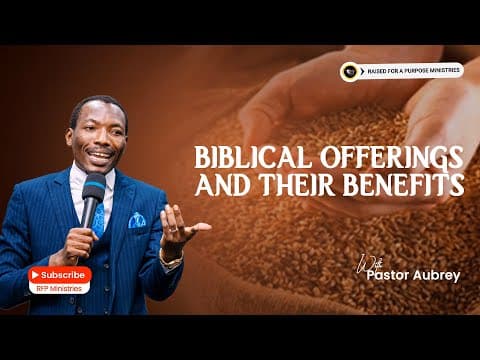
[0:00]This is Pastor Aubrey, the senior pastor of Raised For A Purpose Ministries, popularly abbreviated as RFP. I want to specially invite you to be a part of this that God is doing in this end time, to be part of the army, to be part of the strategy of God in these end times. You can be a part of us by attending our weekly services and weekly programs. You can be streaming our services live or you can be listening to them at any time. We are on different platforms. We are on YouTube, we are on Facebook, we are on Mixlr, and many other platforms. Some of the details are those that are showing on the screen. We are physically in almost every district in Malawi, and even outside Malawi, you can get in touch with us and we will let you know where RFP is. Hallelujah. So, I decided that instead of just tackling the first fruits, I want to tackle the different types of givings and their benefits. So, the different types of givings and their benefits. So, the topic is biblical offerings and their benefits. Biblical offerings and their benefits. Starting with the definition of an offering. What is an offering? So, an offering is a thing offered or given as a religious sacrifice or as a token of devotion. That's how the dictionary defines an offering. An offering is a thing offered or given as a religious sacrifice or as a token of devotion. And that word token, a token means a token means a thing that a token means a thing that is serving as a visible or tangible representation of something else. So, when you are when something is a token, the token may represent a fact, the token may represent a feeling, it may represent it may represent anything. So, in other words, what we are saying is when you're giving your offering, that offering it it's both what we say a sacrifice, but it's also something that is given to represent something. So, when you're giving your offering or you are giving your seed, whatever it is. Number one, it's a sacrifice, but number two, it's also something that you're given to represent something. You may give money, for example, you may give a car, you may give clothes, you may give your phone. Whatever you're giving, you are giving it to represent another thing. Okay? That's why there are different types of givings. And each one of those has got its guide from the Word of God. It has got its place in the Word of God. It has got how it must be done and it has got its related benefits. That when you do it, this is the promise for it. When you do it right, this is what you get. Okay? Now, I want to start off by addressing these five things. Some five things for you to note before I come to the types of givings. I will come to the types of givings, but I want to address these five things. Some of them I've already tackled them uh before or years passed, but we always realize that every year we have got new members and also the law of repetition, or repetition is the law of lasting impression. So, there are some things that we must repeat to make sure that they are properly registered on your hearts. Hallelujah. So, these five things. I will look at them quickly, and then we go to the five types of giving. That's why I said that you must attend both services. Because when we come to the types of givings, maybe I'll look at five or seven, as RFP. Is home for you. Home for me. As time allows us. So, that can't be done in this first service. Maybe this first service I'll just look at one, and the others I'll look at them in the second service. But five things that I want to uh share with you as regards giving. Number one, number one, write it down that the principle of sowing and reaping is a universal principle that cannot be broken. The principle of sowing and reaping is a universal principle that cannot be broken. It is God that set it.
[5:32]Now, put Second Corinthians chapter number thirteen and verse eight. Second Corinthians chapter thirteen and verse eight.
[5:50]For we can do nothing against the truth, but for the truth. (KJV)
[6:14]He says that we can do nothing against the truth, but the only thing that we can do is what is consistent with the truth. So, you do not come to the earth to rewrite truth. So, you cannot you cannot what is it? Second Corinthians chapter thirteen and verse eight. He says, "For we can do nothing against the truth, but for the truth." So, the truth is there. The truth is said by God. And God has set it that this is a principle. This is the way things must go. And the Bible is telling you that the only thing that you can do is to do things that are consistent with the truth. He says, "We cannot do anything against the truth." The only thing that you can do is what is consistent with the truth. If you if you say there is no gravity, So, you go in the air and you jump. You say, I don't look at it. You say, I don't believe in gravity. That's a mistake many Christians make. They say, I don't believe in tithing. I don't believe in Facebook. I don't believe, hey, it doesn't matter what you believe or don't believe. The principle is there whether you believe it or not, it doesn't change its existence. This existence is not coming because of you. Before you came, that thing was already there. God is not going to change things to suit you. For your convenience, for your benefit. God is not changing things to understand you.
[8:11]You know, people say, God must understand me. Ah-ah, you are not in this earth to be understood by God. You are in this earth to understand God.
[8:30]Who should understand the other? Must you understand? Ahh. If you make something, let's say you are an inventor. You have invented something, you have made something. Isn't that thing supposed to operate according to what you had in mind, according to the way you have invented it? Isn't it? You are the one that tells your car what to do. So, when you tell your car that car, I want you to go left. The car must obey, isn't it? The car must not go right and say the owner, the driver will understand me. Ah-ah. So, it's nonsense to say, I do not believe in this. No, no, no. I will tell you something. The Bible already says it. For God so loved the world that He gave His only begotten Son, that whosoever believeth whosoever believeth He says, these things are for the whosoever. Whosoever believes what will happen will get the benefits, shall not perish, but shall have everlasting life. Glory to God. So, he says if you believe, you shall have what if you don't believe, that's your own funeral. Are you following? Genesis chapter number Genesis chapter number eight, verse twenty-two. The Bible says, "Whilst the earth remaineth, seedtime and harvest, and cold and heat, and summer and winter, and day and night shall not cease." (KJV) The earth that you are in now, as long as the earth is there. So, you you think you can come into the earth and start changing things. He says, "Whilst the earth remaineth, seedtime and harvest, and cold and heat, and summer and winter, and day and night shall not cease." (KJV) So, you think you can come into the earth and start changing things. He says, whilst the earth remaineth, seed time and harvest, not only seed time and harvest. Uh-uh. There are also other things. He says cold and heat. You you can't step into earth and say, I pray and I declare in the name of Jesus, it will never be hot again. I don't like heat. It will never be brother. You can't say, I don't want it to be cold. So, I declare from the year twenty twenty-four up to the rest of my life, it will never be cold in the name of Jesus. I bind it. You cannot. Are you there? He said, God has said there will be men and there will be women. That's what the Bible says, there will be males and there will be females. You can't come and say, me, I'm going to be double. All I'm going to be none. I are are you a male? No. Are you a female? No. So, who are you? I am both. Ah. He says, it depends. It does not depend. The Bible says He created them male and female. So, where will it depend? It cannot depend. He created them Genesis one. He created them male and female. Unless if you are not created, then it will depend. But also, who are you to talk about creation because you were created? You were not there in the creation. How can you talk about? How can you talk about? Are you following? The Bible says, "In the beginning God." You were not there. It didn't say, "In the beginning God and Tatalala." Uh-uh. So, you were not there in the beginning. Please, when you come to the earth, I I I like the humbleness of David. David said in Psalm one hundred nineteen, he says, "I am a stranger in the earth. Lord, hide not your words or your commandments from me." He recognizes that this earth, I have also just come. So, Lord, according to the way you have made earth, I have come, help me to understand it, not to start changing things. Seed time will always be there. Harvest will always be there. This is not something that any pastor has come up with. This is not something that anyone has come up with. And it's not even saying, seed time in terms of money. Uh-uh. He says it's a general principle. It's a principle of input and output. It works everywhere. If there must be an output, there must be what? An input, isn't it? Why do you go to school? Those are inputs. Why do you put capital in a business? Those are inputs, because if you don't put input or investment, there will not be dividends. There will not be earnings, isn't it? So, you can't come and say, I come in the name of Jesus, no input, but there must be output. Then go create your own earth, my friend. But as long as this earth remains, this is what will be. Are you listening? That's number one. Number two, number two is the value of your seed. The value of your seed. Now, this one is so important. The value of your seed. Now, from Mark chapter twelve and verse forty-one, let's look at it from the NLT. From the NLT.
[15:01]Mark twelve verse forty-one. The Bible says, "Jesus sat down near the collection box in the temple and watched as the crowds dropped in their money." Ah. Someone says, God doesn't care about our givings, whether we give or not, it doesn't care. He actually doesn't mind. He doesn't mind of the amount we give, he doesn't amount, he doesn't mind how we give it. God is just looking at our hearts. Uh-uh. Says, "Jesus sat next to the offering basket." Sat like this, not closing his eyes. Ah. Looking how people are giving. Jesus. Jesus our Lord, the one that in the name of Jesus, the dead rise, the sick are healed. That's Jesus. He sat next to the offering basket.
[16:05]As people are given, he was looking. And being shocked at certain people as I was showing you. As he says, And others gave. Jesus, if Jesus was looking then, you think he's not looking now? Because it is you, it is you that are that are able to successfully hide your offering. You know, have you seen when people want to give, they're going to take it, put it like that. Uh. And then, you see, they will even go solo, deep their hand to ensure nobody sees. So, what did they release there? Nobody knows. But I will tell you, Jesus is near.
[17:03]Watch it. He says, in the temple. In the temple, there were many places he could have sat on this day. He chose to sit next to the offering basket. ... and watched as the crowds dropped in their money. Many rich people put in large amounts. (NLT) He says, and he watched as the crowds dropped in their money. Many rich people put in what? Large amounts. Uh-huh. Then a poor widow came and dropped in two small coins. (NLT) He says, Jesus called his disciples to him and said, "I tell you the truth, this poor widow has given more than all the others who are making contributions." (NLT) That means comparison. Look at this. No, God does not compare. Look at this. God does not compare us. Look at this. Your grammar, the grammar you learned in school. When you say this is more than, are you not comparing? If X is more than Y, are you not comparing? For they gave a tiny part of their surplus, but she, poor as she is, has given everything she had to live on. (NLT) He's now dealing with percentage. So, God is telling you, I am not only looking at what you have given, I'm also looking at what is remaining. He says he has given what? Everything.
[19:20]Put it in the message translation. Actually, before I even come to the first fruit, put it in the message. Before I even come to the first fruit, This is why the first fruit is one of the greatest givings. Because remember, let's say you live on your salary, okay? You make your expenses on your salary. Then you you say, I take my whole salary and give it as first fruit. You are actually giving all the money you got. That you should have been using to make expenses. Do you see why it's what why it already makes it great?
[20:09]Are you following? The same way that Jesus was able to say, this woman, two coins, but she has given everything. These are, this what, they have given bags of money, but it's not everything.
[20:38]All the others gave what they'll never miss; she gave extravagantly what she couldn't afford she gave her all. (MSG) He says, he has given what? Everything. Put it in the message translation. All the others gave what they'll never miss.
[21:19]This is what I also, this is what I also say. Thank, hey. We thank everyone for giving what can be used for by another person. But that is not enough. You must give what is valuable. Do you know that many people, you know, even in many churches, that's why I don't often say it. Maybe I've said it once, twice, but not many times. Where I will say, give the things that you don't use at home. Bring them to church. We will carry them and give them to other people. If you are not using it. Even broken things. That bad shoe. That let's take it and give. No, no, no. That that's not excellent giving. Yes. What you are not using, another can use. So, take it and what? Give it. But it's not valuable if you stop there. Take some things that you use, things that are valuable to you and also what? Give them.
[22:58]Are you following? I'm I'm talking about that So, I was saying that during that time, I remember I I I made someone, you know, one of those that followers. And someone said, oh, Pastor, I heard that you have left your job. Oh, don't worry, Pastor. We will take care of you. You know, every month we'll collect a little salt from their houses, sugar from the different house. And they were, they were honest about it.
[23:41]That we'll collect little, little things from houses. We will take care of you. And I was looking at it. You collect little, little things.
[23:55]But you see, that's the attitude that people have. You know that? They will say the Lord moved me sister. The Lord moved me to give you a seed. What are they talking about? One thousand quacha. When they could have done more. Start to train yourself to do things that are of value to you. Can you tell your neighbor? Give things that are of value to you.
[24:32]Yes. Now, I'm telling you, some of you, I remember where you are coming from. Yes. I'm telling you, some of you, I remember where you're coming from.
[24:47]Even even even if you sowed and died, the principle is still there. Your resurrection will be greater. Didn't Jesus sow himself and died? When he resurrected, didn't God say about him that God has now highly exalted him. So, it's not like your monies are dying permanently. Ah-ah. The seed must fall into the ground and what? Die. But it won't remain there. It will resurrect. It will come out. When it comes out, it comes back multiplied. Shout Glory. Ahh. Hmm. Number four. Number four is you start from your level and grow upwards. You start from your current level and grow upwards. Second Corinthians chapter eight and verse twelve. Second Corinthians chapter eight and verse twelve. The Bible says in the KJV, that, "For if there be first a willing mind, [it is] accepted according to that a man hath, [and] not according to that he hath not." (KJV)
[26:27]The Living Bible, not the New Living Bible, but that other Living Bible, TLB. Then second part, okay, let me just read it from the TLB. It says, "If you are really eager to give, then it isn't important how much you have to give. God wants you to give what you have, not what you haven't." (TLB) He says, what is important is to give what you have and not what you don't have. So, the principle of sowing is never despise your present level.
[27:14]Never if you are at a level of where your tithe, you know, I I ever asked I I ever asked a certain person at some point because just like Jesus, I am also someone that it's just that now because we are many. So, I don't do it as much. But I am also someone that I go and look at the givings of people. Yes. I go sometimes and look at people's givings. I go and look at them. And sometimes I will look at something. I will tell someone. I will say, no. With your prayers, the levels that you want, this cannot be your giving. Start giving to this level. This one, uh-uh, do something about it. Then there are times that I will look at the givings and I will say, oh, if the brethren are giving like this, that means this is what they have. So, what should we do? Let me hold a conference, a program.
[28:44]And pray with them and preach to them the Word, so that God can increase them. You see? But there was this time, I saw one of the members was not giving tithe. So, I I picked it and I I called the person. I said, I've never seen on the records that you gave tithe. And the person said, no, Pastor, I've been giving, but the tithe is very small. So, for me to labor on the to labor like on the form that one hundred quacha, five hundred quacha.
[29:34]He said, Pastor, I feel embarrassed. So, what do you do? He said, I just take my tithe and I just put it together with my offering. Pastor, people should know that this is the amount. I said, nope. I said, that's wrong. Because you are despising the blessing of the Lord, you will not increase. The Bible says, one shall become what? A thousand. The Bible says, "Do not despise the day of humble beginnings, for the Lord rejoices when things begin." If your salary is thirty thousand quacha, gladly take three thousand, give it as tithe. Thank the Lord. Be happy. Don't be intimidated by another person who gave a tithe of five million. Uh-uh. A few months ago, one of the members gave a tithe of five point five million.
[30:45]But if that one gave five point five, don't be intimidated. Don't say, oh, ha-ha. Someone given toys of half of my five. That's tithe. Me, my salary. Oh. My salary is not even there. What is happening? This this this environment is intimidating. No, no, no. It is not intimidating. You are looking at it the wrong way.
[31:20]It is inspiring. When your friend has done something, it is not a statement of your failure.
[31:34]So, if you see that someone has given three million quacha, don't look at it and say, but these people showing off. This is daylight pride, showing off.
[31:52]Why not just give in secret? No, it's because the way you're looking at it, it's your attitude. It's your attitude. And that attitude will help you. You should have seen that three million and you should have gone to God and say, Father, in the name of Jesus, that one is a Christian like me. They have the same Holy Spirit as me. They pray just like I pray. We are of the same church. Why must they give three million, when I am given fifty quacha? My soon and you take it up in prayer.
[32:41]This is that's what some of us have done. When I read those stories of Kenneth Copeland giving over ten airplanes.
[32:56]Hey, I went to God and I prayed. And I prayed and I said, Lord, I'm going to start with cars. So, maybe Kenneth Copeland is at airplanes. I'll get there. But for now, let me start with cars. So, I also started giving my first car, giving our second car, you know, like that. And then, okay, let's go a bit higher. We gave the coaster. You know, you build like that. I'm working towards one day I can give a bus and we can tour you know, you work at it. Are you there? So, don't be intimidated with other people's givings.
[33:50]Be inspired. And don't look at yourself as, But me. Is this valuable? It is valuable because of what it means to you. Remember, one can give ten million, and that person has given lesser than you. Because remember, it's also proportion, isn't it? It's percentage. That five million may just be zero point zero five percent. You the one hundred thousand that you gave, that could be eighty percent.
[34:44]Are you there? Tell your neighbor one more time. Don't be intimidated. Tell them, be faithful at your level. Yes. Yes. The Bible says, "He that is faithful in that which is least is faithful also in much: and he that is unjust in the least is unjust also in much." (KJV) So, you from your You know, there there is a certain, okay, I've done this with so many people. I I've done it with so many people.
[35:28]I think even the Pastor Jimmy was that time. But I've done it with many members. There's there's a you are seeing today, give lots of monies. It's not that they started that way. That's what I'm telling you. Most of these, they were people that would would be struggling financially. And sometimes I would meet them one-on-one, talk to them, pray with them, and there were times that, you know, I could sometimes take five thousand quacha. Okay. So, I'm talking to someone, teaching them the word, praying with them. Then I'll take five thousand quacha and give them that, this is my gift to you. Then I would say, from that gift you have received, the one I have given you now. I would say, number one, take out your tithe like the money I have given you now. Take out your tithe and give it.
[36:40]Take out your pre-stressed seed and give me. Like I have given you eighteen thousand. Then I will say, take out a pre-stressed seed from this body and give me.
[37:00]And then, take out tithe and give and and and give to the ministry here. Then I would say, the remaining, go and use it. What was I teaching them? I was teaching them a principle. And you see, the Bible doesn't say that the seed you give must not come from the one that you're giving to. Ah.
[37:32]The Bible is not specific. So, someone can give you a seed, and you you give it back. It's still a seed. Doesn't say the pre-stressed seed must not come from the priest.
[37:51]Is that what it says? Are you there? I pray that the Lord be merciful to you.
[38:04]So, if you have given your first fruit, put the details in the envelope. And then we're going to pray. And I think we'll make a bit more confessions and declarations in the second service. In the interest of time. So, now we'll basically take some time to pray, and me and a few other leaders here, we'll also pray for your seeds, and then we'll call it a day. The second service I want to expound further on the types of givings. So, I want us to finish in good time. Are we ready? All right, let's stand up on our feet.


