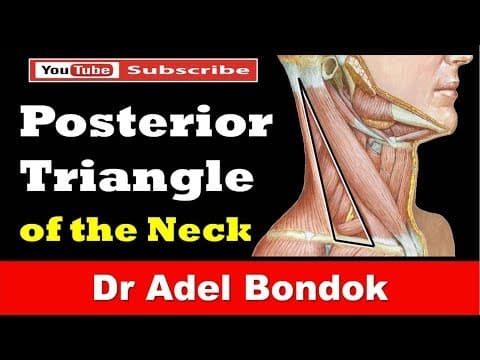
[0:34]Good morning. This is Dr. Adel Bunduk, Professor of Anatomy and Neuroscience Mansora University, Egypt. Today I will talk about the posterior triangle of the neck.
[0:52]Actually the neck, the landmark on the neck is the sternomastoid muscle. This sternomastoid divides the neck into two triangles, anterior triangle in front and posterior triangle behind.
[1:07]So the neck is divided by the sternomastoid muscle into anterior triangle in front and posterior triangle behind. Let us talk about the posterior triangle.
[1:20]Regarding the posterior triangle, you should know the boundaries and the contents. Regarding the boundaries of the posterior triangle,
[1:31]okay, this is the landmark again sternomastoid muscle. So the anterior wall is the posterior border of the sternomastoid.
[1:41]The posterior wall is the anterior border of the trapezius muscle. The apex is the meeting of the two borders at the mastoid process and superior nucleal line.
[1:53]And the base is the middle third of the clavicle. Then we'll talk about the roof and the floor.
[2:02]Okay, so again, this is the posterior triangle.
[2:06]Okay, and this is the landmark, sternomastoid muscle.
[2:11]Uh so anterior boundaries, anterior wall is the posterior border of the sternomastoid.
[2:18]Posterior wall is the anterior border of the trapezius muscle.
[2:24]The apex is the meeting of the two borders at the mastoid process and superior nucleal line. The base is the middle third of the clavicle,
[2:36]because the sternomastoid is attached to the medial third and the trapezius is attached to the lateral third.
[2:45]This posterior triangle is divided by this muscle, the inferior belly of the omohyoid into two triangles.
[2:54]Large triangle above is called occipital triangle. And small triangle below is called supraclavicular triangle.
[3:01]This supraclavicular triangle is also called subclavian triangle because it contains the subclavian vessels.
[3:10]So the boundaries anteriorly it is the posterior border of the sternomastoid, posteriorly it is the anterior border of the trapezius.
[3:20]Apex, the meeting of the two borders at the mastoid process and superior nucleal line. The base is the middle third of the clavicle.
[3:27]It is divided by the inferior belly of the omohyoid into occipital triangle above and subclavian triangle below.
[3:38]Then the roof of the posterior triangle. The roof of course is the skin, superficial fascia, and deep fascia.
[3:47]Skin, superficial fascia containing three main structures, external jugular vein, four cutaneous branches of the cervical plexus and platysma.
[4:00]This one is the lesser occipital nerve, great auricular nerve, transverse cervical nerve, or transverse cutaneous nerve of the neck and supraclavicular nerves.
[4:13]So lesser occipital, greater auricular, transverse cervical and supraclavicular nerves nerves.
[4:24]Medial, anterior posterior and the middle. And this muscle in the superficial fascia is the platysma.
[4:33]Which is supplied by the facial nerve. So the roof, skin, superficial fascia, deep fascia.
[4:40]The superficial fascia contains external jugular vein, branches of cervical plexus,
[4:48]lesser occipital, greater auricular, transverse cervical and supraclavicular nerves and platysma. And then the deep fascia, the investing layer of the deep cervical fascia.
[5:08]Again, this is the roof of the posterior triangle. Skin, superficial fascia and investing layer of the deep fascia.
[5:16]The superficial fascia contains this vein, external jugular vein, and these branches of cervical plexus.
[5:26]This is the lesser occipital, greater auricular, transverse cervical and supraclavicular nerves.
[5:38]And the deep fascia, as I said, it is the investing layer of the deep cervical fascia. And it is pierced by the branches of the cervical plexus and the external jugular vein going into the posterior triangle to end in the subclavian vein.
[5:54]Then the floor of the posterior triangle. This floor is muscular floor. It is formed mainly of three muscles and I will add two muscles.
[6:05]One at the apex and one at the base. The first muscle is the splenius capitis muscle.
[6:12]Okay, these are the boundaries of the posterior triangle. Okay, splenius capitis muscle.
[6:19]Levator scapulae, scalenus medius. And at the apex, semispinalis capitis.
[6:31]And at the base, scalenus anterior. So the floor of the posterior triangle is formed of four muscles, five muscles from above downward.
[6:39]Semispinalis capitis at the apex, splenius capitis, levator scapulae, scalenus medius and scalenus anterior.
[6:51]These muscles are covered by the prevertebral fascia.
[6:59]This is the prevertebral fascia, covering the muscles in the floor of the posterior triangle.
[7:07]So actually, the posterior triangle is related to two layers of deep cervical fascia.
[7:13]Investing layer forming the roof and prevertebral layer forming the floor.
[7:20]Then we'll talk about the contents of the posterior triangle. It is crowded with many structures.
[7:29]So let us put the sternomastoid. This is the sternomastoid. And this is the posterior triangle.
[7:38]This is the splenius capitis. Levator scapulae. Scalenus medius and scalenus anterior.
[7:46]How do you identify levator scapulae muscle? By the spinal accessory nerve.
[7:54]And how do you identify scalenus medius and scalenus anterior? The roots of the brachial plexus.
[8:02]are located between the scalenus anterior and scalenus medius. So the contents of the posterior triangle.
[8:11]Let us remove the sternomastoid muscle. It contains the blood vessels.
[8:19]One, two, three and one at the apex. Four arteries and two veins. The four arteries,
[8:26]this one is the suprascapular artery coming from the thyrocervical trunk.
[8:32]This one is the transverse cervical artery coming from the thyrocervical trunk also.
[8:43]And this is the third part of the subclavian artery. Actually the scalenus anterior divides the subclavian artery into three parts.
[8:49]First part medial, second part behind, third part in the posterior triangle. So the four arteries in the posterior triangle are:
[8:58]Third part of the subclavian artery, suprascapular artery, transverse cervical artery, and occipital artery at the apex.
[9:08]Two veins, subclavian vein in front of the scalenus anterior, and the terminal part of the external jugular vein.
[9:17]So blood vessels, six, four arteries and two veins. The four arteries, third part of the subclavian artery,
[9:27]suprascapular artery, transverse cervical artery, occipital artery at the apex and two veins, subclavian vein and external jugular vein, terminal part.
[9:40]Then nerves. This is the first one, spinal accessory nerve running parallel to the levator scapulae.
[9:47]And these are the roots and trunks of the brachial plexus. And these branches are the branches of the cervical plexus.
[9:59]And I have two nerves from the dorsal rami of the cervical nerves. So the nerves, spinal accessory nerve, this one. Roots and trunks of the brachial plexus.
[10:08]Roots starting from C5, and cervical plexus, and two branches from the dorsal rami of the cervical nerves.
[10:20]Greater occipital nerve and the third occipital nerve. Greater occipital and third occipital. Actually, this is the lesser occipital nerve.
[10:31]From the cervical plexus. And also a muscle, this muscle is the inferior belly of omohyoid. And lymph nodes.
[10:40]So these are the contents of the posterior triangle. Again, again, this is the posterior triangle.
[10:49]This is the sternomastoid. This is the splenius capitis. Levator scapulae. Scalenus medius. Scalenus anterior.
[11:00]Okay, so blood vessels, four. This is the third part of the subclavian artery. This is the suprascapular artery.
[11:13]This is the transverse cervical artery. And this is the occipital artery at the apex. The two veins, subclavian vein and external jugular vein.
[11:24]So blood vessels, third part of the subclavian artery, suprascapular artery, transverse cervical artery, occipital artery at the apex, subclavian vein and external jugular vein, the terminal part.
[12:16]So again, what are the blood vessels in the posterior triangle? Four arteries and two veins. The four arteries.
[12:25]This is the third part of the subclavian artery. This is the suprascapular artery. This is the transverse cervical artery. This is the occipital artery.
[12:35]Two veins. This is the subclavian vein and terminal part of the external jugular vein.
[12:43]Actually, the suprascapular and transverse cervical run in front of the scalenus anterior to reach the posterior triangle.
[12:53]This is the scalenus anterior. This is the scalenus medius, and in between the roots of the brachial plexus.
[13:23]Then nerves in the posterior triangle. This is the first one, spinal accessory.
[13:30]Second one, roots and trunks of the brachial plexus. Cervical plexus, okay, and dorsal rami of cervical nerves.
[13:40]So spinal accessory, roots and trunks of brachial plexus, cervical plexus, dorsal rami of cervical nerves, greater occipital nerve, this one,
[13:51]which is the dorsal ramus of C2, and third occipital dorsal ramus of C3.
[13:59]Regarding the spinal accessory nerve, spinal accessory nerve supplies two muscles.
[14:04]This is the first one, sternomastoid, and this is the second one, trapezius. Spinal accessory supplies sternomastoid and trapezius.
[14:17]Regarding the cervical plexus. Do you see the cervical plexus? No. But I see the branches.
[14:24]So where is the cervical plexus? It is deep to the prevertebral fascia in front of the scalenus medius.
[14:32]So location of the cervical plexus, in front of the scalenus medius, deep to the prevertebral fascia. Formation: ventral rami of the upper four cervical nerves.
[14:49]The brachial plexus begins from C5. And then branches.
[14:55]Branches, cutaneous branches, muscular branches and phrenic nerve. And the phrenic nerve is a muscular branch.
[15:05]Four cutaneous branches, lesser occipital, great auricular, transverse cervical and supraclavicular nerves.
[15:18]Muscular branches. Okay, to sternomastoid from C2 and C3. These are sensory branches, proprioceptive.
[15:26]Trapezius and levator scapulae, C3 and C4, also sensory branches.
[15:32]And then branches to scalene muscles. And ansa cervicalis to infrahyoid muscles. I will talk about it with the infrahyoid muscles.
[15:40]Then the phrenic nerve arises from C3, 4 and C5.
[15:47]This is the scalenus anterior. You should know the anterior relation of the scalenus anterior.
[15:54]Structures in front of the scalenus anterior. Anterior to the scalenus anterior are eight structures. Four twos.
[16:00]Two arteries, two veins, two nerves and two muscles. What are the two arteries? These are the two arteries, suprascapular transverse cervical arteries.
[16:17]Two veins in front of the scalenus anterior, this one and this one, subclavian vein, internal jugular vein.
[16:27]And two nerves, this one and this one, this is the phrenic nerve and this is the vagus nerve.
[16:34]Actually, the scalenus anterior is the landmark for the phrenic nerve. The phrenic nerve runs in front of the scalenus anterior between the muscle and its fascia.
[16:48]And two muscles. Inferior belly of omohyoid or tendon of omohyoid and sternomastoid. So what are the eight structures in front of the scalenus anterior?
[16:58]Two arteries, suprascapular transverse cervical. Two veins, subclavian vein and internal jugular vein. Two nerves, phrenic and vagus. And two muscles, omohyoid and sternomastoid.
[17:14]Regarding the sternomastoid muscle or sternocleidomastoid. So the origin, sternocleido, so it has a sternal head and clavicular head.
[17:26]Sternal head from the front of the manubrium. Clavicular head from the medial third of the clavicle.
[17:35]It is inserted into the mastoid process and lateral third of the superior nucleal line. So inserted mainly into the mastoid process.
[17:46]Nerve supply. The motor nerve supply, spinal accessory. The sensory C2 and C3 cervical plexus.
[17:54]Action of sternomastoid. One muscle. Rotation of the face to the opposite side.
[18:03]And action of the two muscles, forward deflection of the neck. So lesion of the spinal accessory nerve, causes paralysis of the sternomastoid and lead to inability to rotate the face to the opposite side.
[18:18]And thank you very much. Good luck and have a nice day.


