[0:00]In this video, we'll talk about necrosis, which is one type of cell death, and this is a high yield topic for USMLE step one. Watch the video till the end and don't forget to subscribe. Necrosis is one type of cell death which is associated with any kind of pathology. It is resulting due to injury or infection. Let us talk about some hallmarks of necrosis. One of the prominent hallmark is the plasma membrane damage. Second thing, necrosis influences inflammatory responses, which are peculiar to necrosis and not found in apoptosis. So immune cells would come into the picture and can evoke inflammation. Cell undergoes enzymatic degradation and protein denaturation. Also, intracellular components might leak such as lysosome. There could be dysfunctional of uh dysfunction of mitochondria and many other cellular organelles. These are prominent features of necrosis. So lysosomal lysis and mitochondrial swelling and dysfunction are pretty prominent hallmarks of necrosis. So in necrosis, mitochondria swells up and get localized into the peri nuclear region, very adjacent to the nucleus. And there is also a calcium overload, which results in many detrimental consequences. Plasma membrane ruptures and it leads to leak out of cytoplasmic fluid into the vicinity, which is pretty peculiar to necrosis and not found in apoptosis. Lysosomal rupture leads to release of several lysosomal enzymes which degrades other proteins and affects other organelles inside the cytoplasm. Excessive ROS production is a feature of necrosis. And since the mitochondria is dysfunctional, swelled up, ATP depletion is pretty common. When ATP levels goes down, many enzymes which require ATP cannot function properly. As a whole, the overall activity of the cell and overall activity of many enzymes are compromised in necrosis. Another prominent feature is decoupling of electron transport chain and the ATP production, which is very often seen in necrosis. When it comes to mitochondria, cyclophilin D activation is a prominent feature and it leads to dissipation of the proton gradient and alteration in the membrane potential of mitochondria. So overall, it makes the mitochondria dysfunctional and addition to that, it leads to calpain activation and cathepsin D activation, which can have other consequences in terms of cellular physiology. So overall, we understand that mitochondrial dysfunction is a very prominent feature in necrosis. Let's talk about the types of necrosis. We have coagulative necrosis, which is often ischemia associated. We have a liquefactive uh necrosis which can be found uh and most likely they are associated with abscess or bacterial or fungal infections. And then caseous necrosis, which are very often associated with fungal infection and they have very prominent cheese like feature which we will describe in a moment. There is fibrinoid and gangrenous necrosis as well. Starting with coagulative necrosis. When blood flows in the cell stops or slows down, it leads to a situation known as ischemia. It occurs anywhere in the body but not in the brain. The cells and the tissue maintains their structure after death, but eventually get cleared up by the immune cells. The causes of coagulative necrosis includes atherosclerosis, blood clot, hernia, infections or some kind of like trauma or injury. This is an example, a cross section of heart where you can see uh ischemic injury happened and which lead to a coagulative necrosis that a dark red patch. Now, liquefactive necrosis is one type of necrosis where the tissue transforms into a liquid viscous mass. And this is common for bacterial abscess and sometimes CNS infarcts. Often it is associated with fungal infections as well. One of the major cell type or immune cell type which is associated with this kind of uh phenotype is neutrophils. Then we come to caseous necrosis. In this case, we see a prominent cheese like appearance that you can be found in this image. So this necrosis is caused due to many bacterial infection like TB. Also it could be due to systemic fungal infections like histoplasma or nocardia infection. Then there is gangrenous necrosis and the distal extremities, GI tract are the most affected uh portions where blood flow stops and it leads to necrosis of that region. So clostridial myonecrosis is pretty prominent feature of clostridium infection. Then fibrinoid necrosis happens due to the death of cells in the small blood vessels. And it can lead to bleeding and internal hemorrhage throughout the body. And many conditions can cause uh fibrinoid necrosis including too much hypertension when the blood pressure increases so much, it might lead to death of the capillary cells. Also there could be autoimmune disease which deposits uh immune complexes in blood vessels and thereby harming the blood vessels. So these are the reason for which fibrinoid necrosis can be found. So I hope this was useful and informative. If you liked this video, give it a quick thumbs up. Don't forget to like, share and subscribe. Follow us on Instagram and Facebook for detailed notes. You can support our channel using Super thanks. See you in next video.
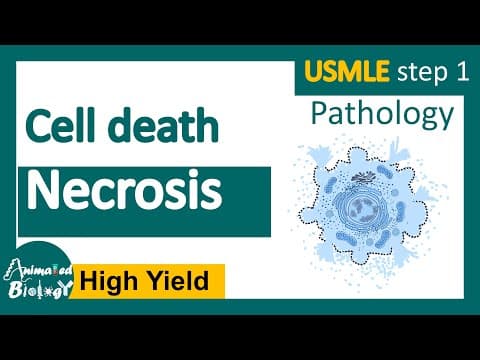
Necrosis and its subtypes | Necrosis - Cell Injury - General Pathology | USMLE step 1
Animated biology With arpan
6m 3s835 words~5 min read
YouTube auto captions
Transcript source
YouTube auto captions
This transcript was extracted from YouTube's auto-generated caption track. The transcript below is server-rendered so it can be read, searched, cited, and shared without opening the original YouTube player.
Pull quotes
[0:00]In this video, we'll talk about necrosis, which is one type of cell death, and this is a high yield topic for USMLE step one.
[0:00]Necrosis is one type of cell death which is associated with any kind of pathology.
[0:00]Second thing, necrosis influences inflammatory responses, which are peculiar to necrosis and not found in apoptosis.
[0:00]There could be dysfunctional of uh dysfunction of mitochondria and many other cellular organelles.
Use this transcript
Related transcript hubs
Watch on YouTube
Share
MORE TRANSCRIPTS


