[0:00]What if I told you there's a border so stark it's visible from space as a line between blinding light and near total darkness, or that the same dividing line, the most heavily militarized zone on Earth, has accidentally become a teeming paradise for endangered wildlife. From a single city that holds half a country's population, to an ancient kingdom that once stretched deep into China. The Korean Peninsula is a land of staggering geographic extremes. So here are 15 incredible geography facts you never knew about Korea.
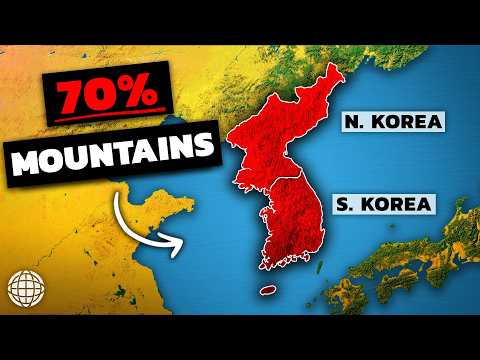
[0:33]The Korean Peninsula is defined by its rugged landscape with approximately 70% of its land mass covered by mountains and uplands. The most dominant range is the Taebek Mountains, which runs like a spine down the Eastern coast. This topgraphic feature is the peninsula's main watershed, because these mountains are so close to the Eastern Sea, the East Coast is steep and has few coastal planes. Consequently, the majority of Korea's population, agriculture and major cities, like Soul and Pyongyang, are concentrated in the flatter, wider planes of the Western and Southern regions. This mountainous terrain has historically isolated regions, creating natural defenses and heavily influenced everything from military strategy to regional dialects.
[1:15]While often viewed as a singular peninsula, Korea is a vast archipelago. Off its southern and western coasts line an estimated 3,500 islands, collectively known as the Korean archipelago. The vast majority of these islands are small, rocky and uninhabited. The Western and Southern coastlines are "ria" coasts, meaning they are complex and jagged with many inlets, formed as rising sea levels drowned ancient river valleys. This intricate geography creates a rich marine environment and countless natural harbors. The largest of these islands include Jeju Island, an autonomous province, Geojeodu, a major shipbuilding center, and Jindo, famous for its tidal phenomenon that briefly creates a land bridge to a nearby island.
[1:58]Korea's most iconic mountains are both volcanoes. Paektu Mountain, on the border between North Korea and China, is the highest peak on the peninsula and is sacred in Korean culture as the spiritual origin of the Korean people. It's an active strato volcano with a massive caldera at its summit, which holds the stunningly beautiful Heaven Lake. In the far South is Hallasan, a shield volcano that forms the majority of Jeju Island. As South Korea's highest peak, Hallasan is ecologically distinct from the mainland, boasting a unique alpine ecosystem and a crater lake at its summit. Both volcanoes are dormant but not extinct and remain significant cultural and geological landmarks.
[2:38]The Korean Peninsula's coastline is dramatically asymmetrical. The East Coast, facing the East Sea, is geologically young, steep, and remarkably straight. The Taebaek Mountains drop almost directly into the sea, leaving behind a very narrow coastal plane and few good harbors. In stark contrast, the western and southern coasts are highly irregular, complex and dotted with thousands of islands. This is a "ria" coastline, characterized by drowned river valleys. The Yellow Sea is extremely shallow, which combined with the coastline's funnel-like bays, produces one of the world's most extreme tidal ranges. These vast tidal mud flats, known as Getbol, are crucial ecological habitats that have been designated a UNESCO World Heritage site.
[3:23]The drainage pattern of the Korean Peninsula is a direct result of its high East, low West topography. The Taebaek Mountains, the Peninsula's primary range, runs along the eastern side, forming a massive watershed. Because this range is so close to the East Coast, rivers flowing eastward are short, steep and fast. Conversely, all of the Peninsula's major rivers, including the Amnok and Duman in the North, and Nakdong in the South, originate in the eastern mountains and flow for hundreds of kilometers west or South. They meander across the broad western and southern planes, depositing rich sediments and creating fertile land for agriculture before emptying into the Yellow Sea or the Korea Straight. By the way, if you love geography and want to dive deeper into the stories of places people love, come join me over on Substack. Every week, I publish additional articles and insights that go beyond the videos, exploring the fascinating details of our planet. It's the perfect companion for anyone curious about this crazy world we live in. Oh, and best of all, it's 100% free to subscribe. So sign up using the link in the description below, or just scan the QR code that's been on your screen this whole time.
[4:33]Korea's Peninsular location, nestled between China, Russia and Japan, has been the single most important factor in its history. This geography made it a cultural land bridge. Chinese writing systems, Confucian philosophy, and Buddhism all passed from China, through Korea and were adapted before being introduced to Japan. However, this strategic position also made it a geopolitical battleground. The peninsula has been a target for invasion and a flash point for regional conflicts for centuries from the Mongol invasions of the 13th century to the Sino-Japanese and Russo-Japanese wars. This dual role of being a conduit for culture and a magnet for conflict defines all of Korea's identity.
[5:13]The original division of Korea, one of the most lasting scars of the 20th century, was not based on any existing geographic, cultural or historic boundary. It was an artificial line on a map. In the final days of World War II in August 1945, with the Japanese Empire collapsing, the US and the Soviet Union needed to divide the peninsula for the purpose of accepting the Japanese surrender. Two young US Army officers, Dean Rusk and Charles Bonesteel, were given 30 minutes to find a dividing line. They chose the 38th parallel North simply because it split the peninsula roughly in half and placed the capital, Seoul, in the American zone. This hastily drawn, temporary administrative line, soon hardened into a permanent political border. The Korean Demilitarized Zone is a 250 km long, 4 km wide buffer zone, created by the 1953 Armistice that halted the Korean War. As one of the most heavily militarized borders in the world, human access has been almost completely forbidden for over 70 years. This absence of people has created an unintended and unique nature sanctuary. The forests, wetlands and grasslands within the DMZ have recovered from the war and now serve as a vital habitat for thousands of species. Many of which are endangered or have disappeared from the rest of the developed peninsula. This accidental paradise is a critical stopover for migratory birds, including the red-crowned and white-naped cranes. And is home to the Asiatic black bears, water deer, and possibly even the critically endangered Amur leopard.
[6:50]The mountainous geography of Korea directly shaped its ancient political landscape. The peninsula's rugged ranges created natural barriers and fortresses, which influenced the formation and borders of the three kingdoms. Goguryeo, Baekje, and Silla. Goguryeo in the North was a formidable military power based in the high altitude, rugged terrain of Northern Korea and Manchuria. Baekje occupied the fertile plains of the Southwest and Silla was nestled in the Southeastern corner, protected by the Sobek Mountain range. These mountains not only provided natural defenses, many of Korea's most famous ancient fortresses are built along strategic ridges, but also isolated the kingdoms, allowing them to develop distinct cultural identities before Silla eventually unified the peninsula in the year 668.
[7:37]The modern borders of the Korean Peninsula do not reflect its largest historic extent. The Goguryeo Kingdom, one of the three kingdoms, was a massive Empire that dominated power in East Asia. At its peak in the 5th century, Goguryeo controlled not only the northern half of the Korean Peninsula, but also a vast territory stretching deep into modern-day China, encompassing most of what is now Manchuria. Its territory also extended into parts of modern-day Russia and Mongolia. This history is a source of modern political and historic friction, as the geographic legacy of this lost northern territory is a key part of Korean national identity. While China also claims the kingdom as part of its own regional history.
[8:21]South Korea exhibits one of the most extreme examples of urban concentration on Earth. The Seoul Capital Area, a single metropolitan region that includes the capital city of Seoul, the port city of Incheon, and the surrounding Gyeonggi Province, is home to over 26 million people. This means that more than 50% of South Korea's entire population lives in this one urban cluster, which accounts for only about 12% of the country's total land area. This hyper concentration is the engine of the nation's economy, culture and political life, but it also creates immense challenges, including the world's lowest fertility rate, extreme housing costs, and massive regional imbalances between the capital region and the rest of the country. When the 38th parallel was drawn in 1945, it created a profound economic imbalance by splitting the peninsula's complementary resources. The mountainous North was awarded the vast majority of the peninsula's industrial infrastructure, built by the Japanese, and an estimated 90% of its valuable mineral resources, including coal, iron ore and magnesite. In contrast, the flatter South was left with a light industrial base, but received the vast majority of the peninsula's arable land and its most productive agricultural planes. In the mid-20th century, the resource rich North was poised for greater success, while the agricultural South was one of the poorest countries in the world. But after the Korean War divided the country once again, South Korea surged well ahead of its northern sibling.
[9:51]Due to its mountainous terrain and high population density, usable land in South Korea is incredibly scarce. To solve this, the country has become a world leader in land reclamation. The most staggering example is the Saemangeum Seawall. Completed in 2010, it's the longest man-made sea dike in the world, stretching 33.9 km across a coastal estuary. The project dammed the sea to reclaim roughly 400 square kilometers of land on tidal flats, an area about two-thirds the size of Seoul. Originally intended for agriculture, this massive new land is now being developed as a hub of industry, tourism and renewable energy, showcasing an extreme form of human environmental engineering.
[10:33]South Korea's population is squeezed into its coastal planes, resulting in extreme population density. With over 52 million people living on just over 100,000 square kilometers, its population density is roughly 507 people per square kilometer. This figure is almost 10 times the global average. When you exclude small city states and micronations, like Singapore, Monaco or Bahrain, South Korea is one of the top three most densely populated countries in the world. Alongside Bangladesh and Taiwan. This density is even more extreme in practice, since 70% of the land is uninhabitable mountains, forcing the population into crowded, highly urbanized cities and creating a society defined by high-rise apartments, intense competition and hyper efficient public infrastructure. One of the most dramatic visualizations of the Korean divide is the satellite view of the Peninsula at night. Photos from the International Space Station show South Korea blazing with light, a dense network of cities and highways indistinguishable from other wealthy developed nations. In sharp contrast, North Korea is almost entirely black, a void of darkness between South Korea and China. The only exception is a single faint cluster of light, its capital, Pyongyang. This stark visual that only shows a pin prick of life is a powerful illustration of the country's severe energy crisis and the profound economic and human geography gap between the two Koreas. I opted to showcase the geography of the entire Korean Peninsula because despite their current division, they really are one people with a single shared history bounded by their incredible geography. Of course, I don't think they're going to reunite anytime soon, but sometimes it's worth looking at the bigger picture and the land people come from. Speaking of fascinating land, this week I'm in Armenia, exploring one of their greenest and luscious regions. And of course, it comes with a few ancient monasteries, so come join me over on my travel channel. I hope you enjoyed learning all about the Korean Peninsula. If you did, be sure to check out this video all about Canada's Atlantic provinces.


