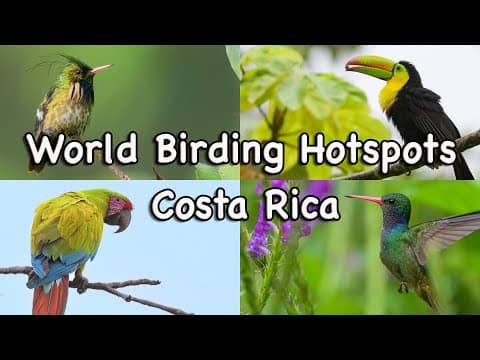
[0:00]Costa Rica is about 14,000 km away from Sydney, and with over 900 species of bird recorded, it is one of the world's top birding destinations.
[0:10]On this nine-day holiday, we'll visit four different locations, starting at the capital city of San Jose.
[0:18]We stayed at the Bougainvillea Hotel on the outskirts of San Jose.
[0:24]It had a huge garden, which is perfect to introduce us to the local birds.
[1:46]Don't forget to visit the center of town, where it's worth going to the local market and trying some of the local food.
[1:58]After San Jose was a two-and-a-half-hour bus trip to the National Park of Tortuguero.
[2:03]We had a quick stop for lunch, did a bit of a walk and saw a couple of birds.
[2:15]To get to your accommodation, you need to load up on one of these boats.
[2:20]They take you for an hour through these narrow canals, where you'll get to see a little bit of wildlife, until you finally reach your lodge.
[3:08]We stayed at the Laguna Lodge, which had some interesting architecture, but it was quite comfortable and had some good food.
[3:20]One of the highlights of the lodge was definitely walking around the garden, looking at the tropical plants, and also looking at the tropical birds.
[3:36]Tortuguero is an excellent place to see the critically endangered Great Green Macaw.
[3:42]Usually located high in the trees, they are tricky to get photos of.
[5:15]The Clay-Colored Thrush is the national bird of Costa Rica.
[5:20]They are one of the most common birds of the country and have been represented in folk stories, songs, and novels.
[5:42]A must do in the national park is to take a boat trip through the canals, where you will see plenty of birds and other animals.
[8:30]The first look at monkeys is always exciting.
[8:33]I'm pretty sure these are Howler Monkeys, but I'm no primate expert.
[8:38]If I'm incorrect, feel free to leave a comment.
[9:10]We also got our first look at the Keel-billed Toucan, an iconic Central American bird.
[9:53]Our next destination was the Selva Verde Lodge, a perfect place to explore virgin rainforests and inland rivers.
[10:06]Situated on about 500 acres, the lodge was comfortable.
[10:11]The weather was hot and humid, and there was quite a bit of rain.
[10:25]One of the highlights of the lodge was the bird viewing platform, where you could sit and eat breakfast and watch wild birds coming and going.
[11:22]One of the largest toucans in the world is the Yellow-throated Toucan.
[11:27]They have been known by a couple of names in the past, including Chestnut-mandibled Toucan and Black-mandibled Toucan.
[11:39]They have quite a varied diet, they feed on fruits, small insects, eggs of small birds and lizards.
[12:04]Unfortunately, their numbers are declining in the wild, and they're classified as near threatened.
[12:09]Let's hope they survive, because they are such a photogenic bird.
[12:40]The tanagers represent about 4% of all bird species on the planet, and Costa Rica has quite a few.
[12:46]They are small to medium-sized birds, and they come in a variety of colors.
[13:20]This is the tiniest hummingbird, the tiniest bird I've ever seen.
[18:52]Our third and final location was to head to Arenal Volcano, where we stayed at the Arenal Observatory and Lodge.
[19:04]The lodge was modern and comfortable, and the lookout had amazing views of Arenal Volcano.
[19:19]There's 350 hectares of primary forest and tropical gardens here, so there is lots of exploring to be done.
[19:41]We don't get woodpeckers in Australia.
[19:44]So I was fascinating watching this large Pale-billed Woodpecker, hammering away at a tree.
[25:46]Costa Rica is a fantastic destination for birding.
[25:50]We didn't do a specific birding trip, I mainly did birding in our spare time.
[25:54]In total, I counted 91 species.
[25:58]I hope you enjoyed this video.
[26:01]Thanks for watching.


