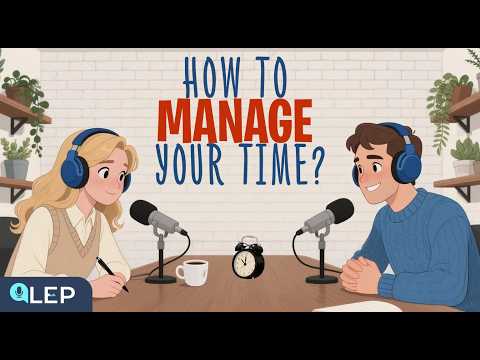
[0:07]Hey everyone, welcome back to Podcast and Chill, where you learn English while growing up through real life topics. I'm Leo. and I'm Gwen. Today, we want to talk about something very real. Why is it that in such a modern world, we're actually getting busier and more tired? Great topic, Gwen. Honestly, I wonder about this too. We have vacuums, dishwashers, and washing machines, blah, blah, blah. All kinds of gadgets to make life easier. Right. We've got online shopping, food delivery. Literally everything comes straight to your door. But somehow, time just disappears. And yet, instead of actually relaxing with all that save time, we end up burning so much mental energy on the little things. Our brains just get completely mentally crowded. Oh, Mentally crowded! Like having too many tabs open in your brain, all loading at once, right? Exactly. A dozen phone notifications, scrolling through random videos, catching up on trending posts on Instagram, then boom, the day is gone. So in today's episode, we'll break down the core reasons behind this problem. And of course, we'll offer some simple, practical solutions so you can finally take back control of your time. This episode is aimed at around the B2 level. But if you're B1, feel free to challenge yourself. Don't worry if you hit any tough words, we'll recap the key vocabulary at the end. All right, no more waiting. Let's get started.
[2:02]Hey Gwen, before we get into the causes, I think we should talk about something first. Like what? Like the difference between generations. Especially the gap between life before and after technology. Okay, then. I've been thinking about that too, actually. It feels a little strange. Right? Like why did our grandparents and parents seem so much more relaxed and happy back then? Clearly, they didn't have modern technology. Almost everything was done by hand. And yet they seem to enjoy life more. I think I know why. Ooh, look at Leo getting all wise today. Hey, stop teasing me. I'm trying to be serious here. Hahaha, okay, okay, I'm just messing with you. Go on, tell us why. Why did our grandparents live happier lives without all this technology? I think it comes down to one word, freedom. Oh, that actually makes sense. Freedom is the feeling of being able to do what you want without being controlled or rushed. Yeah. Back then, they didn't have much, but they had time. More than that, they actually enjoyed the process of doing things. I totally get that feeling. When I was little, I used to bake cookies with my grandma. That sounds so sweet. One time I burned a whole batch. But instead of getting upset, we just laughed at my clumsiness and started over. Love that. So what about now? Now we have all this technology, but we're living way too fast. Work pressure, endless emails, complaints, deadlines, life goals. It feels like sometimes you need to clone yourself just to keep up. I'm kind of shocked about you today, Leo. Very impressive. Thank you. But anyway, that's true. There's so much going on that we just keep our heads down from morning till night. Yeah, and the crazy part is, after all that rushing around, we crawl into bed and think, "Wait, what did I even do today?" Or worse, "Where did my time even go today?" So why does it feel like our time is constantly slipping through our fingers? On the surface, I'd say it's because our brains are getting way too much input every single day. Got five free minutes. Next thing you know, you've been scrolling for an hour. That's super common. Yeah, it happens all the time. But... I don't think that's the real problem. What do you mean? I think that's just what we see on the surface. There's something deeper going on. Like what? Sometimes we actually mix up energy with time. Hmm... that sounds interesting. Can you explain that a bit more? We often think that if we have time, we should be able to get things done. Like "Oh, I have an hour, I can be productive." But in reality, you might have the time and still not have the energy to focus. Ohhh... that makes sense. Like when your brain just feels tired for no reason. Yeah. You sit there, you try to work, but nothing really happens. The problem isn't time. It's that by the time we're free, we're already running on empty. And that's where the problem starts. When your energy is low, your brain naturally looks for the easiest way to feel better. Like entertainment? Yeah. Quick, easy things like scrolling short videos and random content. It feels harmless, right? At first, yeah, but the cost is actually pretty high. How so? Because those things don't really recharge you. They just keep your brain busy. Oh, so that kind of entertainment doesn't actually make you feel better. It just makes you more tired. And now you've also lost your time. Right. Then the next time you have a free moment, you go back to the same easy distractions. That's a loop, a really subtle one. You think you're resting, but you're not actually recovering. The more tired you get, the more you need those easy distractions. So you end up feeling busy all day, but at the same time completely drained. You know what? The problem doesn't stop at mixing up time and energy. It's also about using your best energy at the wrong time. Really? How so? Well, we all have "golden hours" throughout the day, but most of us don't even notice them. Golden hours? Like the time when we feel most energized? Exactly. But here's the thing. Everyone's golden hours are different. Wait, seriously? Our golden hours aren't the same? I know it sounds surprising, but it's true. And there's actually a word for it: chronotype. Chronotype? Yeah. It's basically how your body works. Like when you sleep, wake up and feel most alert. And it's hard to change. That's probably why so many people don't even realize when their golden hours are. Exactly. So if you're a night owl, you probably focus better at night. Wow. I always thought everyone worked best in the morning. Not really. Most people are just following social schedules, deadlines, and habits, not their actual body clock. Oh, I remember reading a study by Tyl Rothenberg about this. He argued that society pushes people into a "standard" schedule, like 9 to 5. But in reality, everyone's biological clock is different. He called this "social jetlag." That's why when we live out of sync with our natural rhythm, we stay tired. Our performance drops, too. And that's only part of the story. Because it's not just about being tired. It's about losing touch with your own life. What do you mean? You may see that life isn't just busy anymore. It's moving too fast. Hold on. Busy and fast aren't the same thing? Not really. You can be busy, but still present. Still aware of what you're doing, who you're with. But when life moves too fast, everything just blurs together. When that happens, you stop actually experiencing things. You're just... getting through them. That's a little sad when we think about it. It is. Like, you eat lunch, but an hour later, you can't even remember what you had. I can relate to that. Or you visit somewhere new, but you're so busy you don't even look around... or take it in. Even rest. Rest isn't really rest anymore, is it? Right. It becomes a task. "I have 30 minutes, so I have to relax now." That sends a moan is exhausting. Haha, exactly. You don't even notice it happening. Days just... go. Fast. But empty. At the end of the week, you sit there with only blurry memories, trying to figure it out. No real memories. Just a list of things you got through. That's what people don't talk about enough. We measure our days by how much we did, not by how much we actually felt. Tell me about it. Slowly, life starts to feel... colorless. Like you're watching your own life from a distance. You're there, but you're not really there. So we should start by protecting our attention. Our attention? Do you mean... how we spend our time? Uh huh. Because, in fact, our time isn't really disappearing. It's being fragmented. Fragmented? Yeah. A little bit of YouTube, a little bit of scrolling, a few "just five minutes" here and there. And before you know it, your whole day is gone. That's uncomfortably true. Most people don't lose time in big chunks. They lose it in tiny pieces. You're right. If we want to fix that, we need to reduce the noise and limit unnecessary input. That's hard. Right? People check their phones all the time. Exactly. So what should we do? Check everything in blocks. Maybe once every hour, or a few set times a day. Can you give an example? Sure. Let's say you're working or studying. Instead of checking your phone every few minutes, you do it for about an hour. Then you take a short break, and that's when you check your messages, emails, or social media. So you're not cutting it out completely, just controlling when you do it? Yup. You're still doing everything, just not all at once, and not all the time. That actually sounds doable. Yeah. And another simple thing is to give yourself some "no input" time. No input? Maybe just 30 minutes before bed. No phone, no videos, no scrolling. Just letting your mind slow down. That sounds... a bit uncomfortable. At first, yeah. But that's actually when your mind starts to slow down and reset. I realized that we don't really give our brains that space. Uh huh. When your mind is always full, it's really hard to focus on anything properly. So even if I sit down to work, my head is still all over the place. A big reason for that is all the small, unfinished things sitting in the background. Like those little tasks I keep ignoring? Yeah, that's why the next thing is to close small loops. Small loops? Yup. Those tiny tasks you keep putting off. Like replying to an email, booking something, paying a bill... Honestly, I always tell myself "I'll do it later." And later usually means it just stays in your head all day. Exactly. It's not big enough to panic about, but it's always there... quietly draining your energy. So how do we actually fix this? It comes down to one really simple rule. If it takes just a few minutes, do it right away. Makes so much sense. Don't let it sit there and grow. Right. Because once it's done, it's out of your head. And I guess that makes it easier to focus after that. True. When those small things are cleared, your mind feels lighter and you actually have space to focus on bigger, more important work. So once we've learned to cut out the noise and clear out those random little tasks...
[12:53]Agree! Less junk, better signal. That's where your best time comes in. You mean those "golden hours" we talked about? Yeah. Those moments when your focus is at its sharpest. But before you can protect them, you have to find them first. Okay. But how do you actually figure that out? Because I feel productive at random times. It's simpler than you think. Just observe yourself for a few days. Observe. Like what? Notice when you feel the most alert, the most clear-headed... when things just feel easier to do. Ohhh, like when you sit down and suddenly everything clicks? Yeah. No forcing, no struggling. You're just in it. Once you find that time, protect it. Use it for your most important task. Not emails? Not random stuff? Nope. Not the easy things. The important ones. Got it. Give it 1 to 2 hours. Fully focused. No interruptions. Save your sharpest hours for your most important work. That's clean. Before we move on to the next tip, I have a quick question for you guys. If you knew your golden hours, what would you spend them on? Yeah, drop it in the comments. Serious or fun, anything counts. Start with: "If I knew my golden hours, I'd spend them on..." That answer might be simple, but it's a starting point. Because once you know what truly matters, you can start giving your best time to it.
[14:34]Alright. Now we come to the last tip, and this is where people usually mess up. Really? Tell me! They don't respect their energy. They just keep pushing until they have nothing left. That's way too real. You start the day strong, but by the end of it, you're just tired and still not done. Then what can we do to fix it? Stop trying to push through everything. Work in focused blocks of 60 to 90 minutes. And then take a break? Yeah, a proper break. 5 to 10 minutes. Step away. Let your brain reset. No distractions. Just you and a quiet moment. So you don't burn out halfway through the day. Exactly. Because once your energy is gone, even simple things start to feel hard. Before we move on to the vocabulary recap for today's video, take a moment to think: How will you use your time and energy differently after this? Change doesn't happen all at once. It starts with small choices repeated every day. You're already on your way. Let's look at some useful words from today's episode. These will help you understand everything we talked about and remember it too. First up, fragmented. It means something is broken into lots of small pieces. For example, "My time feels fragmented because I keep checking my phone." Next, gadgets. These are small electronic devices like phones or tablets. For instance, "I spend too much time on my gadgets every day." The next word we have is mentally crowded. It means your mind feels full and busy. For example, "My head feels mentally crowded when I have too many things to do." Moving on. Running on empty. It means you have no energy left. For instance, "By the end of the day, I'm just running on empty." Up next. Chronotype. This is your natural sleep and energy pattern. For example, "Some people are morning types, others are night types. That's their chronotype." Another word is out of sync. It means not in the right rhythm or timing. For instance, "I feel out of sync when I don't sleep well." And finally, biological clock. It's your body's natural system that controls sleep and energy. For example, "My biological clock is all messed up after staying up late." And that's all the key words for today. Now you've got the tools to actually talk about your energy, focus, and time. Remember, it's not just about learning the words... it's about noticing them in your own life. Try using one of these words today, and see if it changes how you think about your day. Little steps like that add up. Well, Gwen. Today, I learned a bit more about managing my time and using my energy wisely. I hope you do find it interesting. Just a few small changes done every day can make a big difference in your life. Simply noticing our golden hours and clearing out small tasks already makes our day feel longer. Remember, taking real breaks matters too. Your brain needs to reset to work better. Thanks so much for listening today. We really appreciate you spending your time with us. If you found this video helpful, don't forget to like and subscribe. And comment below what you want to improve next. We'll share more tips with you. This is Leo, and I'm Gwen. See you in the next episode.