[0:00]In our last conversation, we talked about the graveyard of hobbies. We looked at the neuroscience of quitting, and we laid out a plan to build that muscle of tenacity, the part of your brain that allows you to push through when things get hard. But, you know, for some of you, a different, more confusing problem emerged. What if sticking with things is not your issue? What if your problem is that you have too many things you want to stick with? You look at your life and see a dozen different paths, and they all feel like a part of you. You are not afraid of the work. You are paralyzed by the choice. This is the classic scanner's dilemma, perfectly captured in the phrase, "I could do anything if I only knew what it was." Society has a word for you too. They call you a dilettante, someone who is a jack of all trades, but a master of none. And the anxiety that comes with that label is immense. It can feel like your greatest strength, your curiosity, is also your biggest career liability. Today, we are going to dismantle that anxiety. We will look at the geometry of a successful career and offer a path for those of us who are never meant to just be one thing. First, we need to understand why the old career advice can feel like a trap. For the last century, the world praised the specialist. Society was a predictable environment, almost like a chessboard. The rules were clear, and the path to success was to go a mile deep in one narrow field. Psychologists call this a kind learning environment. It rewards repetition. This is the world of the I-shaped person, the expert with a single, deep pillar of knowledge. But that is not the world we live in anymore, is it? The world today is a wicked learning environment. The rules are constantly changing, feedback is delayed, and the patterns are not obvious. Think about the difference between a golfer and a firefighter. A golfer operates in a kind environment. The rules never change, and the feedback is immediate. A firefighter works in a wicked one. Every situation is new, the rules are unknown, and their specialized knowledge might not apply. In a wicked world, the hyper specialist can have blind spots. Now, to be clear, we absolutely need specialists. Their deep knowledge is incredibly valuable. The problem is not that the specialist path is wrong. The problem is when it is treated as the only path. When that single standard is used to measure everyone, it leaves people like you feeling like a failure. When your brain is simply built for a different kind of world. To build a career that fits your brain, you have to stop thinking in terms of job titles and start thinking in terms of shapes. The I-shaped person is the specialist. The opposite is the dash-shaped person, a mile wide and an inch deep. This is the trap many of us fall into, knowing a little about everything, but having no real foundation. This lack of depth creates a ton of anxiety, because you feel like you have no ground to stand on. But there are other shapes. The most powerful one for a person like you is the M-shaped professional, or the polymath. Think of it like this, maybe your one leg is data science. You go deep there. That pays the bills. But your second leg is storytelling. You go deep there too, and your horizontal bar is your interest in psychology, history, and design. Suddenly, you are not just a distracted data scientist. You become the person who can weave complex data into a compelling narrative that a CEO can actually understand. That combination is rare. That combination is valuable. The tool that allows a polymath to do this is called far transfer. A specialist uses near transfer, applying a skill to a very similar problem. But a polymath uses far transfer. They see the underlying structure in one field, and apply it to a completely different one. A person who understands the branching structure of a tree's root system might suddenly see a better way to organize a company's database. A musician who understands harmony and counterpoint might look at a piece of software code and see a more elegant way to structure it. That is far transfer. It is the ability to see the music, not just the notes. And all those seemingly random interests you have collected over the years, they form the very library of metaphors you will pull from to create these kinds of breakthrough insights. So how do you actually build this M-shaped life? It requires a different strategy. The first is serial mastery. You cannot build all the pillars at once. That just leads back to the shallow dash. You must pick one pillar and commit to it for a season, maybe six to 18 months or so. Now, the big question is, which one to pick first? The anxiety of this choice is what paralyzes most scanners. The secret is to lower the stakes. You are not choosing for the rest of your life, you are just choosing for this season. A good first pillar is often the one that creates the most stability, the one that can become that good enough job we will talk about. Or, it could be the one that simply has the most energy and excitement around it right now. Pick one and give yourself permission to pour your focus there. You build one leg until it is strong. Until you feel you have mastered the core 80% of it. This doesn't mean you need to be a world-class expert. It just means you have reached a level of fluency where you can solve most common problems without running back to the instruction manual. When your curiosity in that area feels satisfied for now, you make a conscious choice. This is not quitting like a dabbler, running from the pain. This is strategic quitting. It is a graduation. You are deliberately choosing to begin building your next pillar. This requires a second strategy. If your mind is naturally drawn to exploration, it can be a powerful choice to have a day job that provides stability without draining all of your cognitive energy. Many of the great polymaths, like Einstein, did this. He worked as a patent clerk. It was the stable ground that allowed his mind to wander the universe. You may need to reframe your day job. It's not just about the paycheck, it's a strategic asset. A low-drain job leaves you with a surplus of your most valuable resource, your mental energy, which you can then invest in building your other pillars. A high-passion, high-stress job might sound exciting, but if it consumes 110% of you, it leaves no room for the exploration your brain craves. The final piece is a system, because, let's be honest, a scanner's brain generates more ideas than it can possibly hold on to. Your mind is a high-output idea factory, but your working memory is like a small workbench. If you don't move finished ideas off the bench, there is no room to build new ones. Trying to keep it all in your head is a recipe for overwhelm. This is why you need an external place to capture your fleeting obsessions. The great sociologist Niklas Luhmann published over 70 books, and his secret was a system called a Zettelkasten. He didn't try to write a whole book at once, he just wrote down one idea on a small index card. Then he linked it to another related card. Over decades, these connections grew into a massive web of knowledge that practically wrote the books for him. When you get fascinated with medieval architecture for a week, take notes. Put them in a simple system, like Notion or Obsidian. Then, when the obsession fades, you can let it go without feeling guilty. Three years from now, when you are working on a web design project, you might stumble upon those old notes and realize the structure of a cathedral is exactly like the structure of this website. That is the moment of magic. But it only happens if you capture the dots so you can connect them later. So, let's put this all together. You are not a dabbler who lacks grit. You are a scanner, a potential polymath. Your brain is not designed for the stable world of the specialist. It is designed to be a bridge between different worlds of knowledge. This path won't always feel easy, and mastery takes time. But just having a map for your mind brings a sense of calm. The self-blame begins to fade, replaced by a quiet confidence. Pick your first pillar, build it with focus. Use your job as a stable platform, not a cage. And build an external system to hold your endless sparks of curiosity. You were never meant to master just one thing. You were meant to be the person who can see how everything connects. And to help you get started on this, I've created a new, free PDF guide for you, called The Polymath Field Guide. It has a simple framework for auditing your interests and designing your M-shaped career. You can download it using the link in the description. Now, if you found yourself listening to this and thinking, my problem isn't that I have too many interests, my problem is that I quit the moment things get difficult, that is perfectly okay. That just means you are at a different part of the journey. I would recommend you start by watching our previous video. It will give you the tools to build that first foundational muscle. You can click on it right here. Thanks for watching. I hope this gives you something useful you can actually try, and I will see you in the next one.
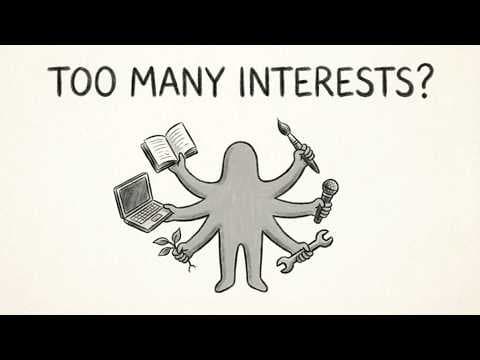
Career Strategy For People With Too Many Interests (The M-Shaped Future )
UnordinaryMind
10m 17s1,676 words~9 min read
YouTube auto captions
Transcript source
YouTube auto captions
This transcript was extracted from YouTube's auto-generated caption track. The transcript below is server-rendered so it can be read, searched, cited, and shared without opening the original YouTube player.
Pull quotes
[0:00]We looked at the neuroscience of quitting, and we laid out a plan to build that muscle of tenacity, the part of your brain that allows you to push through when things get hard.
[0:00]You look at your life and see a dozen different paths, and they all feel like a part of you.
[0:00]This is the classic scanner's dilemma, perfectly captured in the phrase, "I could do anything if I only knew what it was." Society has a word for you too.
[0:00]They call you a dilettante, someone who is a jack of all trades, but a master of none.
Use this transcript
Related transcript hubs
Watch on YouTube
Share
MORE TRANSCRIPTS


