[0:00]Hi, I'm Dr. Matthew McNutt, orthodontist. Thank you for visiting the before and after collection on our website. We're going to describe a class three malocclusion. Perhaps the best way to describe this is to first look at what an ideal harmonious bite looks like. Malocclusion simply means bad bite. The teeth that you see on the screen are arranged in that ideal, healthy bite. Let's use these arrows as guides. When they're lined up, you'll note that this lower first molar is a half a tooth ahead of its upper partner. The teeth are offset from one another in a protective relationship. These premolars here and here are also in the same arrangement with the lower premolar being a half a tooth ahead of its upper counterpart. The canines here are in the same relationship. You'll also notice that when the teeth are arranged in a proper bite, these lower front teeth are tucked up just behind these upper front teeth. That allows them to work together to cut food efficiently. In a class three malocclusion, the teeth are arranged like this. They're characterized by the lower teeth being well ahead of their upper partners. So you'll notice this blue arrow is now well forward of this red arrow. You'll notice this premolar is well forward of this premolar. Often times in a class three malocclusion, you'll also notice that the front teeth are in a crossbite situation like this. A class three malocclusion is typically not a very healthy arrangement for the teeth to be in. It can create a variety of problems for the patient in terms of being able to chew, putting too much stress and strain on gum tissues. In fact, thinning of gum tissues is a frequent occurrence if these lower front teeth are pushed too far forward due to being pressured by these upper front teeth. Like most bite problems, a class three malocclusion can be said to be severe in nature as you see on the screen. It could be a moderately bad problem, perhaps like this, or it could be a mild class three problem, perhaps like this. When it comes to a class three malocclusion, you'll find that the position of the front teeth varies whether it's mild, moderate or severe, as well as the back teeth. When you have a mild class three problem and the front teeth are stacked directly on top of each other, we refer to this as edge to edge. This typically is very destructive for front teeth. Front teeth are incisors, as we call them, are really not meant to stand up to the force of being stacked right on top of each other. They really should pass by each other while chewing like a pair of scissor blades. So when they're tucked in this position, it's much healthier. Now, when the orthodontist is evaluating a class three malocclusion on a patient, they are going to consider a number of different treatment options to correct it. Those treatment options are really going to be based on how bad the bite is. In the most severe cases, jaw surgery may be required in conjunction with orthodontic treatment in order to correct the problem. If it's a mild to moderate situation, the orthodontist has lots of different options in terms of how to best correct it. Sometimes that correction can be achieved with just braces and rubber bands alone. Occasionally an orthodontist is going to describe the extraction of permanent teeth combined with orthodontic treatment and rubber bands in order to correct the bite. It really depends on how severe the bite is. Typically, in the general population, a class three malocclusion is not very common. In fact, a class two malocclusion is much more common. So you won't see as many before and after cases for class three. Thank you very much for visiting our before and after section.
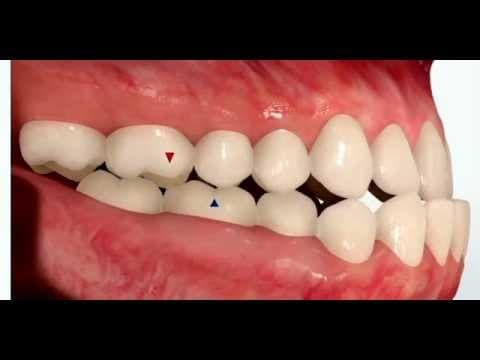
Class III Malocclusion
Matthew McNutt
4m 12s654 words~4 min read
YouTube auto captions
Transcript source
YouTube auto captions
This transcript was extracted from YouTube's auto-generated caption track. The transcript below is server-rendered so it can be read, searched, cited, and shared without opening the original YouTube player.
Pull quotes
[0:00]Perhaps the best way to describe this is to first look at what an ideal harmonious bite looks like.
[0:00]When they're lined up, you'll note that this lower first molar is a half a tooth ahead of its upper partner.
[0:00]These premolars here and here are also in the same arrangement with the lower premolar being a half a tooth ahead of its upper counterpart.
[0:00]You'll also notice that when the teeth are arranged in a proper bite, these lower front teeth are tucked up just behind these upper front teeth.
Use this transcript
Related transcript hubs
Watch on YouTube
Share
MORE TRANSCRIPTS


