[0:00]On the modern day island of Santorini, an entire city was preserved around 1600 BC under the ash of a massive eruption on the ancient island of Thera. Plato's Atlantis has been suggested as being inspired by the ancient island of Thera. We'll tour the archaeological site, as well as explore the objects, buildings, frescos and their way of life. This is Veronica from History Victorum. Join us as we visit the archaeological site of the ancient city of Akritiri on the Greek island of Santorini. Located on the southern area of the island of Thera, modern day Santorini, Akritiri is believed to have been founded in the Neolithic period prior to 3200 BC, and grew in size over time until its destruction by the eruption that reshaped the island. The discovery of Akritiri and what has been found there have led to the belief that this was a wealthy affluent city, well connected to the Agean trade routes. The site is only partially excavated, and it is unclear whether this area is representative of all of Akritiri or is a wealthier section of the settlement. Many have referred to Akritiri as the Pompe of the A in, and it has even been referred to as the inspiration for Plato's Atlantis. The island of Thea, present day Santorini, was created by various volcanic eruptions. The volcanic eruption that buried Akritiri, referred to as the Minoan or Late Bronze Age eruption, was somewhere around 3500 years ago, approximately 1600 BC. And the precise year is still debated. The island of Thera was of an almost circular shape with an entry point into the bay. After the eruption, Thera was left with a larger section and two smaller islands around the Caldera. Further eruptions have occurred since to present day. The results of these eruptions have not been as great, but have impacted the island with the creation of smaller islands, destruction of some small islands, earthquakes, tsunamis, and the release of fatal natural gases. The Minoan or Late Bronze Age eruption is considered to be one of the largest eruptions known. And even though Akritiri is referred to as the Pompe of the Aegean, the eruption of Vesuvius in Italy was smaller in strength. The eruption on Thera left a layer of ash over Thera that was about 60 m thick. It has been estimated that the eruption was preceded by earthquakes and that the eruption itself lasted for several days. Due to the findings or lack of findings in Akritiri, it is believed that the inhabitants were able to leave with many of their belongings prior to the final eruption, and that repairs due to earthquake damage may have been in the process at the time. There are even indications that Akritiri itself had dealt with the impacts of earthquakes in the past. In the late 19th century, Santorini had a quarry site on the southwest coast for the removal of ash to make concrete to be used in the building of the Suaz Canal. In the area of the quarry, they found remains of what was believed to be from a civilization prior to the eruption. This brought French and German archaeologists to the island of Santorini. The excavations along the ravine where a seasonal 20th century torrent of water periodically ran through Akritiri began in 1967. And only a portion of Akritiri is visible today. It is unclear what the size of Akritiri was at the time of the eruption, and there are varying estimates on its size as well as the number of inhabitants. Some estimates range from 1500 up to 12,000 inhabitants in the city of Akritiri. Akritiri was not just a city on the island of Thera, but instead was well involved in trading with other parts of the Aegean. There are a number of items found in Akritiri from mainland Greece, Crete and even as far away as Egypt. There also have been over a dozen items found in Akritiri with Linear A symbols, which is a writing script used by the Minoans. There were also 11 clay seals found in Akritiri, of which only two are believed to have been made with local stones, and the rest are believed to have come from Crete. These seals here are tied directly to the Minoan civilization, as bull leaping was a popular sport in the Minoan culture and is featured in a fresco from Nosos. These finds reemphasize the belief that Akritiri had trading ties to the Minoans. In 2020, a re-analysis of the Blue Monkeys Frescos led to the belief that Akritiri was not just part of an Aegean trading network, but of an even larger network. Agriculture was a large part of life in Akritiri with quite a bit of evidence with mill stations, instruments and tools found in the buildings of Akritiri. They used cereals as the main part of their diet. Meat was part of the Akritiri diet with fish not being that common. It was also determined that snails were eaten as snacks due to pithoid that were found filled with shells. Food was prepared in small kitchens in the home where grinding tools, pots, and storage containers were found. Neither kilns nor pottery workshops have been found in Akritiri to date, which shows there may be still more of Akritiri to be excavated. Vessels were found throughout the archaeological site of Akritiri in large quantities. They were mostly local pottery with some coming from other areas, such as the Greek mainland and Crete, such as these in the prehistoric museum. They were used for cooking, serving, storage of goods, transportation of goods, and for other daily living purposes. Black, brown, and red paints are the most commonly found paint colors on the pottery in Akritiri. Similar to pottery workshops, they have not found a stone workshop to date in Akritiri, even though many stone objects were found in Akritiri with indications that stones were worked on in the site. There were stone tools discovered that were made from local volcanic rock. Some common items were millstones, mortars and grinders. They also found stone bases from Crete and possibly Egypt. Hundreds of loom weights were found in the West House's room three and complex Alpha. Textiles have not been found in Akritiri to date, but due to the loom weights that were found, a linear A tablet that mentions it, and the frescos with ships, it is believed that weaving took place in Akritiri. This has led archeologists to believe that Akritiri was specialized in textile production for local use and for exporting. Evidence has also been found that baskets and mats were made in Akritiri. In the West House and Delta Sector, the remains of mats were found in their ground floors, and the disintegrated remains of baskets were also found here. Very little metal has been found to date in Akritiri, with much of it in the form of lead loom weights. It is believed that the inhabitants took most metal items with them when they evacuated due to the earthquakes leading up to the eruption. Even though wood could not survive this long period of time, archaeologists were able to use techniques to create cast of the wooden objects, similar to the casts made in Pompe. They found several items including beds, such as the one here in the museum, as well as on the archaeological site, chairs, stools, and tables, such as this tripod table in the museum. Akritiri had large multi-story buildings, blocks of buildings, a well planned layout, organized street network, a grid order, and a sewage system. Many buildings were of two or three stories and at times were detached or grouped together with walls of the buildings against each other. Typical homes had a ground floor, while those for communal purposes, such as public buildings, were significantly much larger. The street network through Akritiri looks to be planned and organized with somewhat east-west and north-south directions for streets. The network includes main streets, smaller streets, alleys, and open spaces. The main streets were where building main entrances were located or through a public square. These main streets were paved with large flat stones and at times included broken stone objects. There are a number of open spaces or public squares in Akritiri, varying in size and shape. The two main squares that visitors can walk through are the Triangle Square where the West House is located and Millhouse Square, which is between the Beta and Delta sectors. Water was brought into the house and placed in a water reservoir near the entrance. It is unclear what or where the water source was located. Akritiri has a public sewage system that runs through Akritiri and at times under the streets, as seen here where it was exposed by the torrent of water. The public sewage system was unique in Akritiri due to the fact that internal plumbing from buildings within Akritiri were connected to the sewage system. In the West House, the upper stairs laboratory was connected to clay pipes that ran down to the sewage system in the alley. The connection used the earliest known form of a siphon to prevent the smells from the sewage system from entering the home. This type of technology would not be seen again for 1,000 years until the Roman Empire, and was again lost in the Middle Ages until the 18th century. It is this type of advanced technology that has led many to believe that Thera was the inspiration for Plato's famed Island of Atlantis. Plato described Atlantis as a circular island with advanced technology that sank into the sea. With Akritiri's technology lost under the ash, as well as parts of the island lost to the sea, it isn't hard to see the similarities of Thera and Atlantis. To date, only some of the buildings in Akritiri have been excavated and analyzed. There are a number of commonalities in the architecture of the buildings in Akritiri, including the placement of a window next to the main entry door, small windows on the ground floor, larger windows on the upper floors, timber frames for walls, large stone masonry used for framing doors and corners, doors and windows made of wood, stone or wood used for staircases, and the ground floor was all dirt floor except for the lobby. We'll briefly look at the buildings that are the highlights of Akritiri. We'll begin with the West House. The unique highlight of the building is the lavatory on the upper story that connected into the sewage system. Its most famous frescos are those of the fisherman and flotilla. In the Alpha Sector, primarily Alpha East has been excavated, and a pithoy storage room was found here, and the before mentioned shells were also located here. The Beta Sector was damaged by the torrent of water. The western parts of the building are best preserved of the two buildings. Its most famous for the frescos of the boxers and the blue monkeys. The Delta Sector is famous for the Spring fresco, which was found here along with a lion's head written and a cast that was made of a wooden bed. In the Gamma Sector, in one of the rooms, they found many objects made of stone and metal, which has led some to believe that this room was used for metalworking. In Zest 2, these buildings have not been fully excavated, other than being a three-story building, Zest 2 contained a base with linear A symbols. Zest 5, although not well excavated, has a facade that is entirely made of large stones. Zest 3, the second largest building discovered in Akritiri to date, is famous for the frescos of the saffron gatherers and the mistress of animals with four figures. A woman, blue monkey, the mistress and a Griffin. Zest 4, the largest building found in Akritiri to date, has a unique facade made of large stones in white and green hues. The House of the Ladies has a unique architectural highlight, which is the central light well that allows light to enter into the center of the room. The house is also named after the famous frescos of the ladies that were found on the upper story. Although the archaeological site is open to visitors, it is still an active dig site with excavations currently underway. A public building in the very southwestern corner of the current archaeological site near Zest 3 has resulted in additional finds. They have found a marble statue, animal bones, and a gold Ibex statue, which as you know, very little gold has been found on the site. We look in depth on some of the buildings and their findings in the Akritiri playlist here. Feel free to also explore some of our other videos as well. Thank you for joining History Victorum.
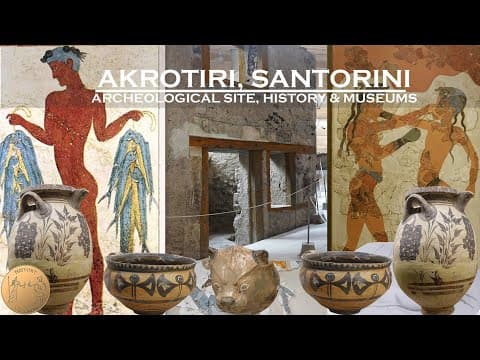
What is in Akrotiri, Santorini? | History, Archaeological Site, Prehistoric Museum Documentary | 4K
History Victorum
12m 20s2,153 words~11 min read
YouTube auto captions
Transcript source
YouTube auto captions
This transcript was extracted from YouTube's auto-generated caption track. The transcript below is server-rendered so it can be read, searched, cited, and shared without opening the original YouTube player.
Pull quotes
[0:00]On the modern day island of Santorini, an entire city was preserved around 1600 BC under the ash of a massive eruption on the ancient island of Thera.
[0:00]Plato's Atlantis has been suggested as being inspired by the ancient island of Thera.
[0:00]We'll tour the archaeological site, as well as explore the objects, buildings, frescos and their way of life.
[0:00]Join us as we visit the archaeological site of the ancient city of Akritiri on the Greek island of Santorini.
Use this transcript
Related transcript hubs
Watch on YouTube
Share
MORE TRANSCRIPTS


