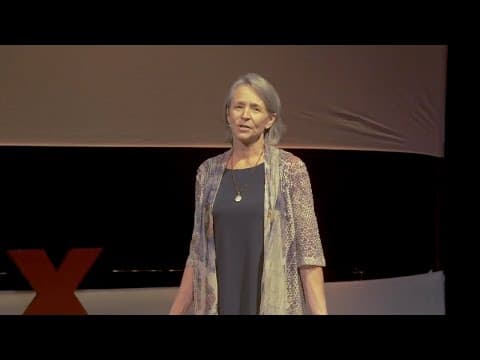
[0:15]I'd like to tell you a story about a boy named Sven. He was in the fifth grade, autistic, and he couldn't read a single word. Not it, me, the, nothing. His teachers told his family that he may never learn to read. With my simple reading program, I taught Sven to read. My story begins when my daughter was in the first grade. She was a challenged reader. At that time, I didn't know about challenged readers. Everyone can read, right? Wrong. According to the US Department of Education, last year, 19% of high school students in America graduated unable to read above a third grade level, which is considered functionally illiterate. That's nearly one in five students or half a million new graduates each year. How can anyone graduate high school not knowing how to read? Teachers are doing everything they can to help these kids, but the traditional way of teaching reading does not work for many students. According to the National Assessment of Adult Literacy, in America, 85% of juvenile delinquents and 70% of prison inmates are functionally illiterate. Illiteracy is the number one predictor of future criminal activity. There is a solution, and this is how it came about. In my twenties, I went to Japan to teach English. I needed to learn Japanese, and I was told to learn to read first. I discovered that the Japanese have developed a system called Hiragana, which makes reading so easy, I learned in a week. I didn't know the meaning of the characters at first. The point is that I could sound out and correctly pronounce Japanese. Ten years later, when my daughter's reading challenge opened my eyes, I decided to take what I learned in Japan and adapt it to English. With the help of a reading specialist, I wrote down all the sounds of English. Then, I analyzed our alphabet. I discovered that of our 26 letters, 12 make only one sound. But these other 14 letters make multiple sounds. The A makes four sounds, the C makes three, the O makes eight different sounds. I believe this is why English is so difficult. Let's take C as an example. The three sounds of C are in cat, face, and ocean. I was also surprised to discover that these 17 letters are sometimes silent. Meaning they do not make a sound in many words. Think for a moment about these four examples. There is no B sound in the word doubt, no G sound in the word sign, no S in island, and no W in who. The program I developed is called Nardagani. I found a way to expose all the sounds of the 14 letters. Underneath the letters is one of these symbols. These symbols let the reader know what sound to make. They also guide students in learning to sound out words. I'm going to teach you two of these symbols. First, everyone's favorite symbol. The square is your lips, the line is your finger, and the sound it makes is shh. The sh sound can be made five different ways. With one S in sugar, two S's in mission, an S H in sheep, a T in vacation, and a C in social. The triangle symbol lets the reader know the ooh sound is needed. The ooh sound can be made four different ways. With one O in move, two O's in school, an E in flu, and a U in super. How about those silent letters? They're underlined and easy to see. Here is an example of our symbols in action. Notice the three different sounds of U. We hum a tune for you. Dr. Jeffrey Wilhelm, distinguished professor of English education at Boise State University, and a nationally recognized literacy expert, conducted a small-scale teacher research study with our program. He concludes that it works. Because it reduces the cognitive overload that is typically experienced by those learning to read English. We have conducted several pilot programs in detention facilities, which were highly successful. Nardagani has been approved by the Idaho State Department of Education for use in Idaho schools. Using Nardagani, Sven, in fifth grade, learned to read with our symbols in eight, one hour lessons.
[7:53]It was pretty hard, but when I started to work with them, it is now easy. I'm going on Safari. I see animals all around me.
[8:34]on Safari.
[8:38]I did it! You did it.
[8:44]So, Sven learned to read our coded books in eight, one hour lessons. Several months later, he no longer needed the symbols. Last year in high school, Sven became a proud member of the National Honor Society of America. Sven says, I once thought reading was impossible.Now, I know all things are possible.


