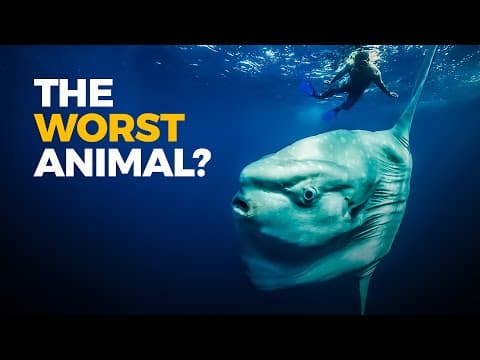
[0:00]I remember the first time I ever saw a picture of an Ocean Sunfish on the cover of a Nat Geo magazine or something like that. I was probably eight years old, and I distinctly remember thinking, why would they put a picture of a half-eaten fish on the cover of their magazine? And I am clearly not the only one who can't comprehend what they're looking at. I don't know what this is. But Jay says it's a big sea turtle. Look It's a baby man. Holy We are witnessing a baby wheel right here, dude. This disembodied swimming head looks like the biggest joke played on Earth. It's often seen just sort of flopping around at the surface. And getting stuck at the surface seems inevitable for a fish that has no pelvic fins and a back fin that never grows, but instead folds in on itself forever. And for a fish that looks basically immobile, it somehow gets absolutely enormous. In fact, it's the heaviest bony fish in the entire world. For years, people thought that it somehow got energy from the sun, because how else could it get so stupidly big? Even it seems surprised at its own continuing existence, its mouth permanently gaping open, literally unable to close. When you first see this fish, it's hard not to wonder if this disc of a creature is an evolutionary accident. That maybe it is somehow breaking the rules of nature, rules which are supposed to select for animals that actually function. Survival of the fittest and all of that. How does such an awkward, slow-moving thing become so massive? How does it exist at all? These are valid questions, but it turns out this fish isn't as clueless as it looks. And its stupid-looking deformed body, and all of its weird flopping around on the surface behaviors do actually serve a purpose. This fish isn't just eking out an existence in the vast ocean, but dominating it. Going places and surviving in ways you would never expect. Because sometimes being weird is the best way to exist on this Earth.
[2:23]Sunfish belong to the family Molidae, and they're related to pufferfish, triggerfish, and boxfish. They're found worldwide in the open ocean of tropical and temperate seas. There are five recognized species of sunfish, ranging from this odd little guy, the dwarf mola, to this behemoth, the giant ocean sunfish. The largest one ever discovered was 6,050 pounds or 2,750 kg, as heavy as a large SUV, and was 3.25 m long and 3.6 m tall. And though they might look ancient, prehistoric or basically not of this world or dimension, they're actually evolutionary newcomers to our planet. The very first fish on Earth emerged over 500 million years ago, but the Molidae family emerged only 50 million years ago. In fact, molas are thought to be one of the most recent fish to appear in the sea. The first thing anyone notices about a mola is that it seems to be missing half its body. Its spine is indeed truncated and it doesn't even have ribs. Its back fin decides to never grow, but rather it folds in on itself indefinitely. This creates a lumpy, round section at the back of the body called a clavus. It's also missing its pelvic fin, and its pectoral fins are small and rounded. The massive fins you do see are oversized dorsal and anal fins. But what's perhaps the most surprising thing about the mola is that it doesn't have any axial muscles. In normal fish, the axial muscles go down the length of the body and are used to flex the body laterally and the undulation powers forward swimming. So without these seemingly essential muscles, how does the sunfish even move? Instead of axial muscles flexing the body laterally, the sunfish has enlarged muscles around its dorsal and anal fins. These massive fins flap simultaneously, propelling the sunfish forward, while its body remains almost completely rigid. The fins direct water flow over them and produce lift-based thrust forces. The leading edge of the fin is rounded and the trailing edge is tapered, and both fins on an individual are the same size. These fins are literally just wings, although vertical ones. This is extremely interesting from an evolutionary standpoint. These two fins originally evolved in fish for a completely different purpose. And in almost all other fish, these fins are asymmetrical. The sunfish co-opted these body parts to create a different method of propulsion in an incredible case of convergent evolution with other underwater flyers. Animals with which it shares little evolutionary history, like manta rays, turtles or even penguins. In fact, the acceleration signatures recorded from ocean sunfish are remarkably similar to free swimming penguins. And although the sunfish fin structures are similar to other ocean flyers, sunfish are the only aquatic vertebrate with its wings in a vertical orientation like this. In fact, I can't find any animal at all with wings in this configuration. As it flaps its wings, it oscillates its tiny pectoral fins for balance and its lumpy, weird clavus acts as a simple rudder. Is this all very weird? Yes. But does it work? Also, yes. Adult sunfish cruise at around 3 km per hour, which isn't exactly fast, but, you know, it works. And it works quite efficiently. Because their fins are so big, they don't have to move fast to create a lot of thrust. On top of this, their skin is not like normal fish skin. It doesn't have scales and instead, the fish is covered by a thick hypodermis. It's inflexible and rubbery, and also greasy and it's made up of a meshwork of collagen and elastin. Their body is so rigid that it decreases drag. And in fact, this layer is so stiff that it's considered to be an exoskeleton, even protecting them from predators like sharks, sea lions, and orcas. Although, not entirely. The combination of high aspect ratio fins and minimal body movements help the sunfish be efficient. But it doesn't really explain why the sunfish moves so slowly. If anything, this should help the sunfish cruise around quickly, like tuna, who are cruising specialists, and also have large fins and a somewhat rigid body. But there is one major difference between these two fish, besides the obvious anatomical differences. Bluefin tuna can maintain a core body temperature of 24 to 35° Celsius, even in water as cold as 6° Celsius. The ocean sunfish cannot elevate its body temperature because it's ectothermic. Endothermic tuna and sharks can move much faster, but at a cost. It takes a lot of energy to maintain a warm body temperature in a cold ocean. So you might think that the sunfish must then hang around in shallow, warm waters to try to stay somewhat warm. And they usually do. Sunfish are most often found in water warmer than 12° Celsius, because prolonged periods spent in water at temperatures of 12° Celsius or lower can lead to disorientation and even death. But the sunfish, as we've learned, ain't no rule follower. They often go deep, sometimes really deep, all the way down into the midnight zone, over 1,000 m down. Here, the water is just 4° Celsius. What the heck are these slow, cold-blooded creatures doing down there? To find out, researchers invented the mola cam. They didn't call it that, but I'm calling it that. This device contained a camera, a light, an accelerometer, a satellite transmitter, and a thermometer that could read the temperature of the water and the temperature inside the fish. With this, the scientists could see what the fish was eating, where it was going, including how fast and how deep. And they found that these fish were going so deep in order to forage. Specifically, to forage gelatinous plankton, mostly deep-water siphonophores. During these dives, their body temperature would drop from 20 to 12° Celsius, a dangerously cold temperature. Why take such a risk? What's wrong with eating prey in shallow water? Because the sunfish's prey isn't always there. While some species of jellyfish may consistently hang out near the surface, much of what the sunfish eats is part of the greatest migration on Earth. Every day, billions and billions of tiny animals move up and down the water column all throughout the ocean. This movement is called the diel vertical migration or DVM for short. It's thought that these animals swim up to food-rich surface waters at night to feed when light is scarce and they're harder for predators to see, and then return to the depths before the sun rises. The sunfish, being one of those predators, circumvents the zooplankton's clever plan and simply dives down to get them, using sunlight to help illuminate their prey as much as possible. And when they dive so deep as to lose all sunlight, they likely spot the glow of their prey's bioluminescence. Hunting at night when their prey is in shallower water must not be as effective for the sunfish, so they don't seem to do it. Sunfish always do their deep dives during the day, and as you can see, they do a lot of them. With their awkward swimming and slow speeds, how do they manage so many heroic dives in a day? For most bony fish, this amount of rapid movement up and down the water column would be a death sentence due to the cold and due to their swim bladder. Swim bladders help fish stay neutrally buoyant without having to expend energy constantly swimming to stay in one position in the water column. But that neutral buoyancy can only be achieved at a small range of depths. If a fish swims below its buoyancy range, its swim bladder cannot compensate enough or quickly enough, and unless it swims upwards extremely hard, it will sink. And the more it sinks, the harder this will become until the negative buoyancy can no longer be overcome. On the other hand, if a fish swims above its upper buoyancy level, it becomes too buoyant. Its swim bladder expands so much that the fish might rise to the surface uncontrollably, if it does not compensate for this increased buoyancy by vigorously swimming downwards or aggressively farting out the gas. If this happens, the swim bladder can even burst. Swimming to great depths and back is simply out of the question for almost all bony fish. So how does the sunfish do it? Once again, by being weird. They don't have a swim bladder at all. Instead, their weird dense bodies keep them neutrally buoyant, no matter what depth they're at. This is largely thanks to their hypodermis, their stiff, gelatinous exoskeleton. While the sunfish's skeleton and muscles are negatively buoyant, their hypodermis tissue is positively buoyant and incompressible. The densities of these tissues average out to be about the same as the density of seawater. With this neutral buoyancy, sunfish use their efficient lift-based swimming to travel up and down the water column many times a day. And repeated surfacing after their deep dives is crucial because this is how they warm themselves back up. When people see sunfish from their boats flopping around at the surface, they aren't stuck there or confused, despite how it looks. This is, in fact, a type of behavioral thermoregulation. Basking in the sun warms their body back up and readies them for their next deep dive. This is also how they got the name sunfish. Their large surface area helps them absorb more heat and helps them float at the surface without using up energy. And the bigger the sunfish, the more heat it can retain, allowing it to dive even deeper and for longer. The biggest sunfish are, indeed, the deepest divers. Being enormous also comes with some other serious benefits in the open ocean. Because when you're a fish and it's time to lay your eggs, it's a guarantee that many, if not most of them, will be immediately gobbled up by your hungry neighbors. Rather than be sad about this, the mola says, I dare you to eat all these eggs. And squirts out more eggs than any vertebrate in the world, made possible by having enormous bodies with enormous ovaries. To give some perspective here, the beluga sturgeon, one of the largest bony fishes, lays up to 7 million eggs in a year. Bluefin tuna, another of the larger bony fish, can lay up to 30 million eggs. But this doesn't even come close to what the ocean sunfish can lay. A 1921 report stated a single 1.5 m female Mola mola was estimated to be carrying no fewer than 300 million ova. And more recently, a 2.2 m female was examined and found to have between 875 million to 1 billion ova in different stages of reproduction inside of its ovaries. It's hard to even wrap your head around how many eggs this is. Mola release their eggs pelagically, as in they just squirt them out wherever, and then they're fertilized externally. But this has never been witnessed in the wild for any of the five species of mola. No one knows how many of these eggs survive and turn into full-blown molas. But with numbers this high, the odds have got to be pretty good. By necessity, these eggs are very small. And thus, Mola mola growth is mind-blowing. For the quarter of a centimeter larva to grow to a 3 m adult, it has to increase its mass by 60 million times. One mola at the Monterey Bay Aquarium gained nearly a kilogram every day for 15 months. And for such a large, bulbous creature, their larva look surprisingly much different. They're small and incredibly spiky, likely to ward off would-be predators. As easy as it is to joke about this weird and lumpy fish, digging into its adaptations reveals that being weird is sometimes the best survival strategy. It unlocks new ecological niches with better access to food and better chances of reproducing. And maybe that stupid look on its face is also an evolutionary adaptation to get everyone to underestimate it. Maybe the Mola mola is the biggest hustler in the sea. Getting bamboozled by a big weird fish is pretty harmless and kind of funny. Getting bamboozled by the media is way less funny. If only all we had to worry about is the great debate about whether the mola mola is cool or if it's dumb. Unfortunately, the world is more complicated than that, and we have to worry about a lot of things. Student loans, the housing market, fundamental rights being stripped away. We all want to know what's going on, but these days, the credibility of the news media has started to break down. We've all seen it. Media outlets only reporting on the news they feel their base wants to hear, or sensationalizing things to the point of absurdity to get the clicks. With hundreds of news sources out there, it's downright annoying trying to sift through all the nonsense. This is why a good news aggregator app like Ground News is so helpful. When Ground News said they wanted to sponsor this video, I was so excited, because it's an app that I use every day. Ground News provides you with a feed of headlines curated from over 50 outlets from all over the world, but with the content organized, so you can see through the spin and bias and figure out what is really going on. You can quickly swipe through the different headlines that different news outlets are giving to the same story. Sometimes the differences are subtle, other times, not at all. You can also see which news outlets are choosing to ignore or under-report stories that are being widely reported elsewhere. You can even sort to see the stories that are particularly being spun one way or the other. For example, this story about shipping emissions and climate goals is being widely reported from the left, somewhat from the center, and almost not at all from sources that lean right. Then, when you click on the story, you can see a graph of all the outlets reporting on it and the bias distribution of those outlets. It shows that it has only an 11% right bias, and is thus flagged as a blind spot story for people on the right. Readers from any political leaning can identify media bias and check source credibility. There's even a web browser extension that can show you the breakdown of how news outlets from across the political spectrum are reporting on the same story. This all helps you immediately notice certain bias trends, which is helpful, but also fascinating. Seeing the different choice of words in headlines from different organizations, while also seeing their bias flagged is a super effective way to see exactly how prominent and widespread news bias really is. It adds another layer of interest to reading the daily news. As of now, there's no feature to show you bias from sources rating the coolness of animals, but, you know, never say never. So if you're looking for a better way to stay informed about current events around the world, check out Ground News by visiting ground.news/realscience. The link is in the description. You can try it free or subscribe to get access to all the features you see here and support transparent independent news. Ground News is also offering all real science viewers a special 30% discount on their Vantage subscription, the top-level subscription option. This offer is only available at ground.news/realscience or by clicking the link in the video description.


