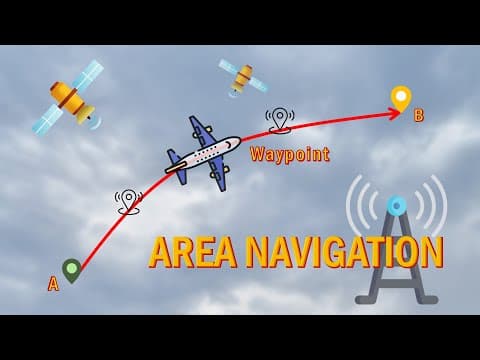
[0:00]Hello, and welcome to JxJ Aviation. In this video, we will be looking at what is meant by area navigation, or NAV, and how it has benefited airlines around the world.
[0:15]What is Area Navigation? Area navigation or NAV refers to a method of navigation which allows an aircraft to fly on a desired flight path, let's say from point A to point B. To fly on this flight path, the aircraft takes assistance of ground-based navigation aids, space-based navigation aids, or self-contained navigation aids, or a combination of these. This method of navigation comes under instrument flight rules. To understand the advantages of this method of navigation, let's look at some of the other methods of navigation.
[0:52]The other methods of navigation. If we consider visual flight rules or VFR for flying from A to B, the pilot is relying on visual landmarks outside the aircraft. So the aircraft can only be flown at low altitudes and there should be good visibility along the entire route. Now let's consider the traditional method of navigation using ground nav aids. The aircraft must now fly towards the ground navades, such as a VOR DME and on reaching it, the aircraft must fly to the next VOR DME until it reaches its destination. Area navigation, or NAV, however, allows an aircraft to fly directly from A to B. So what is the advantage of this?
[1:43]The advantages of RNAV. The biggest advantage of RNAV is that it allows a direct routing from A to B. This means reduction in flight time, reduction in fuel consumption, more efficient use of airspace, reduced interaction with ATC.
[2:04]How does RNAV work? Before global navigation satellite system, GNSS, was available, the ground nav aids were used to create Phantom waypoints. These waypoints had the name of the VOR, the radial and the distance. The aircraft would fly to this waypoint and then to the next Phantom waypoint until it reaches the destination. With the help of GNSS, such as GPS, the waypoints can be created using specific coordinates. This means that waypoints can be created on routes where ground-based nav aids cannot be installed, which may be due to terrain or over oceans. Does this mean that aircraft navigation is solely dependent on external signals? No. Modern aircraft navigation can be done by systems installed within the aircraft. Let's see this in more detail.
[3:03]Aircraft Navigation Systems. Modern aircraft may be installed with an inertial navigation system or an inertial reference system. These systems contain gyroscopes and accelerometers, which sense the movement of the aircraft and provide the aircraft position continuously. The position information can be used to fly to a particular waypoint, even if external signals are not available. For these systems to be accurate, they must be aligned on the ground when the aircraft is stationary. To achieve a higher level of position accuracy, the signals from GPS or ground nav aids are combined with the aircraft navigation system information to accurately navigate a particular route. That's all for my video on area navigation. Thank you for watching. If you like the video, please subscribe.