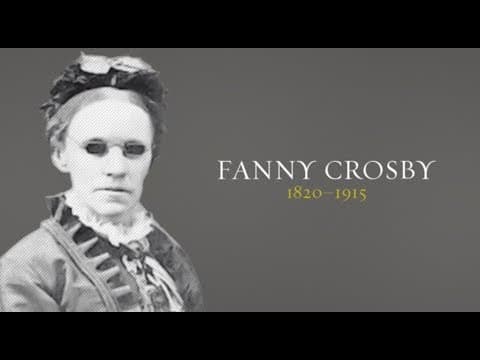
[0:29]Thank you very much indeed. Good morning, gentlemen. It's good to be with you. First time I've been here. I want to just read a very few verses of scripture to you. I'm not going to preach on them and I'll explain why in just a moment. But Paul writing to the Ephesians says, Speak to one another with psalms, hymns, and spiritual songs. Sing and make music in your heart to the Lord, always giving thanks to God the Father for everything in the name of our Lord Jesus Christ. And to the Colossian church he writes, Let the word of Christ dwell in you richly, as you teach and admonish one another with all wisdom, and as you sing psalms, hymns and spiritual songs with gratitude in your hearts to God. And then the Apostle James in the final chapter of his epistle says, Is any one of you in trouble, he should pray. Is anyone happy, let him sing songs of praise. And you will see the theme that runs through those two readings is singing. Now when we come to hymnology in the English language, there are three great hymn writers. Isaac Watts, who lived from 1674 to 1748. Charles Wesley, who lived from 1707 to 1788. And the lady about whom I am going to speak today, Fanny Crosby, who lived from 1820 to 1915. She certainly would be America's greatest hymn writer. If we were to ask the question, how many people have been blessed through her hymns, how many people indeed have been brought to faith in Christ through her hymns? Well, of course, no one knows, but I would think it must be a great number, and perhaps only eternity will reveal the full impact of her hymns. So, right from the start today, I have to say I'm not expounding the word of God, which would be my normal thing to do. But in conjunction with Ben, I actually was asked if I could tell you a little bit about Fanny Crosby. As you've already heard from Bert, I think it was, who said that Fanny Crosby was blind. In fact, I thought for a moment he was going to actually do my talk for me, but thankfully, thankfully, he cut it short at that. Can I just remind you of some of the hymns that Fanny Crosby has written before I actually talk about her? Hymns that you'd be familiar with. To God be the glory, great things he has done. Blessed assurance, which we've already sung this morning. All the way my Savior leads me. Praise him, praise him, Jesus our Blessed Redeemer. Here from the world we turn, Jesus to seek. Jesus, keep me near the cross, there a precious fountain. Some day the silver cord will break. Rescue the perishing, care for the dying. And I am thine, oh Lord, I have heard thy voice. I'm sure all of those are familiar to the vast majority of all the work of Fanny Crosby. Well, what do we know about her life? Fanny Crosby was descended from a humble family who had emigrated to America, to New England, in the 17th century. She was born in a little village in Putnam County in New York State, on the 24th of March, 1820. When she was just six weeks old, she suffered from inflammation of the eyes. And a local doctor recommended that hot poultices be placed on her eyes. Not only did it not heal the inflammation, but it blinded her for life. And yet, you know, as I have read about her and done a little bit of research for today. If her life could be summed up in two words, I would sum them up in the words joy and trust. Joy and trust. And I hope that today those two words will come as a challenge to you. Are you enjoying God? Are you enjoying the Christian life? I'm not asking you what your circumstances are. They may not be good, but are you enjoying God because you are trusting in God? And that really, as I say, sums up Fanny Crosby's life. She bore that doctor no ill will. When she was an adult, well on in years, she said, I have not for one moment felt a spark of resentment against him. For I have always believed that the good Lord in his infinite mercy, by this means, consecrated me to the work that I am still permitted to do. When I remember how I have been blessed, how can I complain? You can see her her her trust in God, her joy in God coming out even that she never bore any resentment against the doctor who had made her blind. She published her autobiography when she was 83 years of age, so there's a chance for some of you yet. She published her autobiography and in it she said, It seemed intended by the blessed providence of God that I should be blind all my life, and I thank him for the dispensation. If I could meet that doctor now, I would say thank you, thank you, over and over again for making me blind. In fact, she claimed that even if a cure for her blindness could be found, she would not make use of it. Because she believed that blindness was God's gift to her in order that she could write songs and hymns for his glory. She actually said this, I could not have written thousands of hymns if I had been hindered by the distraction of seeing all the interesting and beautiful objects that would have been presented to my notice. What an example she gives us, what a challenge she brings us of a complete trust and acceptance in the goodness of a sovereign God. Well, now you might think in spite of her blindness did she have an easy life? And the answer is no. Before she was one year old her father died. And her mother and grandmother moved with her to the state of Connecticut. They moved to a house which was owned by a Christian lady named Mrs. Hawley who lived nearby. And those three ladies, her mother, her grandmother and Mrs. Hawley were her first instructors, they were her teachers. Mrs. Hawley would read to her from the Bible and teach her Bible stories and get her to learn the Bible. Now, gentlemen, listen to this next sentence. When she was 10 years of age, she knew by heart and could recite by heart, all of Genesis, Exodus, Leviticus, Numbers, Matthew, Mark, Luke, and John.
[8:00]By the age of ten, eight books of the Bible. As an adult, she actually compared her life and we'll see this later on when we think about some of her hymns. As an adult, she compared her mind to a writing desk. You know the old writing desk with lots of little compartments in them. And she said that those little compartments were filled with information that was readily available to her. So she seemed to be able to have a mind where she could open a little compartment of the writing desk and and pull out the required information. She wrote her very first poem when she was eight years of age. It's a little eight-line poem I have it here in front of me. And as an eight-year-old, she wrote, Oh, what a happy child am I, although I cannot see, I am resolved that in this world contented I will be, How many blessings I enjoy that other people don't, So weep and sigh because I'm blind, I cannot nor I won't.
[9:05]As an eight-year-old already, you can see this trust in God and and and realizing that she had what did she say, how many blessings I enjoy. As a child, she would compose little poetic pictures. She said, When I gathered flowers and caught their fragrance, I wanted to say something poetic about them. As I wandered down to the brook with my grandmother, listening to the ripple of the waters, I felt something in my soul that I wanted to say about the river. So as I've said, joyfulness was the characteristic of her life. Early in life, she resolved that blindness would not make her unhappy, blindness would not prevent her from being useful to others. And the one thing that has to be said about Fanny Crosby is this, she never looked for pity because she was blind. Never ever did she look for pity because she was blind. She loved her home, but as she came into her teens, she felt she was ready and willing to go away in order to be further educated. And just before her 15th birthday, she received a word that she would be going to the Institution for the Blind in New York City. That she clapped her hands and says, God has answered my prayers. And so on the 3rd of March 1835, as I say, just before her 15th birthday, her mother took her there, and she was to remain there for 23 years, eight years as a pupil, and then 15 years as a member of staff teaching blind children. Now, as we might expect from what I've already told you of her, she proved to be an excellent student in all subjects. Well, that was all subjects except one. Mathematics. She once wrote, I hate, abhor, it makes me sick to hear the word arithmetic. Her poetic gifts were soon recognized and very soon she became known as the school poet, but the principal of the school felt there was a danger in this. He felt there was a danger of so much praise going to her head. And he warned her to beware of pride, and he urged her to use her gifts for the glory of God. And later on in life, looking back at that, she wrote this, she said, his words came like a bombshell, but they did me an immense amount of good. They did me an immense amount of good, the danger of becoming proud in her achievements. And he just after that, she was commanded not to write any poetry for three months, but she found that very hard because the thoughts and the words and the rhymes and the lines, they just seemed to come into her head whether she wanted them to or not. And she found it very hard not to write poetry, but then a most fascinating thing happened. A phrenologist came to the blind school. Now, a phrenologist is one of those men who reads the bumps in your forehead and can tell all about you. Now, I don't know what you think of that, but that's what a phrenologist does. But interestingly enough, very, very quickly, as he examined the pupils' foreheads, he identified the school mathematician, and that was certainly not Fanny Crosby. But when he came to Fanny, he said this, and I have the words here in front of me. He said, here is a poet, give her every advantage. Let her hear the best books and converse with the best writers. She will make her mark in the world. Isn't that amazing? She will make her mark in the world, and she did. And from that moment she was allowed to write all the poetry that she wanted to. She actually composed three books of poetry rather than hymns because up to this point she hadn't started writing any hymns. 1844, when she was, what was that 24, she published her first one. Seven years later, 1851, her second one, and 1858, seven years later, a third one. And interestingly enough, in the preface to her second book of poetry, she makes reference to her declining health. But she lived for a further 64 years.
[13:30]She was given a great honor along with other members of the Institution for the Blind. She was chosen to go to Washington, to to speak to Congress on the subject of the advantages of a systematic education for the blind. Back in those days, of course, the middle of the 19th century, there, you know, blind people just had to pick up what education they could. But she went as I say with a delegation from the school to speak on the advantages of a systematic education for blind people. Apparently she held her audience captive as she recited a poem which she had composed specially for the occasion. And as a result, she made friends of a certain Abraham Lincoln, who went on to become President of the USA. She also made a particularly good friend of the secretary of the Institution for the Blind. And that was a man called Grover Cleveland, and Grover Cleveland also became President of the USA. In fact, Grover Cleveland, this is done to do with Fanny Crosby, he holds a unique place among presidents of the USA. Does anybody know what it is? He was elected twice. Well, well done. He's the only man. I've got here. He's the only man in the history of the USA to serve two non-consecutive terms. You know the way the President very often, if he's president for four years, he'll be elected for a further four years. Grover Cleveland was president from 1885 to 89, and then he wasn't elected. But four years later he was elected again, 1893 to 1897. So he's the only man in the history of the USA ever to be elected in two non-consecutive terms. And he became a very close friend of Fanny Crosby. She used to say, when I want a sympathetic friend, I go to Mr. Cleveland. What about Fanny's actual Christian experience? Well, as I said at the start, her family, her upbringing always had a strong spiritual influence on her, but it was not until she was 30 years of age, that she came to a true saving knowledge of the Savior. You know, isn't it interesting, men, that that, you know, we can have a church upbringing, we can have spiritual influences on us. Those in themselves don't mean necessarily that we know the Lord Jesus Christ as our own savior. It's only when we trust him for ourselves that we know that saving knowledge. And Fanny was rather like that. The story of her conversion is this. She had been attending the Broadway Tabernacle Methodist Church in New York City. And on the 20th of November 1850, God spoke to her. And I, I, I find this fascinating. He spoke to her as the congregation sang a hymn. I, I just find that fascinating that the lady that we know is one of the three greatest hymn writers, probably that the world has seen, was herself spoken to by God during the singing of a hymn. It was that hymn of I the great Isaac Watts, Alas and did my Savior bleed, and did my sovereign die, Would he devote that sacred head for such a worm as I. And speaking later, Fanny wrote, she said, the hymn finished with the words, Here, Lord, I give myself away, 'tis all that I can do. At that my very soul was flooded with celestial light, for the first time I realized that I had been trying to hold the world in one hand and the Lord in the other. Here, Lord, I give myself away, 'tis all that I can do. You know, even for men of our age, and I speak as someone who will never see 70 again, I know that some of you now won't see 80 again. But, gentlemen, even even at our age, it's possible to be trying to hold the world in one hand and the Lord in the other, and it can't be done. Here, Lord, I give myself away, 'tis all that I can do.
[17:48]Eight years later, in 1858, she left the Blind Institution because she'd got married. She married Alexander Van Alstyne. That's why sometimes you'll see some of her hymns and underneath it will say Francis Van Alstyne. That was simply her married name, the married name of Fanny Crosby. He was a gifted musician, and he also was totally blind. He had been a student at the school just as Fanny had, and then he had become a member of the staff just as Fanny had. And they lived together very happily for 44 years. He died in 1902. She survived him as a widow for a further 13 years. She said about him, he is a firm, trusting Christian, a man of kindly deeds and cheering words, our tastes are similar, and he has composed the music for several of my hymns. They had one little girl, a little girl who also was called Fanny, but she died before her first birthday. Now, here we are considering a lady who was blind from birth, whose own father died before she was one year old, and who in turn had a baby who died before she was one year old. Now, if anyone from a human viewpoint had reason to complain against God's dealings with her, you would have thought Fanny Crosby had. Yet not once. She was never anything other than joyful, always ready to minister to those in need or in sorrow, always giving pleasure to others, always trusting in God. A significant turning point in her life came on the 2nd of February 1864. She met a man called William Bradbury. He was a well-known American hymn writer and publisher, and he told her, For many years I've been wanting you to write hymns for me. I wish you would begin right away. And she did begin. In 1864, so she was 44 before she even began to write hymns. It had all been poetry up till then, and when you think that in her remaining years of life, which was what 50, 51 years, she wrote something like 8,000 hymns. I've done a little bit of mathematics and I I've worked out that she probably wrote about 160 hymns per year. Now, there are 52 weeks in the year, so you're talking about three hymns every week. So you're talking about a new hymn every other day, approximately. Her first hymn was entitled Our Bright Home Above. It begins this way, We are going, we are going to our home beyond the skies, where the fields are robed in beauty, and the sunlight never dies. We are going, we are going, and the music we have heard, like the echo of the woodland, or the singing of the bird. You know, when I read those lines, it reminded me of the fact that as a child, she was taken down to the fields and the forests and the rivers by her grandmother. And can you see how in that hymn she's imagining heaven as as that type of of surrounding, but where, of course, she'll see. And talking about this hymn writing, she said, I had at last find my mission and was the happiest creature in all the land. And as I say, over the next 50 years, it's reckoned she penned almost 8,000 hymns. How did she go about writing her hymns? I'm very conscious of the time. I'm hoping to be finished, gentlemen, before 12. How did she go about writing her hymns? Well, she herself explained this. She said, I never undertake a hymn without first asking the good Lord to be my inspiration in the work I'm about to do. Apparently, it helped her to hold a small book in her hand, something that she would do when she would give lectures or even concerts. But with regards to hymn writing, she would pray, she would meditate until she was in the right mood. Sometimes she would even say over to herself the words of two or three or four other hymns, and that would help to inspire her. And then the ideas would come and she would write them, of course, in her mind. She couldn't write them on paper. She would write them in her mind and commit them to memory. And it's said that she could have several hymns and songs going about in her head all the one time. But can you see the importance of the the little the writing desk with its drawers. You know, it's as if she was able to to say that him is there and this other him is here. She didn't get them mixed up. They were totally separate for her. She would let each song lie still, as it were, in her mind for a few days, and only then if she was satisfied with the content, would she dictate the words to a friend who would then send them off to her publisher. One of her biographers writes a very interesting thing. He says, her hymns are the outgrowth of her own experience. And to an unusual extent, they reflect the changing phases of her experience. Indeed, it would not be difficult from a simple study of her hymns to write her spiritual biography. And I find that interesting that she wasn't just sitting down just to write hymns. She was writing it out of her own experience.
[23:06]And again, her her cheerfulness, her trust in God comes to the fore in her hymns. She she wrote a hymn, I don't know it, some of you may do. But it has the lines, God will take care of you, be not afraid. He is your safeguard through sunshine and shade, tenderly watching and keeping his own. He will not leave you to wander alone. And you know, gentlemen, if there's someone here today and maybe you are going through a rough time, but if you know the Lord Jesus Christ as your savior, then take hold of those words, God will take care of you. Be not afraid, he is your safeguard through sunshine and shade. Of course, her own walk with the Lord was paramount for her, and this was nourished by her love for the Bible. to a friend on one occasion she said, during these many years, my love for the Bible has not waned. Its truth was bread into my life. My mother and grandmother took pains that I should know the Bible better than any other book. All that I am, all that I ever hope to be in literature or in life is due to the Bible. And at the age of 90, she said, My love for the Bible and its sacred truth is stronger and more precious to me at 90 than at 19. Can we say that today? Can we say whether we're 80 or 76 or whatever it might be, the Bible means more to us now than it ever did? She went on to say, My simple trust, there's that word again. My simple trust in God's goodness has never failed me during these many years. There is nothing in this wide world that gives me so much joy. There's that word again, as telling the story of my Savior's loving mercy, and tell it she did. Just to conclude, I just want to tell you a little stories connected with two or three of her hymns. You know, the hymn, Rescue the perishing, care for the dying. We don't sing it so often now, but I'm sure you're aware of it. She wrote it in 1869. She said of it, many of my hymns were written after experiences in New York mission work. I was addressing a large company of working men one hot summer evening when the thought kept forcing itself on my mind that some mother's boy must be rescued that night. So I made a pressing plea that if there was a boy present who had wandered from his mother's home and teaching, he would come to me at the close of the service. A young man of 18 came forward and said, Was it me you were referring to? I promised my mother that I would meet her in heaven, but as I am now living, that will be impossible. We prayed for him, and he finally arose with a new light in his eyes and exclaimed in triumph, Now I can meet mother in heaven for I have find the Savior. Few days before this, a Mr. William Howard Don, William Howard Don, he was an industrialist, inventor, but he wrote many hymn tunes in his spare time. And just a few days before that, this Mr. Don had contacted Fanny and had had sent her the subject, Rescue the Perishing. So while she sat there that evening, she says, the line came to me, Rescue the perishing, care for the dying. When she got home, she went to work on the hymn, and before she went to bed that night, the whole hymn had been written. Rescue the perishing, care for the dying, snatch them in pity from sin and the grave, weep over the erring ones, lift up the fallen, tell them of Jesus, the mighty to save. That hymn became very widely used in the missions of Sankey and Moody. There's a case of words coming first, music coming second, not the reverse. Her own favorite hymn was Safe in the arms of Jesus, and one day in 1868 this man, William Howard Don, said to her, Fanny, I have a tune that I would like you to write words for. And he played it over.
[27:25]And she said, That speaks to me, safe in the arms of Jesus. She went to her room, and half an hour later that hymn was complete. And the tenderness of the words, the sweetness of the tune just go perfectly together. became probably one of the favorite hymns of 19th century American churches, and it was played at the funeral of another American president, Ulysses S Grant. There's a lovely story associated on one occasion, Fanny was being taken to the home of a clergyman in the clergyman's coach, and the coach driver, as well as driving the horses, was listening with half an ear to the conversation. And on inquiry, he discovered that his passenger was Fanny Crosby. And he'd he jumped down, he stopped the horses, he jumped down, he took off his hat, he almost bowed to her, and he called a policeman over and he said, this is Miss Fanny Crosby, who wrote Safe in the arms of Jesus. And the big policeman looked very sad. He said, we sang that him last week at my little daughter's funeral. And Fanny took the policeman's arm, and and she said, I call all the policemen and the railway workers my boys because they look after me so well when I'm traveling. Bless your dear heart. Tell your wife that your little daughter is safe in the arms of Jesus. And the big policeman went away wiping the tears from his eyes. One final example, man, then I'm done. One summer evening, she was on the platform at a DL Moody meeting. Several people had taken part telling of their experiences with the God and with the Savior. Mr. Moody then turned to Fanny Crosby, and he says, Now, we want a word from you. She thought for a few moments, and then quietly rose to her feet. She said, there's one hymn that I have written, but it has never been published. I call it my soul's poem. And sometimes when I'm troubled, I repeat it to myself, for it brings great comfort to my heart. And she began to say, Some day the silver cord will break, and I no more as now shall sing. But, oh, the joy when I awake within the palace of the king, and I shall see him face to face, and tell the story saved by grace.
[29:58]And it said that those who were present would never forget the upturned face and the look from those sightless eyes, as she said, and I shall see him face to face. You know, I find it interesting, looking through several of her hymns, to see how often her hymns contain reference to sight. That's one case in point, and I shall see him face to face. Earlier on this morning, maybe you weren't aware of it, even though we were told that the writer of this hymn had been blind. Perfect submission, perfect delight, visions of rapture burst on my sight. You know, the hymn, Jesus, keep me near the cross, one of the verses begins, Near the cross, I'll watch and wait. The hymn here from the world we turn, I think it's the last verse. It finishes, Come to our heart's delight, make every burden light, cheer thou our waiting sight, we long for thee.
[31:04]So it's fascinating that that someone who was blind all her life, yet she brings sight into her hymns on many occasions. Or possibly lack of sight. All the way my Savior leads me, what have I to ask beside? Can I doubt his tender mercy who through life has been my guide? I think that's probably my favorite Fanny Crosby hymn. And just as I finish, can I tell you, I'm going back now, more than 40 years ago, I was in the Lake District in England. And I remember on one occasion leading a blind Christian man from Australia around the course of a river in the Lake District. For the duration of that trip, I was his guide. You know, I was his eyes. I had to tell him when we were coming to steps, whether there were steps up or whether there were steps down, how many steps there were. To avoid a tree or a branch here and there, try to describe to him the color of the leaves and the trees and so on. I was his guide, I was his eyes. How easily we take our sight for granted, isn't that true? But Fanny could look back on a long life in which she never saw physically. But she bore testimony to the fact that all the way her guide was the Lord Jesus. Many of her hymns are are bright and breezy, to God be the glory, great things he has done, and praise and praise him, Jesus our Blessed Redeemer. Others are quieter, Jesus, keep me near the cross, there a precious find more reflective here from the world we turn, Jesus to seek. And in the morning of Friday, the 12th of February 1915, just a few weeks short of her 95th birthday, the Lord called Fanny Crosby to himself. On one occasion, she'd said to a friend, when I get to heaven, the first face that shall gladden my sight will be that of my Savior. Isn't that wonderful to have that that confidence? As I say on the 12th of February 1915 for the first time she could see, and best of all she could see her savior. And I shall see him face to face, and tell the story saved by grace. All the way my Savior leads me. Oh, the fullness of his love.
[33:40]Perfect rest to me is promised in my Father's house above, when my spirit, clothed immortal, wings its flight to realms of day. This my song through endless ages, Jesus led me all the way. Can we say that? I hope and pray that we can. God bless you.
[34:07]All the way my Savior leads me. All the way my Savior leads me. What have I to ask beside? Can I doubt his tender mercy, who through life has been my guide? Heavenly peace, Divinest comfort. Here by faith in him to dwell. For I know whate'er befall me, Jesus doth all things well.
[34:46]For I know whate'er befall me, Jesus doth all things well. All the way my Savior leads me. Cheers each winding path I tread.
[35:04]Gives me grace for every trial. Feeds me with the living bread. Though my weary steps may falter, and my soul athirst may be. Gushing from the rock before me. Lo, a spring of joy I see. All the way my Savior leads me. Oh, the fullness of his love.
[35:48]Perfect rest to me is promised in my Father's house above. When my spirit, clothed immortal, wings its flight to realms of day. This my song through endless ages, Jesus led me all the way.
[37:08]Amazing grace, how sweet the sound. That saved a wretch like me.
[37:30]I once was lost but now am found. Was blind but now I see. T'was grace that taught my heart to fear. And grace, my fears relieved. How precious did that grace appear. The hour I first believed. Through many dangers, toils and snares.
[38:40]We have already come. T'was grace that brought us safe thus far. And grace will lead us home.