[0:02]This is The Climate Question from the BBC World Service. I'm Sophie Eastall, and I'm speaking to someone with a very enviable job, a safari guide in Tanzania, Nema Amos.
[0:16]I'm in the vehicle right now. What I'm seeing in front of me is the Woodlands area. A lot of birds, the greenery of the Woodland area, it's beautiful. I don't see any any animal for the moment. I know at night they're going to be a lot of them because when everybody is sleeping, that's the time that these animals are going to roam around like, okay, this is our land, especially hyenas. It's a pretty incredible place to call your office. Yes, for sure. And what animals are you following at the moment? At the moment, great migration. Great migration is among the biggest thing that our guests love to see, because it's very amazing to see the number of the wilder beasts that we have, the number of the zebras. This week, we're tracking some of the largest animal migrations on Earth. The hundreds of thousands of wildebeest, zebras and gazelles that stomp through East Africa, and the great white sharks that hunt the oceans. But the world is warming. So I want to know, how is climate change impacting these epic animal journeys?
[1:37]Great migration is the biggest migration that we have here in Tanzania. We have these millions of wildebeest, mixed with zebras that we have here in Serengeti, moving from the one place to another for availability of food and water. And what does it look like? I mean, I've only seen it in videos, but it must be a pretty awesome sight with so many animals. Yes, it's plenty of animals. A lot of wilder bees. When you see thousands of them running together, I mean, it's I don't know, it's something that you can't even be able to explain it well, if you see it. It's a magical thing. Yeah. And do you get the other animals running after them, I mean, the predators, the lions and the cheetahs? For sure. Yes. Wilder beasts, they are the main source of the Serengeti ecosystem. They help to increase the number of the predators. So whenever the migration pass, the lions, the leopards, cheetahs, small cats, vultures, hyenas, everybody's happy because food is everywhere. And what kind of noise does this great migration make? Is it pretty noisy? Wow, it's a, it's a funny noise, for sure. I get this from a lot of my guests when the migration, they're around here. They're like, okay, you know what, we couldn't sleep at night. Somebody was waking up all the time. They're making the noise like, ah, ah, all the time. Imagine for thousands and thousands of wilderbeest around. It must be quite hard to sleep. For sure, it's it's very hard.
[3:24]As the seasons change, the wildebeest move from the Serengeti in Tanzania to the Maasai Mara in Kenya, following the rains and the resulting luscious grass. For the last few months, the hungry herbivores have been busy giving birth to their calves. I've been working for more than five years as a safari guide. So and it's always the great moment when I get to see the wilderbeest giving birth. I'm telling you, it's a wonderful moment seeing how they're giving birth and straight ahead after one minute, two minutes, the calf can be able to walk, the mother can be able to lactate the calf. It's a moment that whenever you see it, you're like, okay, these are incredible animals.
[4:08]But recently, Nema has seen the patterns of this birthing change. Because of the climate changes, last year we had an unexpected rain, a lot of rain, which made even the wilderbeest to being a little bit confused like, I was at the eastern part of Serengeti this January, and there were plenty of the wilderbeest giving birth around that area. Where they were supposed to not be at this time. But because it's raining everywhere. So they are like scattered going up and down, going east to west. So it has been a little bit confusing.
[4:47]Climate change is making rainfall in the Serengeti and the Maasai Mara more unpredictable. Last year, vast quantities of rain on the Tanzanian side meant the grass grew everywhere, so the wildebeest were giving birth in different areas than usual. And it's not just Nema who's concerned about this. I first got involved in this when I was an undergraduate student in Kenya in the early years. During that time, we went to visit Maasai Mara and I got really interested in the place ever since. Joseph Agutu moved to Germany, where he's a senior statistician at the University of Hornheim, and he focuses on wildlife in this very ecosystem. He's been analyzing data captured by the Kenyan government, which sends people in low-flying planes over this vast Savannah to painstakingly count by the human eye and with photographs, the number and timings of wilderbeest, and climate change is causing the great migration to change. We are seeing that the migration used to visit Maasai Mara in much larger numbers. In the 1970s and 1980s, there used to be at least over one million wildebeest coming to Maasai Mara from the Serengeti. But over the years that number has gone down. Nowadays, it's hard to find more than about 250,000. That's a big change, from over a million to 250,000. It's a massive change, it's a massive change indeed. The other change is that these few that do make it to the Mara each dry season, spend less time in the Mara than they used to do in the early years. And they're spending about one and a half months less, based on our estimates than they used to do in the early years when they were coming in larger numbers.
[7:07]The first is through the Mara River. So in recent years, the Mara River nearly completely dried out, which represented a serious challenge. Secondly, when the rainfall reduces, then the amount of grass produced also reduces, forcing the migration to move over longer areas looking for water and food. They go closer to villages, to the homes of poachers, so the number of the wilderbeest that are killed as a result of this increases. So when there's more drought, that pushes wilderbeest closer to humans, how much of the numbers got up in terms of wilderbeest being poached? About 100,000 wilderbeest are poached every year. On top of that number, you would add more in years which have got less rainfall due to drought.
[8:02]So there's a massive loss. Joseph's seen drought get more intense and more frequent in recent years. Since 2021, East Africa has been gripped by a horrific three-year drought, and scientists say it was made 100 times more likely by climate change. We've made a whole program about ways to tackle drought in this region. Just search our back catalog and type, How can we fight drought in the Horn of Africa, wherever you get your podcasts. It's not just drought that's causing a problem. But temperature is increasing. In Maasai Mara, the average minimum temperature at night used to be about 7° Celsius in the 1960s. But that has now increased to 11°, which is an increase of 4° Celsius. That's a massive change in temperature. It means that the water that is in the ground and the river evaporates faster, so there's less for the animals to drink, and it's harder for grass to grow in Kenya. So they stay longer in Tanzania, where they're more likely to come into contact with poachers as they roam the plains for food and water, and they're also more likely to overgraze the grass. Climate change isn't the only factor. Joseph says there's been dramatic changes in land use since the 1970s. There are far more livestock, which means competition for grazing, and there's been an increase in human settlements, which come with a lot of fencing, so it's harder for the wilderbeest to roam freely through the territory. Yeah, I think the animals are trying to do the best they can to adapt. The habitats are getting lost or degraded in various ways.
[9:52]So climate change just continue to pile more pressure on these animals and accelerate the loss of the animals and the loss of their habitats. And Joseph, you're Canyon yourself and you're obviously really passionate about these animals and this place. Does it make you sad that such fewer numbers are coming to the Canyon side? I am concerned about the migration, not just because the few are crossing into Kenya, because, you know, from the perspective of the wilder beast, they really do not know Kenya or Tanzania. They see the old Serengeti Mara. They don't have passports. They don't have passports. They see the Serengeti Mara as one ecosystem. So if one part of the system is not working well, then the whole system gets affected. So if we really want to preserve the migration into the future, then we really need to make sure that the whole system as a whole is working.
[10:57]For tour guides like Nema, these changes make her job a whole lot harder. So you get some of the guests like, okay, maybe my map shows me I have to go to the northern part of Serengeti because it's going to be a crossing at this time of the year. And then because of the climate change, the wildebeest can delay to go there. So it's gives maybe as a safari guide a lot of pressure because there is no wilderbeest here. And I want my guests to get the same same experience. My guests are traveled maybe from UK, from US, from all part of the world for this. So it gives us a lot of pressure and also it's the best time also to explain to our guests about the climate change and to give them the education about it. I mean, these changes that you've seen with the wilderbeest, I mean, how worried are you about climate change and what's happening to the Serengeti? Yes, it's something that gives you a lot of worrying about the migration and everything. Wilderbeest migration in Serengeti is very, very important. You know, when they move from one place to another, they shape the landscape, eating the grasses, opening the Woodland area, helping other animals to increase, helping also our country because, I mean, the wilderbeest migration is among the most famous in Africa. So it's helps to increase money in our country, people to get employed in our national parks. So the migration is very important, not only for the animals, but for the ecosystem and for the humans too.
[12:33]You're listening to The Climate Question from the BBC World Service. I'm Sophie Eastall, and we're hearing the stories of incredible animal migrations, and how they're being affected by the changing climate. The UN recently released a landmark report on the state of the world's migratory animals, from turtles and fish to reptiles and birds. It studied more than a thousand creatures and found that nearly half are in decline. Climate change was one of the top threats. We've heard a story about land migration on the plains of the Serengeti and the Maasai Mara. But what about animals that prowl the ocean?
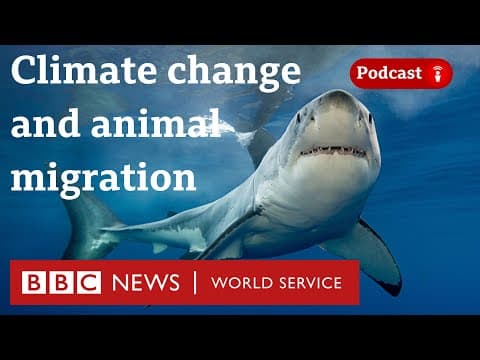
[13:18]I love sharks. I think they're super interesting because they just capture people's imagination. This is Trisha Atwood. She's Associate Professor of Watershed Sciences at Utah State University in the US. There's been a couple of close encounters. I just happened to be in a very tight area in a boat channel, and a very large tiger shark just kind of came up right behind me. He was trying to get around me, and I didn't really know what he was doing. Um, but it it did cause me a little bit of panic. I bet, was it a close shave? Um, I mean, he was so close behind me, I could have kicked it in the face, but he just went right past me. I do remember my husband was with me, and he was still onshore. He was yelling at me, Trisha, Trisha. Wow, how dramatic. Well, all went well, and you're here talking to us, and we're very glad. What we're here to talk about is migratory animals, and sharks migrate. Can you tell me why they migrate? Yeah, so animals migrate for all types of reasons. So some of them migrate for food resources. But animals, including sharks, will also migrate to locations that are more suitable for things like mating or for giving birth. So, for example, lemon sharks in the Bahamas will travel back to the same location where they themselves were born to give birth to their own pups. And so sharks are moving around to either track their food resources or are attempting to get to places that are more suitable for the activities that they are doing during that season. And what kind of distances are we talking with these migrations? Are they covering huge swathes of ocean? Oh, absolutely. Some of these shark species can travel massive distances. We've seen great white sharks that have traveled from the coast off of like Perth, Australia, all the way to South Africa. Wow, that's incredible. And so we know that climate change is increasing temperatures, including ocean temperatures. Is that impacting sharks? Absolutely. So, sharks and lots of other animals sometimes are cued by water temperatures or air temperatures. Um, that is telling them, hey, this is the season for you to go somewhere else. Because climate change is altering those temperatures. They may choose to migrate at a time that isn't appropriate. They may decide to migrate before that food resource is there. Then when they get there, there's no food, and now they're in trouble. Animals are also moving because where they currently are located may be completely uninhabitable for them now. So all animals have a thermal temperature limit that their body operates at. And if you exceed those limits, the temperatures are too high or those temperatures are too cold, the body can't function right anymore, and it will start to die. Really? So have there been some examples where sharks have moved because of rising sea temperatures into other places? Yes, so we have seen that great white sharks are moving to cooler waters. So great white sharks are kind of like the Goldilocks, and they like these temperate waters that aren't too hot and aren't too cold. Just right. Yeah, just right. Well, where they're currently living isn't just right anymore. And so they're having to move in search of colder waters. In California, that means they're having to move north. And we've seen that since 2014, great white sharks have moved about 600 kilometers more north than we would expect to find them.
[17:04]So I looked into this study that Trisha mentions, and it's fascinating. After a marine heatwave in 2014, residents of Monterey Bay in northern California reported dozens of sightings of juvenile great white sharks. They were never normally seen in this area, because their bodies aren't big enough to withstand what should be cooler temperatures. Scientists analyzed millions of data from GPS tagged sharks, and they found that the range of these young sharks had moved 600 kilometers north of where they usually live. And although they're young, these sharks aren't that small. They can still be up to 2.5 meters in length. So you can imagine how sea swimmers in Monterey Bay felt. Here's Trisha again. It's great to see that they're adapting, because if they didn't, there's a chance that they could go extinct. But being as these sharks are very, very large organisms, and they do kind of invoke a level of fear in people, um, it's got people a little bit nervous. Even though we have not seen any increases in human conflict with great white sharks. Humans aren't the only ones alarmed by great white sharks. Sea turtles are also pretty frightened of becoming dinner. Yeah, so sharks have this amazing ability not just to scare us, but to also scare the things that they eat. And that changes the behavior of their prey. And we see that organisms that they eat, like sea turtles, will kind of move into areas and eat more in locations where they know the risk of coming in contact with a shark is lower. When you remove those sharks, those things like sea turtles can eat everywhere and anywhere, and they can do it extensively. They can really hammer down sea grass meadows. Add the sharks back in, we see that those sea turtles move to very particular locations where the risk of being eaten is lower, and they will just forage there, leaving the whole rest of the sea grass metal to grow. Sea grass meadows are really useful. In fact, they actually help to protect all of us from climate change, which is mainly caused by carbon dioxide. Here's how. Sea grass, it's a plant. And everybody knows that plants are one of our major defenses against climate change. Plants take up CO2 out of either the water column or out of the air, and that helps store it in their biomass. And so we want lots of plants to be in the ocean. So when we start to lose things like sharks, that can cause a change in how much carbon is being stored. So we've known that from research in Australia, that sharks help increase carbon storage in coral reefs and sea grass ecosystems by 40 to 60%. 40 to 60% more carbon storage, thanks to sharks. So when shark's migration is altered because of rising sea temperatures, this whole carbon storage system gets disrupted. Trisha says this is happening in the waters off the United States, Australia, and Indonesia. But when sharks are in the right place, these fearsome animals can be climate change heroes. Given that sharks have this vital role in helping to store carbon in the oceans, do you think that world leaders who are kind of grappling with how to combat climate change, are aware of this power? No, but I think, um, you know, Jaws has a lot to say for that. Um, I mean, you know, the guy who wrote that book, he regretted writing that book. He spent most of his life after writing that dedicated to shark conservation. I didn't know that. Yeah, yeah, it's really interesting. Yeah, he felt, I guess, an extreme guilt because, you know, people basically went on a murdering spree after that movie. I mean, it instilled a level of fear in people that they had probably never ever imagined. I've never even seen Jaws because I know I'm going to be too scared. But sharks aren't the only migratory animal that acts as a secret weapon against climate change. Research that we worked on shows that by just managing about 10 groups of animals, we could be taking out or sequestering more CO2 from the atmosphere by about six gigatons of carbon per year. Six gigatons a year. So for perspective, some experts say that we need to suck 10 gigatons of CO2 a year out of the atmosphere to meet our climate goals. Trisha's study found that protecting and restoring the populations of certain animal species, including sharks, could get us 60% of the way there. Any guesses what the others are? Marine fish, whales, grey wolves, muskoxen, elephants, bison, sea otters, and
[22:16]Yep, those snorting, grass munching wilderbeest that we heard about earlier are in this powerful lineup. Why? Well, it's a lot to do with the basic functions of life, eating and pooing. Each wildebeest eats 4 kg of grass a day, that means a super herd leaves behind it 420 tons of dung every day. It's an immense windfall for dung beetles. All that juicy grass that the wilderbeest chomp is made out of carbon, and so their dung is made out of carbon, and that gets eaten by dung beetles who bury that carbon into the soil. But wilderbeest also help prevent wildfires. Yeah, so we've seen that when we lose wilderbeest, they're not grazing those grasslands anymore. And that can cause those grasslands to be overloaded with fuel. So when that grass becomes dry and dead, it's fuel for fires. And fires are the worst thing imaginable when it comes to climate change, right? You're taking carbon that was stored in a plant and you're instantly turning it into CO2. And so when we lose wilderbeest, we have more fires and we have more intense fires. And that strongly reduces the amount of carbon stored on those ecosystems. When the wilderbeest aren't migrating anymore, it means that the areas where they are staying longer, can become damaged by overgrazing. So maybe those grasslands aren't producing as much anymore, and the areas where they used to go into that they're no longer making it to, we see that they become these massive fuel stocks for fires. And I mean, you worked on this really interesting study about this amazing secret weapon that we have to store carbon. Do you think that world leaders who are kind of grappling with how to combat climate change are aware of this power? No, unfortunately, we don't think so, which is why we did the study and and why we're continuing to do these studies to let people know that managing animal populations for climate isn't something that we're currently doing. But it's an untapped initiative that could really help us close the negative emission gap that we need to keep our planet from warming any further than 2° Celsius.
[24:42]So in Kenya, there could be more wildfires as wilderbeest aren't coming as much as they used to, which as we've heard, has a climate cost. And all across this massive ecosystem, it's the migration of these animals that's key to locking that planet warming carbon into the landscape. And that's why we need to protect it. Along with the sharks that terrorize the oceans and conserve the sea grass meadows, they're a secret weapon in the fight against climate change.
[25:18]Of course, there are many other reasons why we should protect these migrating creatures. For people like Nema, they mean everything. Working as a guide in Serengeti, I love it because I love animals. I love nature. So me working here with all of these animals, the landscape, the beauty of Serengeti makes me feel like I'm in the right place, where I'm belonging.
[25:52]That's it for this week. If you have a climate question or a comment on this show, we'd love to hear from you. You can email us at theclimatequestion@bbc.com. I'm Sophie Eastall, and the producers this week were myself and Octavia Woodwood. The editors were Gray Jackson and Tom Bigwood. The series producer is Simon Watts. Mixing and sound design was by Tom Brignall. Thanks for listening. Bye.


