[0:00]officials have condemned Iran's retaliatory tax on the country and now they say they have the right to respond. For more on this, let's bring in Majed Al-Ansari. He's advisor to the Qatari Prime Minister and spokesperson for the Foreign Affairs Ministry. Thank you for joining us, sir. Now, I want to ask you first, how are officials in Cutter responding and keeping people safe at the same time? Well, I, I have to tell you that this is a trying time for us here in, in Doha. As you know, we were attacked two times last year by missile attacks. And we are defending our country now to the utmost that you can as a country. We've been targeted with more than 90 missiles, 92 missiles to be, to be exact. 89 of them have been downed by our Patriot defense systems. More than 25, uh, drones have been launched at us. And almost all these drones, 22 of them have been down before hitting, hitting targets. So, uh, our military, our great men and men and women in the military are doing all they can to make sure that the people of Qatar, the residents in Qatar, the people who have been stuck here in transit in, uh, Hamad Airport, more than 8,500 of them, 140 nationalities of people living in in Qatar, they're all safe now, uh, from these attacks through the work of our military. But obviously, it's, uh, the tensions are rising and, uh, we're keeping vigilant. Does your government support the strikes in Iran's leadership? You know, I, we have been working very closely, uh, in supporting the Omani led talks for peace in the region. We've always said that this cycle of violence in our region that started in 2023, you know, after the attacks of October 7th, if, if left to its own devices, will engulf the whole region. And this is exactly what we are seeing right now. This is why we're working very closely with our allies in the United States, uh, working to shoulder to shoulder with, uh, our friends in the region and with the American administration to make sure that, uh, uh, talks succeed that we have peaceful resolution to all the differences in, uh, in the region. You know, uh, Iran is our neighbor, but we have always had, uh, our, uh, you know, our opinions, uh, and, uh, issues with what they do in our region. If you look at Syria, for example, for 14 years, we're at odds with them because we, uh, uh, of their support for Bashar Assad's regime. Same goes for Iraq and, and other regions, but we've always believed that all the neighbors for our country, all the people that are living in our country deserve peace, and that has to be, uh, through the negotiation table working together. The decision to, uh, move from talks to, uh, to escalation was not ours. Uh, you have to ask the administration about it, but we are committed to the cause for peace in in our region and to protecting our country from any attack on our sovereignty like the ones the Iranians are launching right now. Qatar has seen, has essentially been struck multiple times now, twice by Iran, and now once by Israel. Does that change how Qatari officials view the country's position and posture? You know, uh, we will not be deterred, Ike, by attempts to, uh, minimize or deize, uh, Qatar's role in the international arena. You know, when his Highness the Amir was asked about Qatar, he said Qatar is an energy provider and a peace facilitator, and this is how we believe that this is what we pride ourselves on in, uh, in Qatar. And I have to tell you that, uh, we are continuing our role as, uh, as mediator in so many of these conflicts, working with the US administration and, and others for the cause of, uh, of peace. Uh, our relationship with, uh, with our region is based on finding peaceful resolutions to a lot of these conflicts that have engulfed our populations for, for so many years. If you look at the situation with, uh, with Iran, we have kept a working relationship with Iran. We have mediated so many times, uh, through the, through our history, uh, for their conflicts and disputes in, uh, in the region, working with the US and, uh, and others. But right now, this is a moment of defending our country, defending our sovereignty. These attacks on Qatar are not simply attacks, uh, on American, uh, personnel or bases. Uh, it's they're attacks on our residential areas. If you look at the attacks today, you know, our our airport was targeted multiple times in the duration of these attacks. Now, thankfully, we were able to avert all of these attacks through the work of our military, but there was also targeting of civilian infrastructure, uh, commercial infrastructure, uh, that was also thwarted. So these attacks are aimed at our people. They are, they are aimed at our country, and we will do everything we can to make sure that the people in Qatar and the residents of Qatar are safe. Sir, have you been in touch with Iranian officials since the Ayatollah was killed? We, I, we are right now busy with defending our country. We haven't been in touch with, uh, with the Iranians. We are working with the, uh, with our regional partners here to make sure that we thwart any attacks at our sovereignty. And, uh, although we do support, uh, you know, uh, peace, as I said, uh, peaceful means of ending any conflict, including this one, we believe it will end at the end through dialogue. And, uh, right now, the focus is on protecting ourselves and protecting our country, uh, from, uh, from these attacks. Now, meanwhile, some oil tankers at the moment are avoiding passing through the Strait of Hormuz. Are you worried about a possible closure of the straight? Of course, Ike, you have to remember, uh, this region is both a transit hub and an energy hub. 70% of, uh, the, the, the world's energy supplies come from this region. A big chunk of international transit happens through this region. You know, when the attacks started and we had to close our airspace, which remains closed to this day. We had 8,500 people in transit, which our government immediately worked on getting them to, uh, to safety and getting them to, uh, residents here in in Qatar while they wait to be repatriated. So this is certainly not a sustainable situation for the international economy. It's not a sustainable situation for international aviation. And we have to work together to make sure that this ends, uh, very quickly and we can resume life normally here in, uh, in the region, so the economic and the human repercussions of, uh, of this conflict does not linger on.
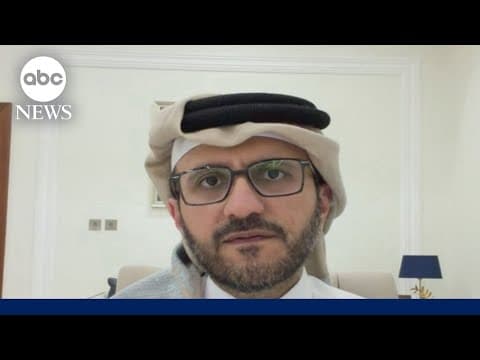
Qatari officials condemn Iran retaliatory attacks
ABC News
6m 25s1,170 words~6 min read
YouTube auto captions
Transcript source
YouTube auto captions
This transcript was extracted from YouTube's auto-generated caption track. The transcript below is server-rendered so it can be read, searched, cited, and shared without opening the original YouTube player.
Pull quotes
[0:00]officials have condemned Iran's retaliatory tax on the country and now they say they have the right to respond.
[0:00]He's advisor to the Qatari Prime Minister and spokesperson for the Foreign Affairs Ministry.
[0:00]Now, I want to ask you first, how are officials in Cutter responding and keeping people safe at the same time?
[0:00]And almost all these drones, 22 of them have been down before hitting, hitting targets.
Use this transcript
Related transcript hubs
Watch on YouTube
Share
MORE TRANSCRIPTS


