[0:04]Lust's going to get you killed. But pride's going to be the death of you and you and me and you and you and you and me and you and you and you and me and you and you and you and me and you and you
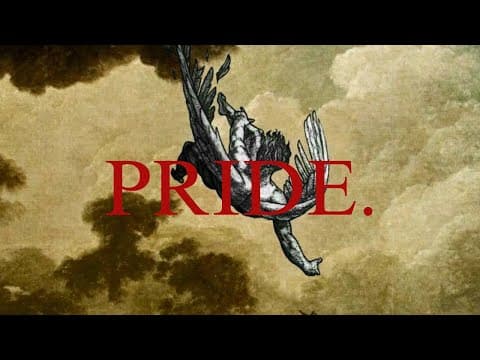
[0:25]Pride, the absolute worst sin. Now, some of you may be thinking, what about wrath, physical violence, greed, or sloth, but trust me when I tell you, pride is the king of them all. It's the poison that enhances every other sin. It's the voice that whispers, you deserve this when you don't deserve it. It's the unseen hand that turns ambition into arrogance, confidence into delusion, and success into downfall. Unlike other sins, pride isn't just corrupt, it blinds. It convinces people that they are beyond reproach, that rules don't apply to them, that their perspective is the only truth. That's what makes it so dangerous. A greedy person may know they'll be greedy, a wrathful person might recognize their rage, but a prideful person, they think they're justified in everything they do. They think they're right even when that's completely false. And history proves this time and time again. Kings who refused to listen to their advisors, generals who thought they were invincible, companies who ignored change until they became obsolete. Pride isn't just a personal flaw. It's an empire killer, a story ruiner, a tragedy in slow motion, and today, we're going to break down why pride is so insidious, how it blinds us and how, if left unchecked, it leads to ruin. From myths to history to fiction, we'll look at those who flew too far, too close to the sun, and we'll see what happened when their wings melted. You just had to blow it up, you and your pride and your ego. You just had to be the man. If you'd done your job, known your place, we'd all be fine right now. Pride is the excessive belief in one's abilities, importance, or correctness. It's different from confidence, which is necessary. Pride is confidence's evil twin, the Hyde to the Jekyll, if you will. One that refuses to listen, refuses to change, and refuses to acknowledge any weakness. The ancient Greeks saw pride, or their word hubris, as a direct challenge to the gods, and it was the main downfall of most of the Greek heroes like Achilles. Even the most intelligent Odysseus, as clever as he was, suffered because he couldn't resist boasting about outwitting the Cyclops. The gods, namely Poseidon, made sure he paid for it. In Christianity, pride is the thing that led Lucifer to fall. Lucifer, once an angel of immense beauty and power, refused to bow to anything he viewed to be less than himself. Even when that thing was the literal embodiment of fullness and completeness, his pride made him believe that he could be equal to God, and so he fell. In Buddhism, pride is one of the main barriers to enlightenment. The moment you think you know it all, you stop learning. The moment you think that you are the center of the universe, you forget that suffering, joy, existence, and everything is shared by everyone. Even in Norse mythology, the gods themselves were not free from pride. Odin, seeking wisdom, sacrificed his eye, and yet he still made many, many mistakes, thinking that he could outmaneuver fate. Loki manipulated everybody and decided in his own arrogance and his own strength that he could do anything without mistakes, and that caused his eternal punishment, an incredibly long amount of suffering. The lesson, no one, not even Norse gods or gods from any mythology are immune to pride. Pride is not just an individual flaw. It's a universal warning, repeated in countless philosophies, religions, mythologies, and viewpoints, and that's the reason I brought these parallels because pride is the sin that blinds. It blinds us to everything but ourselves, and it isn't just seen that way from one viewpoint or philosophy. Everyone knows that that's what pride does. The biggest danger of pride, it makes you believe that you're invincible. It creates a mental fog where you start to ignore warnings, dismiss good advice, and overestimate yourself. It's the voice in your head that says, they just don't understand me, or I know better than everyone else, and then you stop believing that, and you stop growing, and you stop seeing danger. You stop wearing these horse blinders, charging forward, blind to the cliff ahead. Take Icarus, the classic tale. They make wings out of wax and feathers, and Daedalus warns him, fly too high and the sun will melt your wings. But what does he do? He pulls a Top Gun Maverick move, and he goes straight for the sun. In that moment, he believes he's above consequence and above limitation. His pride blinds him until he's drowning in the sea below. It wasn't ignorance that doomed him. It was his pride and his refusal to listen. And then there's Boromir, a good man, a noble warrior, he fights for his people, he wants to protect them. But when he sees the ring, pride tells him that he can wield it. It whispers, you are strong enough, you are wise enough, you deserve this power. It wasn't greed, it wasn't malice like people think it was. It was pride convincing him that he, unlike all before him, could resist the corruption. And in the end, his downfall wasn't just tragic, although it really was, it was completely avoidable. It's funny how pride often masks itself as other sins, wrath, sloth, greed, many of them, convincing us that we were acting for the right reasons. When in reality, we're just walking towards disaster. And then there's Dr. Victor Frankenstein. He wasn't trying to create a monster, he was trying to create life. He had noble intentions, but pride blinded him to the consequences. He thought that he could play God, ignoring all the moral responsibility, dismissing the warnings of all of those around him, and he decided to push forward because he believed that his knowledge placed him above natural law. And his creation, the very thing he worked so tirelessly to bring into existence, ignoring everything, all of the warnings and red flags, ended up being his undoing. Even in modern storytelling, we see this pattern repeat. Let's take Tony Stark specifically in Iron Man 2. He's dying, but instead of seeking help, instead of trusting others, he drowns himself in more reckless behavior and denial, feeding his god complex. His pride tells him that he can fix it alone, that he can do it, that he can save everybody and himself, and that he doesn't need to rely on anyone else. It takes nearly losing everything for him to finally see the truth. His strength doesn't come from arrogance, but the ability to finally admit when he needs help. In one last classic example, that being Shakespeare's classic, classic, classic work, the Scottish play Macbeth. We can look at Macbeth, he is literally told beware of Macduff. But yet his pride convinces him that no man born of a woman can defeat him. He takes ironclad prophecy as invulnerability, rather than as a cryptic warning, as it should have been. His pride blinds him to nuance, and it ultimately leads to his ruin. Pride doesn't just distort reality, it actively replaces it. It turns warnings into challenges, mentors and people that we look up to into naysayers, and consequences into impossibilities. It convinces us that we are all the exception, that we are the ones that are going to break the rules of history, but history is ruthless, and those who ignore it are doomed to repeat its harshest lessons. The only way to beat pride, humility. Humility is something that we see in many different places. A place that I often go back to is Zuko from Avatar, bowing to Iroh, finally admitting that he was wrong, and it's one of the most powerful moments in the whole series. He spends years believing that his suffering was unjust and that he was entitled to his father's approval, only to realize that he'd been chasing the wrong thing. His humility didn't make him weaker, it made him stronger, wiser, and more capable of true leadership. Or Boromir's final stand is sacrificing himself for Pippin and Merry. This was the moment he finally let go of his pride. He realized far too late that the ring had corrupted him, but instead of denying his mistakes, doubling down, he chose to atone. His pride led him into the darkness, but his humility brought him back to the light. In real life, there's plenty of examples of in history where people chose humility, self-awareness, reconciliation over revenge, pride, uh, Nelson Mandela, or the Apollo 13 team who listened instead of doubling down on bad decisions. The greatest leaders in history were those who knew when to set their egos aside. Humility doesn't mean self-hatred or making yourself a doormat. It means knowing your limits. It means understanding that no matter how powerful, talented, or wise you think you are, you're still fallible. And pride doesn't actually always manifest itself as arrogance or overconfidence. Sometimes it disguises itself as the complete opposite. Paralysis, self-pity, or the refusal to engage with the world. Shinji Ikari from Neon Genesis Evangelion is the perfect example. At the start, he believes he's worthless, but he swings in the series between pride and nothingness. He runs from his responsibility, he believes that his suffering is unique and insurmountable. But what is this if not a form of pride, the belief that his pain is more profound than anyone else's, and that no one could possibly understand him? Pride isn't just thinking you're the best, but it's also believing that your misery is the center of the universe. Shinji's journey is about breaking out of that mindset. He learns painfully throughout all of Evangelion, The End and the Rebuild movies, that while his suffering is real, it doesn't make him special, that others suffered too. That isolation and self-hatred don't protect you from pain, they only deepen it. And his realization in The End of Evangelion movie that life is worth living despite the pain is his form of humility. Accepting imperfection, embracing the unknown, accepting love from others, choosing connection over isolation. True humility is realizing that you are important, but so is everyone else. Your struggles matter, but they don't make you the sole protagonist of reality. Shinji's character is proof that sometimes the antidote to pride isn't lowering yourself, it's stepping up, facing the world, and realizing that you are not alone. Pride unchecked is a wrecking ball. It destroys relationships, blinds leaders, and topples empires. But the right kind of praise, the kind that's rooted in dignity and self-respect, that fuels ambition, resilience, and growth. That's the right kind of pride. Pride is a double-edged sword, wielded wisely, it can shape civilizations, fuel revolutions, and push individuals to greatness. Wield it recklessly, and it can reduce those same civilizations, turn those same revolutions into tyrannies, and shatter individuals beyond repair. True confidence doesn't come from stubborn arrogance. It comes from knowing when to push forward and when to step back. It's the difference between a warrior who fights to the bitter end, refusing to surrender out of misplaced pride, and one who knows how to retreat today so that victory can be ensured tomorrow. It's the difference between a leader who listens to advisors and adapts, and one who ignores all warnings, convinced of their own ability. History is filled with those who let pride dry them off a cliff. Consider figures like Julius Caesar, who refused to listen to the warnings and the signs of betrayal, or Napoleon, who could have solidified his empire as one of the greatest in history's, but decided it was a good idea to invade Russia in the winter. But then there are those who mastered their pride, who understood that stepping back, swallowing their ego, and learning from mistakes was the true mark of strength. Leaders like George Washington who relinquished their power, gave it up willingly rather than becoming a dictator, or a tired leader, Abraham Lincoln, who put unity over his own personal beliefs and grievances so that he could hold a nation together. And what about in our own lives? How many friendships, relationships, careers, and ambitions have been sabotaged by the inability to admit faults or to listen or to compromise? How often do we let our own insecurities and egos convince us that backing down is a weakness, when in reality, it's one of the greatest strengths that we can have? Pride makes us chase validation instead of growth. It makes us believe that admitting fault is a sign of weakness, not wisdom. But the truth is, humility isn't about demeaning yourself. It's about understanding yourself, seeing it as it truly is. It's about knowing that real strength lies in adaptability, in the willingness to evolve and to change. It's about realizing that the world is bigger than your own reflection. So if there's anything to take away from this long video, let it be this. Ambition is good, confidence is necessary, and self-respect is vital, but pride, when left unchecked, turns all of these virtues into vices. It warps ambition into recklessness, confidence into arrogance, and self-respect into self-destruction. Because if history has taught us one thing, those who fly too high will always fall, but those who learn to balance their flight, to soar with wisdom rather than pride, are the ones who truly reach the heights that are worth aiming for. Thank you, and see you, Space Cowboy.