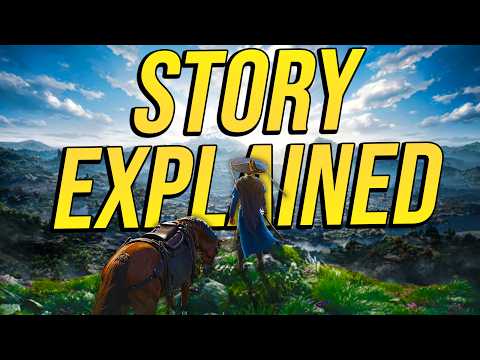
[0:00]Wherwnd's Meat is full of lore just beneath the surface of the story we're told. For those who don't know, it's an open world MMO with Souls-like combat and a Souls-like story, where you are often left with more questions than answers by the end of each chapter. Like, what is the Jade pendant, and what does it do? What happened to Aunt Han or Uncle Zhang? Where do all the bosses come from? Who's that handsome bald man behind the microphone? Stop. And since Vati isn't around to explain what it means, then I'll need to be the change I want to see in the world. So, allow me to indulge in the soft-spoken, lore diving fantasy. Where winds meet begins with an unnamed man attempting to flee pursuers whilst carrying a baby. As we flee, we can see that he is chased down by straw hat wearing bandits, and we get word that a group known as the Orient Pavilion is hunting us too. This opening serves two purposes: to tutorialize the player in combat and movement, specifically against the Void King, and then to show off how exceptional Wherewind's Meet looks. The visuals are stunning for a free game, but, I digress. Once defeating the Void King, we see a blue insect crawl into it, and in that split second, we see a glimpse into what is later shown to be the future. By the time we snap out of it, our friend is killed by the Void King, and we presumably escaped to Qinghe, where we see our protagonist raising the baby, who is now a small child. Us. Before we dive into the lore proper, it's important to lay foundational knowledge that Westerners like myself, and maybe you, might be unfamiliar with when first playing. The most important is that this is an interpretation of the story and based on my own speculation, so keep this in mind. First, the phrase Jianghu is present all over the game but is never fully explained. Through context clues, we can understand that the Jianghu is considered to be the wider martial arts world. While real world history is a foundation for the story here, much like other Wuxia media, these lands' exact geological locations are undefined relative to the real world. A helpful metaphor is to think of it in a similar vein to the working world. There is an entire world within corporate careers and different rules that go along with that world, even if it exists within our own. Children and those too old to work are often spared from this world, and the Jianghu is no different, with the larger difference being that one world is composed of people all fulfilling roles within corporate culture, and the other world being filled by those practicing different martial arts. Since I mentioned it earlier, Wuxia is another term you'll hear not within the game, but within game discussion, and in layman's terms, it refers to a style of storytelling and setting. One where gods, mythical arts, and immense power are not uncommon. Wherwinds Meet follows plenty of Wuxia archetypes, and a helpful reference would be to relate the concept to Westerns. A Western typically features cowboy outlaws, old historic settings, and gun-slinging bounty hunters. Wuxia stories operate in a similar framework. Because this is a different genre and there are plenty of metaphors and plots that get lost in translation, this video will be my best interpretation of the plot, not a definitive or objective recount. This is especially the case because Wherwinds Meet has more content on the way that will provide more answers and maybe even recontextualize the answers we find here. Second, and this might be familiar to those who have played Sleeping Dogs, is that, at least within China, the words aunt and uncle are not meant literally. They are often used as a means of addressing someone senior to you. The reason this distinction is immediately important is to, one, prevent confusion over dozens of people who you meet that are named uncle, and two, it calls into question if your Uncle Zhang and Aunt Han are truly your relatives, or if they are simply the adoptive parents completely unrelated to you. If that's the case, then the origins of the young master are truly unknown. The following video will contain spoilers for all of the main campaign for Wherwinds Meet. There is plenty to see here, and since it's free, if you are at all interested, then I suggest experiencing the story for yourself. This is especially the case when we consider that by the time this video drops, the largest update yet for the game, the Hushiyumanguan update will launch. It's going to add an absurd amount of bosses, regions to explore, and it will continue to expand the story of the young master. It's the perfect time to get into the game, and while this video will focus on the story, the gameplay here is what has me coming back. The boss fights are a ton of fun, the combat is tight, and there is a significant amount of variety. And despite being free to play, I never felt pushed to buy microtransactions. You'll find a link in the description, and thank you to Everstone Studio for sponsoring this video.
[4:47]We awaken to see our character, now a young master, being attacked by the same bandits that chased our Uncle Zhang in the opening. The bandit takes our Jade pendant and then leaves. In order to find who this person is, why they wanted the pendant, and how it relates to our uncle, who has now been missing for some time, and with the help of our little friend Ruby, we head back to where we now live, which is with our Aunt Han, in a place called Blissful Retreat.
[5:19]We spend plenty of time exploring Qinghe before eventually making it to Blissful Retreat, where we finally meet Aunt Han and are tasked with serving some of the locals, such as an elegant woman in a private room, who may become important later. The locals all speak of a man named Killer Blade, who seems to have made his way to Qinghe in search of something. And it's not before long that we encounter this legendary figure and engage in our first official boss fight.
[5:48]It goes about as you'd expect. After evading Killer Blade, we can meet up with a man who claims that Aunt Han is a ghost. At first, this sounds like the ramblings of a madman, but after giving it further thought, we decide to investigate a nearby clinic, where we find strange tools and a mask that resembles human faces. There are faceless ones that roam the halls, only able to make out short sentences. From them, we glean that they are victims of a failed face change. And with this, we arrive at our first question: who is Aunt Han? And what does this dungeon mean? We know that Aunt Han, alongside Uncle Zhang, initially raised us from birth. Aunt Han, like many people in the Jianghu, have a particular art that they specialize in. Aunt Han's mythical art is the ability to change one's face. This makes her exceptionally valuable to those on the run, as they could be reborn with a new name, face, and potentially, even a new voice. But this art takes time to practice, and it becomes clear as we explore the cave beneath Blissful Retreat that some people lost their face in the process of Aunt Han's practice and were left as shambling husks. As we wander these halls, we hear of men sobbing at the loss of their face.
[7:07]Because of this, and the zombie-like state of many of those who dwell here, it leads one to theorize if Aunt Han's face-changing methods carry over to personality too. After making this discovery, we can read a scroll that knocks us out and takes us to the domain of the Heartseeker. There's a lot of confusion around this boss because she bears the resemblance of a character we meet later, and yet is mistaken by the young master for Aunt Han. The common theory online, as shared by Reddit user Square Pilot, is that this boss fight is actually an internal revelation. Sparked by learning that Aunt Han is the aforementioned Water Lady and that she has hid her exploits from you for so long, we can't help but imagine her as a demon of sorts, no longer to be trusted. We later learn information that suggests that this is an entirely different character, but for now, we can continue on our journey to find Aunt Han. Reuniting with Killer Blade, he is able to locate Aunt Han and in the process, find out that the Orient Pavilion has been snooping around Heaven's Pier, likely looking for Han and her records of the different face-changing surgeries she performed. Aunt Han decides it's time to leave, but not before the Orient Pavilion attack and engulf the Blissful Retreats in a blaze. The smoke covers so much of the sky that it leads everyone to run in circles trying to escape. This is because some kind of witch has placed a spell on the area, and only defeating the witch can break that spell. Ruby has a plan to take a secret tunnel that leads out of Heaven's Pier and create a beacon for others to follow. But we stop her because it is simply too dangerous. She defies us anyways and ends up paying the ultimate price. Without time to grieve, the witch makes herself known to us as Qianye. And by this point, it becomes clear that she was the Heartseeker we battled earlier. With this new information, we can assume that the Heartseeker from before must have been Qianye. And my theory is that Qianye, who we met prior in Blissful Retreat, was praying on us to discover Han's secret and attempted to enter ours. I believe because she was not powerful enough to enter Aunt Han's mind, she chose instead to try and enter ours. Because she was doing this remotely, her power was limited, and that's why her boss fight was so much easier than it is now. In her second phase, it appears as though we see what is likely her true form. The different aspects of Qianye's character design clearly come from the Yin and Yang symbols, and this further carries into the arena, which is a mirror, and the fight itself. On the top side, we, like most fights, wait for attacks and parry them, being a bit more defensive. But on the flip side, we need to maintain aggression to stop our health from draining. Fair warning, this fight is hard, and our victory is bittersweet. After defeating Qianye, it's revealed that this defeat was only enough to break us from her paralyzing spell. The Orient Pavilion keeps surrounding us and Killer Blade, and even he sacrifices himself to give us an opportunity to escape. Days later, we emerge and discover that after everything, we still lost. Heaven's Pier was scorched, our friends are dead, and Aunt Han is missing, and we are no closer to solving the many mysteries in front of us. We do get one clue, however, about Aunt Han's whereabouts, and in order to follow it, we have to head into the next region, Kaifeng.
[10:31]Chapter two begins with us making our way to Kaifeng and immediately seeing a different side to the art of deception. As we're quickly swindled by just about every person we meet. Kaifeng is visible from a distance, we can see it's a prosperous city, unlike the more rural Qinghe, our introduction is thus a contradiction. Because instead of a bustling economy similar to what we'd seen in an ideal modern city, we instead see people swindling each other and selling fake treasure basins that all promise to bring wealth. Upon meeting Little Fu, Yingying, and Granny Turtle, three generations of people struggling with finances in their own way, we find out that the person we are looking for is likely the Ember of East. Someone many classes above those we've just met, and it's said that we can encounter the Ember of East within the Heroic Assembly at Revelry Hall. Making it into Kaifeng proper, we see that while the city looks prosperous, it is suffering greatly due to the recent outlawing of Tong coins, the city's previous currency. With the new copper coin currency being hard to get, many people are left with nothing, and some, like Granny Turtle, have entire basins full of coins that are no longer worth anything. Within Revelry Hall, we get to see the wonders of the upper class. The performances here are a delight to see, we get a fancy outfit, get some entertainment, and even see the elusive Ember of East as they show off their gold treasure basin that makes coins appear from thin air. As the show is being performed, however, the basin is stolen and we are blamed for it. This causes the prefect to give us a poison that will kill us in seven days, if we do not report back with proof of who truly stole the basin, then he will withhold the antidote from us. This begins a whodunit story that eventually takes us on a search for the Ghost Market. In our search, we find that the Dao Lord, the most obvious suspect in who stole the gold-making vessel, is actually three girls: Little Xiu, Little Fu, and Little Lu. And once we make them come clean, they introduce us to the Black Market and explain that the gold-making vessel was all an act to try and push the local politicians into allowing Tong coins to be exchanged for copper coins. After returning to the surface and meeting with Yingying again, we see that they are, in fact, the Ember of East, and this explains plenty. It explains that the whole mystery, including the gold-making vessel, was all an act devised by the three girls and the now defunct Ember of East. Yingying told us that previously she used to live a life of luxury, but was cast out, and that's not exactly false. Yingying is no longer the Ember of East, but her time with the common folk of Kaifeng gave her greater appreciation for their struggles, and thus, she decided to help. Granny Turtle exemplifies the sympathy she feels for these people. Granny Turtle has two children: a daughter that supposedly died young, and a son who died in the war, though she does not know it. Granny Turtle appears to have an early form of Alzheimer's, being often unable to remember things and sleeping for most of our time in Kaifeng. Getting back to the reveal, Lord Shu, from the same city as Yingying, takes her captive at the Universal Furnace, and it is now our goal to enter it and rescue her. The furnace has people being worked to the bone, and in private quarters for Lord Shu, what we can learn from the many journals and collectibles in here is that Lord Shu is not who he seems. Backed by the Orient Pavilion, a God of Avarice, a synonym for greed and gluttony, pretended to be Lord Shu, championing the confiscation of the Tong Coin, all to line his own pockets. Once discovering this, we can head out to confront Shu, and when we do, we can see he is trying to instate himself as a god, even dawning a golden mask. A fun detail throughout this fight is that piles of money will be dropped on the floor, and the greedy among you will know that if you pick it up, you'll suffer a heavy consequence in the fight itself. In his third and final phase, Shu takes on the full grandeur of the God of Avarice. We are seemingly defeated. But once the people of Kaifeng band together and sing a song in unison, we are given the power to defeat Shu, rescue the Ember of East, and convince the prefect to not only allow Tong Coins to be converted into newer currencies, but also to move Kaifeng entirely to paper money. This is, of course, told by Big Shiao a few weeks after the battle, and since it isn't too integral to the plot at the moment, I'll ask you if you know what Big Shiao's secret is. Our final scene is of Yingying and Granny Turtle taking a stroll down the street and seeing a young man call out to the elder in front of him. It appears that Granny Turtle's son has returned from the war, and with joy in his eyes, he runs directly past Granny Turtle into someone else's arms. While this ending is much happier than that of Chapter one, this moment alone brought a tear to my eye. Our time in Kaifeng taught us about the strength of community and the importance, and the hope, for a brighter future. It was Little Fu and Yingying's hope for a better economic state that pushed their plans into motion. It was Granny's way of rallying the community that provided the support the young master needed to move forward. With Kaifeng now behind us, we can set our sights on the now released Hushi update, which features a new storyline. But interestingly, the primary focus isn't on the young wanderer. Instead, on a man with a burlap sack tied around his collar. But first, let's discuss our entrance to Hushi.
[16:06]After finding a package washed up on the Qinghe shore, we can track down its supposed recipient, an ethereal veiled woman, accompanied by a man with a camel's head, and a paper fox. We can tell that they are either ghosts or not from the same mortal plane as Qinghe, because they only appear at night. And whenever one of them leaves, the candle closest to them is snuffed out. It's common symbolism to have fire represent life or spiritual presence. What isn't common symbolism in the West, however, are foxes and camels. Camels were a major symbol of the Tong Dynasty because of the Silk Road. For those who don't know, the Silk Road was a network of trading routes that connected China with the rest of its surrounding civilizations, like Rome. While its routes are not often used today, in ancient times, these routes allowed specialty goods to make their way to different places. Some of these routes, however, were more difficult to traverse than others, and so the camel, known for its ability to successfully weigh through the desert and carry heavy loads, became a symbol of not just the Silk Road, but the Tong Dynasty itself. As it was under said Dynasty that the Silk Road was arguably at its peak. Moving over to our other friend, we can take a look at what foxes might symbolize in both Wuxia stories and Chinese history. The myth of the fox spirit, in olden times called the Huli jing, are spirits that manifest as either foxes or seductive women. Their intent is individualized, so in our case, we can't know if the foxes we see in the stories are good or bad. But I can't help but assume that our veiled friend here has some connection to the fox. Perhaps she too is a Huli jing, but is taking on the appearance of a woman to make us more comfortable. Do be warned, in modern Mandarin and Cantonese, the term Huli jing is almost always used in an insulting way, so be careful who you call that. Finally, the veiled woman asks us to play multiple rounds of Mahjong, a Chinese board game created in ancient China. And I think this game has a lot more symbolism than it may seem at first. We can notice that the circle tiles reference Chinese currency, such as the Tong Coins, which you'll remember, played a large role in the Kaifeng storyline. We can also see that there is a set of tiles called the winds, and chances are, this board game is Wherwind's Meat. Yeah, whatever. Anyways, the winds in this case symbolize change and prosperity, so one can assume that the story ahead will cover similar themes. And while Burlap Sack, as everyone calls him, is at times a pitiful man, he is nothing if not determined, and his determination is what allows for a new era of prosperity for China and the Silk Road. Upon completing countless rounds of Mahjong, we're given a task from the Veiled Lady to travel to Hushi and complete a painting, which reveals itself to be the story of Burlap Sack. Our arrival to the Jade Gate pass is started by seemingly traveling through time. We hop onto a boat in a gorgeous cutscene of what seems to be an empire prospering and then collapsing, plays before us. If I had to guess, this is meant to symbolize the late Tong Dynasty, which, after its fall, gave way to the early Song Dynasty's founding, and it was during said Dynasty that Cotton started being cultivated in China. When we enter Hushi at first, however, things are more desolate than it seemed. Sandstorms make it difficult to see, and we wander aimlessly, fending off vultures and following ghosts until eventually, the broken ship we are on rises and takes us into the region proper. Before we move any further, I want to clarify that I don't think Hushi is a real place, or at least, does not exist in the same plane as Qinghe and Kaifeng. Not only is it in a separate map, but there are also too many supernatural occurrences in the world for it to simply be another region. So what is it then? Well, I think it's a collage of different moments in history and a representation of the Silk Road. As mentioned, the Silk Road spanned not just deserts, but the sea, the grasslands, and just about everything else. That's why we get the mythical arts to turn into a fish that skims across the desert waves. It's why we arrive by boat, and why there are seemingly nonsensical oases of greenery. Hushi is meant to represent the Silk Road as a concept, and thus is a highlight reel of all the places that network encompasses, though we generally stay focused on the desert. We can begin the tale of Burlap Sack by approaching a tree next to the town of Kerez, where Burlap Sack has worked to earn a spot on a trading caravan to Blackwater. We learn a few things about Burlap Sack off the bat, which is that he's past his prime and that he isn't very good with words. I think this is represented well when we are given the option to talk smoothly, but end up fudging it no matter what.
[20:50]It shows that Burlap Sack's mind isn't necessarily gone, he just struggles with communicating. After departing the town with a different merchant and traders, the crew gets word that Blackwater has entered a war and that they will no longer be stopping there, to Burlap Sack's dismay. Before he can protest for too long, the crew is stopped by bandits, and one of them recognizes Burlap Sack's shoes as belonging to someone in the Tong Army. Despite his denial, the crew is convinced that he is a soldier. But before the bandits can execute the man, Burlap presents a document stating that he is just a commoner and is free to pass through. Still convinced he is a soldier, the crew force him to go his own way for their own safety, though one of the merchants, Liyang, gives Burlap a water flask, revealing that he too is a soldier, and thus feels sympathy for him. When we next step into Burlap's shoes, we find him stumbling, lost around the desert, chasing a fox who has his water flask, being tricked by mirages in the desert such as a fake oasis. Burlap eventually reaches the end of his rope. With no water, money, or safe travel, he becomes convinced that heaven does not want him to live, that the very gods are against him. We will later learn that the opposite is true. But not before the vultures have their say first. Being chased into a tower and just barely surviving the vultures, Burlap passes out, but is woken up by a familiar friend. But the news he brings isn't kind. It seems the sack has gone missing. But before he can wallow for too long, he is rescued by a group of people who not only have shelter, but water too. Capable of finally getting some rest, Burlap is back on his feet, but without the sack, he is without purpose. Two people died already trying to deliver this sack to Blackwater, and if he too fails at delivering, then those deaths will be in vain. Our fox shows up again, presumably the same fox from before, and leads us to a room where the sack has emerged and is open. And we can finally see what Burlap was guarding so closely, cotton seeds. Rejoicing and beginning to trust the fox spirit, Burlap Sack makes his final push for Blackwater Station, but it is sadly empty and filled with bandits holding his previous traveling crew hostage. At the last moment, however, the Ganzhou Oguz began storming Blackwater Station. Since it isn't explained up to this point, allow me to explain what the Ganzhou Oguz are. In China, there was a Turkish Dynasty called the Ganzhou Kingdom, and within it, were the Oguz Turks, which originated in Central Asia. I believe that the white clad warriors are Oguz Turks, which were allied with the Tong Dynasty. This is why Burlap is happy to see them, however, Handlebar who does not feel the same way, as they had betrayed the Tong soldiers, meaning that they would likely be killed. In order to stop Burlap from snitching, he strangles him, seemingly to death, but Burlap is able to recover and try to retrieve the sack. Xialian spots Burlap, the man who gave him the water earlier, and with his help, is able to make it to a camel and has escaped within his reach. But he still doesn't have the sack, so with no choice, we must fight. With everything he has left, Burlap takes down the Oguz and bandits, but not before suffering a fatal blow, and not before, thanks to all the blood spilled, the seeds are soaked and thus ruined. Liang, now recovering from his wounds, honors Burlap's final dying wish, which is to be laid to rest under a nearby tree. As he lays down to die, he sees the vultures circling above. With the knowledge that the vultures will go for his eyes first, he pours the remaining clean cotton seeds onto them, with hopes that the vultures will eat them and deliver them across China. How do they deliver them? By shitting on farms across China, of course. Thus, the story of Burlap Sack has come to an end, and we get to see how cotton was spread across China. All thanks to one man, the will to survive, and perhaps with the help of some spirits. For as much as Burlap was convinced that heavens were against him, it was the fox that led him back to the seeds, and it was the fox that led him to Blackwater Station. I believe that it was always in the divinity's plan to have the seeds spread like they were. Perhaps this is why Burlap was able to die peacefully, even in the face of death at the claws of vultures. It was all part of a bigger plan, and ultimately, he completed the mission. Ultimately, the story of Burlap Sack was indicative of the people's ability to enact change. With the introduction of cotton, and because of how easy it was to cultivate large sums of it, cotton goods like clothing became much cheaper for the average citizen compared to goods made from silk. If we remember back to our time in Kaifeng, we were able to see how the people could come together to enact change in regards to Tong Coins, and how the voice of even an old woman was enough to pull a community together. Here, we get to see a similar situation, seeing the humble beginnings of a journey that spans across the history of China. It appears that the Hushi update sets a new trend going forward for Wherwind's Meet, where it's possible that through other dream-like sequences, we can experience pivotal points in Chinese history, told through Everstone Studio's signature Wuxia style. What this update also opens the door to, is more narrative focused questlines. While our time in Qinghe and Kaifeng allowed for plenty of action and combat, the final set piece of the Universal Furnace being the best to come to mind, our time in Hushi saw exactly one boss fight. Our time as Burlap Sack put us into an unfamiliar role, someone not equipped to conquer the Jianghu, and I'd be curious to see if we continue viewing stories through that lens going forward. Do keep in mind, however, that this is merely one aspect of the Hushi region. There are tons of new cosmetics, including your own Burlap Sack for completing this questline, new bosses, mystical arts, and landmarks for you to see. The new content here keeps up with the bar set in Kaifeng, and that extends to the boss fights, which I find the most important, given that it's my favorite part of the game. Truly, Burlap Sack is just the beginning of the secrets in the Hushi region, but then again, I wouldn't want to spoil all the fun for you, would I? So let's return to our most pressing questions from the beginning of the video. What is the Jade pendant? I believe the Jade pendant has to do with Uncle Zhang and his contact Qianye, as the Jade pendants are required in order to meet him, though I won't say much more than that. As for our uncle, we learn that he was on the run for supposedly killing his father and enlisted the help of Aunt Han to raise us. Aunt Han and Uncle Zhang are not together. As it seems Aunt Han's ex-lover went by the name of Chu, and there is a whole other video that can be made of that revelation. It's my belief that Uncle Zhang is dead, as he appears in the dreamscape version of Blissful Retreat. As for Aunt Han, she is someone with wider connections in the Jianghu than we initially thought. After performing multiple face-altering operations and keeping records of it, the Orient Pavilion began hunting her in search of the records, probably so that they could find out where their enemies now live and the faces they now dawn. Finally, we can ask what's next, and the simple answer is that the young master is going to continue searching for Aunt Han and continue traveling to different locations. I imagine that Aunt Han will continue to act as a catalyst for us to get invested in local political strife, and, if content continues to be as good as it is now, then I'm more than happy to stick with that story structure for now. If you want to see any other lore videos exploring the different characters in this game, then please let me know. What I've discussed so far only barely scratches the surface of the lore and story in Wherewind's Meet. Even outside of the game's direct story, there is so much historical context that heightens the story being told here, and because there is so much complexity in that story, it's easy for parts of it to get lost in translation or slip through the cracks. Thank you once again to Everstone Studio for sponsoring this video, and don't forget to check out the new Hushi update for the biggest content drop in the game's history. There will be links in the description. Thank you for watching and take care.


