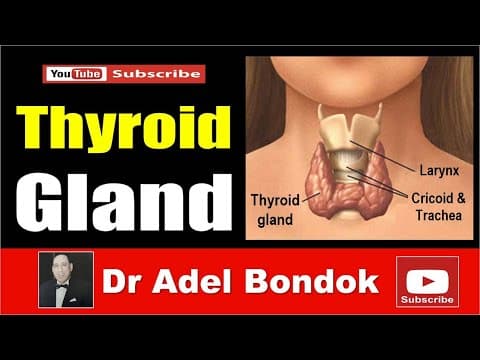
[0:12]Good morning. This is Dr. Adel Bonduck, Professor of Anatomy and Neuroscience, Mansoura University, Egypt. Today I will talk about the anatomy of the thyroid gland. I will talk about the position, the shape, the surfaces, the relations, arterial supply, venous drainage, lymph drainage, and parathyroid glands. Start by the position of the thyroid gland. The position, the thyroid gland is located in front of the lower part of the neck here. The thyroid gland covers the front and sides of the upper part of the trachea. The thyroid gland is covered by the pretracheal fascia, which fixes the gland to the trachea and to the larynx. That's why the thyroid gland moves up and down during swallowing.
[1:13]Regarding the shape of the thyroid gland, the thyroid gland is formed of two lobes and isthmus. This is lobe and this is isthmus. The isthmus overlies the second, third and fourth tracheal rings. Each lobe extends from the oblique ridge of thyroid cartilage till the fifth or the sixth tracheal ring. A small lobe called the pyramidal lobe. This pyramidal lobe may project from the upper border of the thyroid gland and to be connected with the hyoid bone by fibrous band called levator glandulae thyroideae. This fibrous band, which is called levator glandulae thyroideae, is the remains of the thyroglossal duct.
[2:09]Regarding the relations of the thyroid gland, the thyroid gland has three surfaces. This surface is the superficial or lateral surface. This surface is the medial surface and this surface is the posterior surface. And this border is the posterior border and this posterior border is very important clinically or surgically because it is related to the parathyroid glands. Start by the relations of the lateral surface. The lateral surface or the superficial surface is related to 5 S. The first S is the skin and superficial fascia, skin and fascia. And then four muscles. The four muscles are sternomastoid. The second one is the sternohyoid. The third one is the superior belly of the omohyoid. And the last one is the sternothyroid. Sternomastoid, sternohyoid, superior belly of omohyoid and sternothyroid.
[3:32]Again, the lateral surface, this is the lateral surface or the superficial surface, is related to 5 S. The first S is the skin and fascia. Then four muscles. The four muscles are the first one, sternomastoid muscle. Then sternohyoid. Okay. And this one is the superior belly of the omohyoid. And then sternothyroid. Let us see the muscles again from another view. This is the front of the neck and I can see the isthmus, part of the isthmus here. Okay. So, skin and other four muscles. This is the sternomastoid. This is the sternohyoid. This is the superior belly of omohyoid. And this is the sternothyroid.
[4:42]Then the medial surface of the thyroid gland. This is the thyroid gland. This is the lobe and this is the isthmus. This is the cricoid cartilage. This is the first ring of the trachea and the isthmus overlies the second, third and fourth tracheal rings. Let us remove the thyroid gland to see the structures related to the medial surface. The medial surface is related to eight structures. The eight structures are two tubes above, the first one is the larynx and the second one is the pharynx. Two tubes below, the continuation of the larynx is the trachea and the continuation of the pharynx is the esophagus. So two tubes above, larynx and pharynx. Two tubes below, trachea and esophagus. Then two nerves and two muscles. The two muscles, this one and this one. This one is the inferior constrictor and this one is the cricothyroid muscle. Then two nerves, this one and this one. This is the external laryngeal nerve, two nerves. This is the external laryngeal nerve and this is the recurrent laryngeal nerve.
[6:10]So the medial surface is related to eight structures. Then the posterior surface. This is the posterior surface. Posterior surface. The posterior surface is related to the carotid sheath and this carotid sheath contains internal jugular vein, most lateral, common carotid artery, most medial and in between the vagus nerve. Behind the carotid sheath, we have the sympathetic chain and prevertebral muscles. The posterior border, this is the posterior border of the thyroid gland. This is the posterior border. It is related to the two parathyroid glands. The superior parathyroid gland is located in the middle. The inferior parathyroid gland is located at the lower end. This is the superior parathyroid and this is the inferior parathyroid gland. So we finished with the relations of the thyroid gland. Now the arterial supply of the thyroid gland. The thyroid gland is supplied by three arteries. Superior thyroid artery from the external carotid artery. Inferior thyroid artery from the thyrocervical trunk, first part of subclavian artery. And thyroid ima artery in 10%. It arises from the aortic arch or the brachiocephalic artery. It supplies the isthmus. Ima equals the lowest. So again, the thyroid gland is supplied by three arteries. Superior thyroid artery, inferior thyroid artery and thyroid ima artery which supplies the isthmus. Superior thyroid artery arises from the external carotid artery. It accompanies the external laryngeal nerve. Inferior thyroid artery arises from the thyrocervical trunk of the subclavian artery and it is accompanied by the recurrent laryngeal nerve. Superior thyroid artery supplies upper 1/3 of the lobe and upper 1/2 of the isthmus. The inferior thyroid artery supplies lower 2/3 of the lobe and lower 1/2 of the isthmus and the parathyroid glands.
[8:58]And the thyroid ima artery is present only in 10% of the population and it arises from the aortic arch or the brachiocephalic artery. Regarding the venous drainage, the thyroid gland is drained by three veins. Superior thyroid vein which ends or drains into the internal jugular vein. Middle thyroid vein which drains into the internal jugular vein also. Inferior thyroid veins drain into the left brachiocephalic vein. So we have superior thyroid, middle thyroid and inferior thyroid veins. The superior thyroid vein and the middle thyroid vein drain into the internal jugular vein. The inferior thyroid veins drain into the left brachiocephalic vein. Regarding the lymph drainage, the isthmus drains into the pretracheal lymph nodes. Regarding the lobe, the upper part of the lobe drains into the upper deep cervical lymph nodes. The lower part of the lobe drains into the lower deep cervical lymph nodes. So the thyroid gland drains into pretracheal lymph nodes from the isthmus, upper deep cervical lymph nodes from the upper part of the lobe, lower deep cervical lymph nodes from the lower part of the lobe. Clinically, two structures may be injured during thyroidectomy. These two structures are number one, the two parathyroid glands. And number two, the laryngeal nerves, the external laryngeal nerve and the recurrent laryngeal nerve. So in thyroidectomy, we have to take care or be careful of the parathyroid glands and the external and recurrent laryngeal nerves. In thyroidectomy, we have to ligate the thyroid artery. So where do you ligate the thyroid arteries? The superior thyroid artery is ligated close to the upper pole of the thyroid gland to avoid injury of the external laryngeal nerve.
[11:45]The inferior thyroid artery is ligated away from the gland close to its origin to avoid injury of the recurrent laryngeal nerve. So the superior thyroid artery is ligated close to the upper pole of the thyroid gland to avoid injury of the external laryngeal nerve.
[12:31]And thank you very much. Best wishes and good luck.


