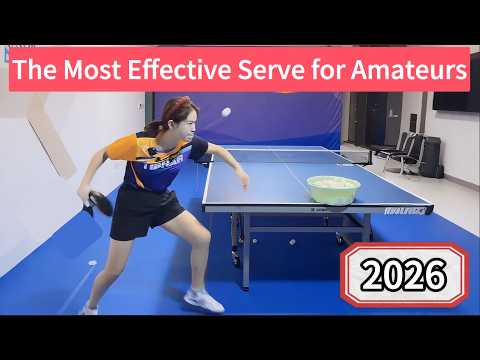
[0:01]At 10:10, you can serve 10 balls. At minimum, you need 3-4 complete service sets. The more variations you have, the harder it is for your opponent to read you. Backhand fast heavy backspin, short no-spin to the forehand, these two serves are a must to practice. They're common weak points for amateurs. A standard backhand serve—when serving right sidespin with the backhand, you must stand in the middle. Don't serve from the backhand corner, the angles are limited. For this sidespin topspin serve, even if you tell him it's sidespin topspin, how many amateurs can really flick it well? Most will push. That gives us an attacking opportunity. Even if he flicks, you're already positioned to open into topspin rallies. That makes it much easier. Second, the backhand long serve—mix sidespin topspin and sidespin backspin. If he's a pure pusher, focus on sidespin topspin. If he likes to attack or loop, focus on sidespin backspin. Just these two lines. Backhand serve means short to forehand, long to backhand. Stand in the middle to serve. You'll get twice the result with half the effort. Down-the-line short serve—short to forehand, with a bigger angle and arc, is very hard to receive. Let me say one thing: don't obsess over reverse pendulum and hook serves. From what I've seen, among strong amateurs in recent years, some have mastered the hook serve, but not the reverse pendulum. Many players have excellent backhand serves. That proves it's easier to control and practice. While you're struggling with right sidespin serves, you can first develop your backhand serve, as a complement to your forehand side serves. Now about the fast long serve—at 0:0, when practicing this serve, you should combine it with other spins. The fast long serve is most effective at the start of the game and at key points. Here's my suggestion: at 0:0, you can take the initiative. My habit is to sneak the first serve long. But when serving long to the forehand, don't use a fast heavy backspin. Usually it's a fast long serve, speed is the priority. At critical moments, if your opponent reacts very quickly, I don't recommend the fast long serve. But if he reacts slowly, has poor anticipation, and doesn't move his feet, fast long serves to the middle are most effective. If you use it in mid-game, you must vary it. If he gets used to it, switch to a fast long backspin. Alternate one fast long, one fast long backspin. That easily confuses opponents.
[3:10]Amateurs fear fast balls. You can boldly serve long to the backhand. When sneaking to the forehand middle, try topspin. Before serving, combine it with short serves. One short, one fast long—the effect is excellent. Lack of confidence causes errors, because you don't trust your serve. Just practice more. I strongly recommend practicing the hook serve.
[3:44]The hook serve has two major advantages: great deception, and a natural downward angle. With the same motion, I can produce different spins. The difference in arm swing and brushing range is minimal. So amateurs struggle to read it. Second advantage: it's easy to generate strong sidespin topspin.
[4:12]The hook serve is the only serve that feels like looping the ball. If you're good at topspin, don't give up the hook serve. Once mastered, you can even tell your opponent it's hook topspin—and still go straight into a topspin rally. So topspin players shouldn't miss this. If your hook serve doesn't trouble opponents, it's because your placement is too predictable. Let's talk about serving long to the backhand corner.
[4:46]If your right sidespin goes toward this area, I can receive it easily from here. So your hook serve must travel toward the sideline. This is very hard to practice. You can't serve it like this—you must send it toward the sideline. I practiced this for a long time. This position—after not using it for a long time, I made many errors. When practicing, never serve to this spot. Always aim for the sideline. It may look like the ball curves inward, but compare defending from here and from here—once it goes outside the body on the backhand, he will likely miss. Then you follow with a short forehand serve.
[5:37]Stand in the backhand position, serve fast sidespin topspin to the sideline. Slow won't work. It must be fast. Sidespin backspin as well—let the ball exit toward the sideline.
[6:03]The effect will double. This is an excellent placement. The second placement—short to the forehand. With the hook serve—short to forehand—watch—just a light wrap like this, and it curves outward. For all short serves, don't focus on making them extremely spinny. If you chase spin, the arc gets too high and the speed too slow. Don't think about maximum spin—think about making it as short as possible. If I serve like this, he'll attack immediately.
[6:45]It should be like this—First, make it short and floating. In the short game, curve is critical. Deny him a clean contact point. That causes errors. Second, both motions must look similar. Use a big motion for a short serve. Once it's consistent, with the hook serve—sideline sidespin topspin and sidespin backspin differ from left sidespin. It must be fast. Remember this keyword—short serves should be as short and as floating as possible, don't chase spin. Second—stand in the middle to serve. If you stand in the center—like this—down-the-line serves easily go into the net, I've tested it. It's the hand that stays in the middle, while your body shifts slightly to the backhand side. Hand in the middle position—the best effect is: start with several long serves to the backhand. Along this line—try it next time. The speed is very fast. It feels almost like a straight-line drive. The hook serve naturally applies force at 45 degrees. So this line is easy to execute.
[8:12]It makes the opponent uncomfortable. So always serve from here. Then you can vary sidespin topspin and backspin freely. Second placement—long to the forehand. Most amateurs have slow footwork. So a sidespin topspin sneak serve works well. The force application looks like this—at the last moment, only then does the opponent realize it's crosscourt.
[8:45]So earlier, serve crosscourt more often—then at the key moment—I use this frequently—it works extremely well. Because you've already pressured the backhand long, his attention isn't on the forehand. You must serve in sequence. First serve long to the backhand.
[9:09]Don't start with the short forehand. Otherwise his focus shifts to the forehand. Go backhand long first—then forehand long—Only when long serves lose effect do you switch short. If he has adapted to the long serve, his instinctive block will land here. So after serving—just cover the forehand side and attack. Now, what's the key to the short forehand serve? If his footwork is poor, make it float aggressively.
[9:42]Send it drifting outward, around this area, so it kicks out right after the first bounce. Don't worry about topspin or backspin. If this tactic stops working, serve to this spot—with sidespin topspin. Both forehand and backhand flicks will feel awkward. This placement—To summarize these placements: one long to the backhand, one long to the forehand, one curving outward.
[10:16]When he starts receiving well, go back to long to the backhand. Then return to short forehand topspin. If you always serve the same spot, even if he misreads once, he'll adjust. You need tactics to move him. If he's familiar with all these placements, serve sidespin topspin to the middle.
[10:40]Not to backhand or forehand—That's the general structure of the hook serve—the placements I just mentioned. Now, some advice for amateurs: If you truly want to win points with your serve, you need three service systems. One is your regular serve—for example, left sidespin. Second, choose one right sidespin variation—don't train both reverse pendulum and hook. They're essentially similar concepts. Pick one and master it. Third—the best serve isn't one where the opponent misreads it. The best serve creates an opportunity for your next attack. Remember this words


