[0:00]It is February 28th, 2026. A date that will mark an irreversible watershed in the contemporary history of the Middle East and the entire world. In a night of colossal air strikes, jointly conducted by the United States and Israel in the heart of Iran. Ayatollah Ali Khamenei, the supreme leader who has ruled the country with an iron fist since 1989, was killed at the age of 86. His sudden and violent death, which came at the culmination of months of mounting tensions, not only leaves an enormous power vacuum at the top of the Islamic Republic, but also triggers a series of chain reactions that are already setting the entire region ablaze. But let's take a step back to understand exactly what happened in these frantic hours. Who was struck and what the immediate consequences are of an attack that has a declared and unprecedented objective, regime change in Iran. It all begins on Saturday, February 28th. The skies over a staggering 24 Iranian provinces are crossed by a massive wave of Israeli and American fighter jets, drones and missiles. This is not a simple warning strike or an operation limited to nuclear sites, as occurred in June 2025. The main target, the most protected and inaccessible one, is Ali Khamenei's super fortified compound in Central Tehran. The attack literally pulverizes the residence. The first to break the news to the world is not Iranian state television, which is in an evident state of shock and confusion, but the President of the United States, Donald Trump. Trump announces the elimination of the Ayatollah, calling him one of the most evil people in history. In his message, the American president reveals the use of highly sophisticated tracking systems to locate the supreme leader. stating that this is the greatest chance for the Iranian people to take back their country. Official confirmation from Tehran arrives only several hours later. The Supreme National Security Council and Iranian State TV announced the death of the man who led the country for 37 years, as its highest spiritual, political, and military authority. The government immediately declares 40 days of national mourning. But Khamenei is not the only high-profile victim of this surgical raid. Members of his closest family circle also lose their lives under the rubble of the destroyed compound. News agencies close to the military confirmed the deaths of a daughter, the son-in-law, and a granddaughter of the supreme leader. Alongside them, the American and Israeli bombings eliminated key figures of the security apparatus. Among these stands out General Mohammad Pakpour, head of the Revolutionary Guard's ground forces. The civilian toll of the joint offensive, however, is incredibly heavy. The Iranian Red Crescent reported over 200 dead and nearly 750 wounded across the country. Among the most dramatic news is that of an attack that struck an elementary school in Minab, in Southeastern Iran, causing the deaths of over 100 people. The internal reaction in Iran reflects the deep divisions of a torn country. On one hand, there are scenes of inconsolable grief. In Mashhad, Khamenei's hometown, thousands of supporters gathered in tears around the Imam Reza Shrine, waving black flags and portraits of the supreme leader. On the other hand, international sources and eyewitnesses on the ground report diametrically opposed scenes in Tehran, where, under the cover of night, groups of citizens celebrated in the streets, the fall of the man who had bloodily repressed the massive democratic protests of recent years. In particular, between January 8th and 9th, Iran was a stage for what has already been classified as the bloodiest repression of civil protests in the country's history. The Iranian government admits to roughly 3,000 victims. Leaked documents from internal intelligence estimate that between 30,000 and 36,500 people were slaughtered in just 48 hours. But the question that obsesses chancelleries around the world today is, who will take Khamenei's place? His disappearance creates a frightening power vacuum. Since 1989, Khamenei had consolidated absolute authority. Now, there is no clear and designated successor. According to the Iranian Constitution, it is up to the Assembly of Experts, a council of 88 clerics, to elect the new supreme leader. In the meantime, the country will be led by a transitional council formed by President Masoud Peski, Gholam Hossein, Moeni A, and another high-ranking official. However, many analysts fear that normal institutional procedures will be bypassed. The Revolutionary Guards, the powerful Pastaron, who control both the army and enormous slices of the Iranian economy, could take advantage of the chaos to definitively consolidate power, transforming the theocratic republic into a full-fledged military dictatorship. Iran, though fatally wounded at its highest levels, has already responded. A few hours after the start of the raids, the Iranian armed forces activated their arsenal, unleashing a massive reprisal on multiple fronts. The first target was Israel. Dozens of ballistic missiles rained down on Israeli territory. One of them evaded the defense systems, scoring a direct hit on a building in Tel Aviv. Rescue workers speak of at least one dead and 22 wounded, with the structure partially collapsed and in flames. But the escalation did not stop at Israel. Iran widened the conflict by striking the bases and interests of American allies in the Gulf. The United Arab Emirates came under an unprecedented attack. The Abu Dhabi government declared it intercepted most of the 137 missiles and 209 drones launched against their territory. Yet, in Dubai, there were injuries at the international airport and flames were spotted in iconic hotels like the Burj Al Arab and the Fairmont. And as the skies ignited, anger also exploded in the squares of Iranian allies. In Baghdad, Iraq, a furious crowd mourning Khamenei's death clashed with Iraqi security forces, attempting to storm the American Embassy in the green zone. The world wakes up to a profoundly altered reality. The US-Israeli military operation achieved its primary tactical objective, decapitating the leadership of modern Iran. But it has also triggered a chain reaction that no one exactly knows how to manage. American forces from Central Command declare they are ready to continue the campaign to dismantle nuclear sites in the coming days, while the Revolutionary Guard swear that the hand of vengeance will not let go of the Imam's assassin and that they will strike relentlessly until the enemy is defeated. The gamble of Washington and Jerusalem is that this formidable shock will lead to the definitive collapse of the theocratic regime from within, giving power back to the people. But the concrete risk, tangible in these hours of sirens and rubble, is that of a devastating regional war that could drag entire countries into the abyss and block global energy routes. The architecture of the Middle East that we have known in recent decades has officially collapsed.
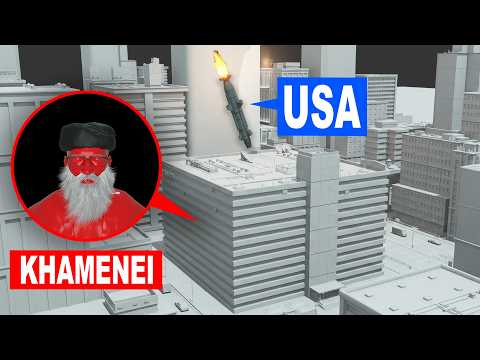
How the United States Killed the Leader of Iran
Gapa Vision
7m 41s1,136 words~6 min read
YouTube auto captions
Transcript source
YouTube auto captions
This transcript was extracted from YouTube's auto-generated caption track. The transcript below is server-rendered so it can be read, searched, cited, and shared without opening the original YouTube player.
Pull quotes
[0:00]A date that will mark an irreversible watershed in the contemporary history of the Middle East and the entire world.
[0:00]In a night of colossal air strikes, jointly conducted by the United States and Israel in the heart of Iran.
[0:00]Ayatollah Ali Khamenei, the supreme leader who has ruled the country with an iron fist since 1989, was killed at the age of 86.
[0:00]But let's take a step back to understand exactly what happened in these frantic hours.
Use this transcript
Related transcript hubs
Watch on YouTube
Share
MORE TRANSCRIPTS


