[0:00]Most people treat Chat GPT like a new intern, but I use it to drive five strategies. It's like having five of the world's smartest minds work 24/7 for only $20 a month to help me move faster, decide better, and focus on what truly matters. But I only figured this out after spending years in tech and AI as a CEO, board member, and investor, where I watched elite teams use AI in ways most people never see. So today, I am sharing those five strategies to use chat GPT so well, it feels illegal. The first strategy is called the clone. When I was a kid, my grandpa had late stage Alzheimer's. Every few minutes, he would look at my grandmother, the woman he had been married for over 60 years and he would ask, who are you? And then he would go ahead and tell me a story, forgetting that he just told me the exact same story five minutes ago. His brain didn't have memory of his last five minutes. Chat GPT suffers from something very similar. Every time you open a new chat session, you're starting from zero context. But there is a way to give Chat GPT an almost telepathic ability. It can keep the memory and context for you alive without you explaining every single time. For that, I apply a three-step framework called ESP. E is extract. Open the voice mode in Chat GPT and say, "Listen, you're my Chief of staff. Interview me for 20 minutes, 30 minutes, my background, my tone, my strategy, my blind spots." Then, talk a while. Be messy, don't self-edit. This step is about raw capture only. S is synthesize. Now, this is where you turn the raw data into an operating system. So upload the transcript of whatever you said to Chat GPT and ask Chat GPT to organize it into a summary on who you are and how you think. Now go to settings, custom instructions and paste your summary. By the way, this is also the place where you tell Chat GPT exactly how you'd want it to behave. Always format data as tables, don't send me walls of text. But now, Chat GPT knows who you are, how you want your responses shaped, and what to avoid by default. And here's where it gets really wild. P is for projects. Think of a project as a space where you store your context. It lives with your instructions, memories, files, repeated tasks. For instance, for your work projects, upload your resume PDFs and data that's relevant. You can even customize the instructions inside each project's settings. Just remember not to mix domains. So for example, I have my consulting project, and then my YouTube project, and my health project, separate. This turns your AI from a temporary chat into a persistent brain. But that's only the first battle. You still need an army to do the heavy lifting. That is our next strategy. The second strategy is called the Swarm. There's a great story in ancient Indian mythology about a demon who was impossible to defeat with a single weapon. So the great goddess manifested eight arms, wielding eight different weapons at once. She was known as "Ashta Bhudha Durga." Eight arms, eight weapons, eight battles fought in parallel. And most of us are fighting our own modern demons with just our two bare hands. Our brain can only handle one task at a time. You need to hire three specific advanced capabilities of Chat GPT. Number one, your hands. Stop doing tasks one by one, use the agent mode. Dispatch the swarm. Instead of searching for a single lead, give Chat GPT a command. Find 50 leads in the SaaS space. Verify their emails. Rank them by revenue. That's it. Let it run. You go get coffee. But there is one catch. Chat GPT is still trapped inside a text box. It can find leads, but it can't actually put them into your CRM or build a process around them. Number two, your eyes. Stop describing your problems. Chat GPT is very visual. You can take a photo of a whiteboard sketch, a broken car part, or a complex analytics dashboard. Just upload it. And then say, analyze this picture, tell me what's wrong with it, and tell me one move that I can make to fix it. You're using Chat GPT as your eyes, not just your keyboard. And the great thing is Chat GPT can see things human eyes can't. And finally, number three, your research assistance. You can do deep research that was once the domain of an analyst who you would pay $50,000 for. Recently, I was in a meeting with a Chief Technology Officer of a large firm and he said something very interesting. He said, I had to evaluate six presentations delivered by a very large IT consulting firm on the technology infrastructure of a massive data center. And there were 300 pages of dense information. But what did he do? He uploaded them all in Chat GPT, hired a swarm of AI analysts. One afternoon. That's all it took. Now that would have taken weeks before. That's the world we're heading into. In the age of AI, you won't be billing for your time anymore. You'll only bill for your taste. So this swarm gives you an army of powerful interns. But your next strategy isn't about hiring AI to take orders, it's there to challenge you. Your third strategy then is the Devil's advocate. Around the 1500s, the Catholic Church was the most powerful organization on Earth, but it was also under a lot of attack. By 1587, the Pope had a massive problem. The church was canonizing saints left and right. So the Pope did something pretty radical. He created an office called the Advocatus Diaboli, the Devil's Advocate. This person's entire job was to argue against the canonization of any saint. To find the dirt, to poke holes, to be ruthless. The church realized this 400 years ago, when the stakes are high, good decisions are rarely made through agreements. They come from conflict. Now, why is this necessary? Well, it's called the IKEA effect. We fall in love with anything we build ourselves. Research shows that smart people are great at spotting flaws in other people's thinking, physically incapable of seeing them in their own. So the key insight, most people use Chat GPT for validation, but you should use it for violation. But here's the problem, Chat GPT is programmed to keep you happy. So you have to force it to behave differently. So here are the three tricks to break the AI's people pleaser programming. First, use magic triggers. Force adversarial thinking. Instead of saying, what do you think? Be specific. Prompted and say, audit this using first principles. Act as my fiercest competitor. You may not get what you want, but you will get what you need. Second, shadow boxing. Don't step into the ring unprepared. Let's say if you're going out to raise money for your venture. Tell the AI, simulate a debate between a ruthless, skeptical VC and a visionary product designer. Let the VC push back on the idea. I want to see that fight and learn from it. This way, you let AI expose the weak points, so you don't fumble on them in the real world meeting. Third, the blind spot check. Feed it your strategy and ask one question. Based on what you know about me, what are the gaps in my reasoning? When we get successful, we develop two bad habits. We trap ourselves in this bubble of our ego and we surround ourselves with people who just say yes. That's why this strategy is so critical to save you from yourself. But knowing where you're wrong or why you're wrong is not enough. You still have to learn fast about what's right. That's where our next strategy comes in, the neural link. And it breaks the rule most of us grew up believing, that mastery takes 10,000 hours. You know, there is a famous story about a physicist, Max Planck. After he won the Nobel Prize, he went on a tour, giving the same speech about quantum mechanics every night. Now his chauffeur sat in the front row every time and literally memorized every word. One night the chauffeur said, Professor, I'm getting bored just listening to you. Let's switch. I'll give the lecture on stage and you sit in the audience wearing my cap. Planck, of course, agreed. Same words, same structure, same cadence, the speech was flawless, but at the end, a physicist in the audience stood up and asked a deep technical question. But the chauffeur didn't panic at all. He smiled and said, "I am surprised to hear such a simple question in a city as advanced as Munich." To prove how simple it is, I'm going to let my chauffeur answer it. Of course, that was Max Planck. But here's the point, most people use Chat GPT like that chauffeur. They copy-paste smart-sounding phrases and answers to sound intelligent. They have fluency without foundation. So here are three ways to get that neural link, true understanding without becoming that chauffeur. First, the jargon translator. For instance, tell it, explain the concept of API using the restaurant metaphors only. Suddenly, the menu becomes the documentation, the kitchen is the server and the waiter is the API, the messenger that takes your order, delivers it in the kitchen, brings back the results. You aren't learning from scratch. You're translating that jargon into your jargon. Second, the progressive professor. Richard Feynman said that if you can't explain it simply, you don't understand it. So don't ask Chat GPT to explain quantum computing, but instead say, explain quantum computing to me three ways. One, like I am a five-year-old. Give me the simplest explanation. Number two, like I am a 15-year-old, explain it with logic and examples. And three, like I am a college student, share the underlying theory. When you do that in that particular order, you will feel any concept click into place in your brain instantly. And third, the degree download. You teach it, you keep it. So use AI to be your target audience or a peer. Prompt it to say something like, I want to build a cool AI commerce product. I need to learn the foundation of how machine learning works. Skip the theory, only give me actionable skills, no fluff, and then test me so I can teach it back to you. You just replaced a boot camp worth $50,000 with a PDF. So here you are. You have built a high-performance Chat GPT machine. But such machines tend to overheat. The fifth strategy is called the Executive Coach. And without it, none of the other strategies would work. 2,000 years ago, Marcus Aurelius was the Emperor of Rome, but he was also the loneliest. He had no one to talk to, so he hired a coach. That coach was a blank scroll. Every night in his tent, he wrote down his anxieties, his fears, his advice to himself. He titled that manuscript, "To Himself." If you are a successful executive or on the path of being one, you need an executive coach. I had two, and they both changed my trajectory dramatically. But sometimes, executive coaches and mentors aren't going to be available to you at midnight when you need them the most. When you can't sleep because of a decision you have to make. And that's when you can use Chat GPT to show you a mirror with zero emotional baggage. You can even turn the voice mode. That's what I do. Here are three tricks to turn Chat GPT into your temporary executive coach. First, the vomit mirror. When you are overwhelmed, your brain is going to be a tangled mess. It happens to me. Open voice mode and say, I am going to rant for five minutes about everything stressing me out. Don't interrupt, just listen. When I'm done, organize my chaos into three lists: problems I can solve today, problems I need to delegate, noise I need to ignore. That's it. And then, go ahead, just rant as long as you want. Second, the stoic mirror. It's possible that you may have just lost a deal, or you got fired or something terrible happened. You can say to Chat GPT at that point, I just took a massive loss. I feel like a failure. Reframe this situation for me using the stoic principles and tell me why this is actually an opportunity. Have that conversation until you're convinced. Push back, let it push back to you. Even if you're not convinced, it'll slow down the emotional spiral that you're on, instantly. And the third and the final mirror, the decision mirror. Before you make a massive decision, like quitting a job or starting a new company, talk it out. I am about to do X. Here's my logic. Let's have a conversation. You don't have to put faith in Chat GPT's advice. In fact, please don't. But talking it out clears your own head about your own judgment. We covered five strategies and 15 ways to optimize your relationship with Chat GPT. But here's the truth. All of these skills are essentially alpha. In finance, when traders find an edge, they make a fortune, and it's called the Alpha. But eventually, everyone figures it out. What's rare today becomes required tomorrow. That's how life works. And what happens when it all becomes a commodity? How will you maintain your edge then? I'll share my personal story that changed my idea about my edge. A week before I took my CEO job, my executive coach pulled me aside. And he said, "Remember, your title is CEO, Chief Executive Officer, but that E does not just stand for Executive. It also stands for Emotions. You're the Chief Emotions Officer now as well. You have to manage the emotions of your own people. That conversation stayed with me for years. Because for a long time, we have forgotten that message. You know, we spent the entire industrial age trying to turn ourselves into machines. We measured our worth by our output, our productivity. If we didn't produce or we didn't consume, we didn't matter to the market. So what did we do? We tried to out-robot the robots. But now, the actual machines have arrived to take their job back. And that's not a threat, that's actually a permission. Permission to us, to stop pretending like we're machines. Permission to feel, to show compassion, to connect to those mysteries, to connect to others, to connect to this mystery called life. In a way, I feel that AI and machines are coming to free us from labor, so we can return to our essential nature. AI's ultimate gift might very well be then, that it will make us more human. If you like this video, here's another one that I think you will like. Thank you, and I love you.
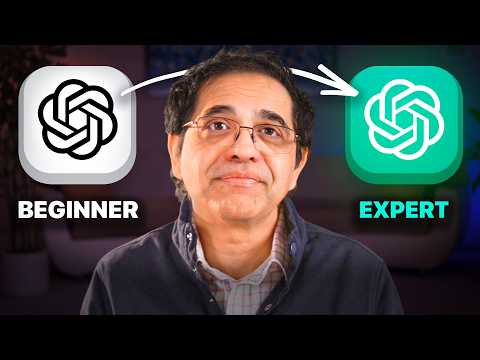
5 Hacks To Use ChatGPT So Well It’s Almost Unfair
theMITmonk
16m 23s2,539 words~13 min read
YouTube auto captions
Transcript source
YouTube auto captions
This transcript was extracted from YouTube's auto-generated caption track. The transcript below is server-rendered so it can be read, searched, cited, and shared without opening the original YouTube player.
Pull quotes
[0:00]Most people treat Chat GPT like a new intern, but I use it to drive five strategies.
[0:00]It's like having five of the world's smartest minds work 24/7 for only $20 a month to help me move faster, decide better, and focus on what truly matters.
[0:00]But I only figured this out after spending years in tech and AI as a CEO, board member, and investor, where I watched elite teams use AI in ways most people never see.
[0:00]So today, I am sharing those five strategies to use chat GPT so well, it feels illegal.
Use this transcript
Related transcript hubs
Watch on YouTube
Share
MORE TRANSCRIPTS


