[0:01]What are human rights? Human rights is um, jeez, that's a good question.
[0:09]Human rights? Well, that's a tough one. Wow. Um, I don't even know how to give that a definition.
[0:17]I would probably have to do a little bit of homework or something. Any right that I think any, just as a normal, you know, uh, human, any the rights that humans have.
[0:26]There's a very large debate. Human rights can mean many things. You can ask 20 people and you will get 20 different opinions. I wouldn't know. It is a complicated question. It's conscious. You just take for granted that they're there, but we don't even consider what they are.
[0:41]Human: A member of the homo sapiens species; a man, woman or child; a person. Rights: Things to which you are entitled or allowed; freedoms that are guaranteed.
[0:51]Human rights are the rights you have simply because you're human. It's how you instinctively expect and deserve to be treated as a person.
[1:00]Like the right to live freely, to speak your mind, and to be treated as an equal.
[1:06]There are many kinds of rights. Most apply to a certain group, but human rights are the only ones that apply to absolutely everyone everywhere.
[1:15]That means kids, old people, poor people, basketball players, garbagemen, rappers, teachers, Africans, Indians, Albanians, Christians, Muslims, Cabalists, Atheists, your mom, your dad, your next-door neighbor, and you. All have the exact same human rights.
[1:30]In other words, they're universal. But the question remains, what are they?
[1:36]Name human the human rights? What the human rights are? Um, the right to live, equality between all peoples. Right to religion, the right to, Is there supposed to be a list somewhere I should be aware of?
[1:49]According to the United Nations, there are a total of 30 human rights, which are usually lumped together and called simply Human Rights.
[1:58]They're all listed out in the Universal Declaration of Human Rights, which is the world's most widely accepted document on the subject. But it was a long time in coming.
[2:08]At first, there were no human rights. If you were in with the right crowd, you were safe. If you weren't, well, you weren't.
[2:17]But then a guy named Cyrus the Great decided to change all that. After conquering Babylon, he did something completely revolutionary.
[2:25]He announced that all slaves were free to go. He also said people had the freedom to choose their religion, no matter what crowd they were a part of.
[2:37]They documented his words on a clay tablet known as the Cyrus Cylinder. And just like that, human rights were born.
[2:45]The idea spread quickly to Greece, to India, and eventually to Rome. They noticed that people naturally followed certain laws, even if they weren't told to. They called this natural law.
[2:58]But it kept getting trampled on by those in power, not until a thousand years later in England. They finally got a king to agree that no one can overrule the rights of the people, not even a king.
[3:10]People's rights were finally recognized and they were now safe from those in power. Kind of. It still took a bunch of British rebels declaring their independence before the king got the point that all men are created equal.
[3:26]Which isn't to say he liked the idea, but he couldn't stop them and America was born. The French immediately followed with their own revolution for their own rights.
[3:37]Their list was even longer and they insisted that these rights weren't just made up. They were natural. The Roman concept of Natural Law had become Natural Rights.
[3:48]Unfortunately, not everyone was so thrilled. In France, a general named Napoleon decided to overthrow the new French democracy and crown himself emperor of the world. He almost succeeded.
[4:02]But the countries of Europe joined forces and defeated him. Human Rights was again a hot topic. They drew up international agreements, broadly granting many rights across Europe, but only across Europe.
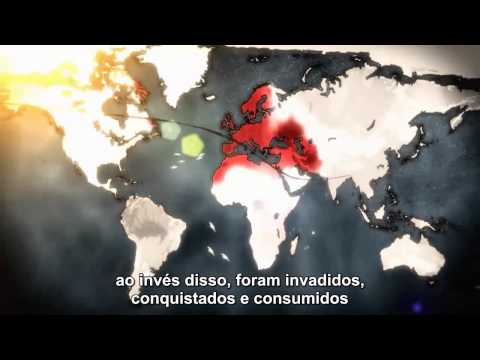
[4:16]The rest of the world somehow still didn't qualify. Instead, they got invaded, conquered and consumed by Europe's massive empires.
[4:26]But then a young lawyer from India decided that enough was enough. His name was Mahatma Gandhi, and in the face of violence, he insisted that all people of Earth had rights, not just in Europe. Eventually, even Europeans started to agree.
[4:43]But it wasn't going to be that easy. Two World Wars erupted. Hitler exterminated half the Jewish population of Earth in horrifying Nazi death camps. All told, 90 million people died.
[4:58]Never had human rights been so terrifyingly close to extinction. And never had the world been more desperate for change.
[5:07]So the countries of Earth banded together and formed the United Nations. Their basic purpose was, to reaffirm faith in fundamental human rights, in the dignity and worth of the human person.
[5:23]But what were human rights? Were they the proclamations of Cyrus? The natural laws of Rome? The declarations of France?
[5:32]Everyone seemed to have a slightly different idea of what human rights should be. But under the supervision of Eleanor Roosevelt, they finally agreed on a set of rights that apply to absolutely everyone.
[5:46]The Universal Declaration of Human Rights. The French concept of natural rights had finally become human rights.
[5:56]So, in summary, at first, only a few lucky people had any rights. Until one of those guys decided, "Hey, other people should have some rights too!" which was great, except not everyone agreed.
[6:07]And it only took a few thousand years of fighting and declarations and more fighting until everyone finally agreed that human rights should apply to everyone. And they all lived happily ever after.
[6:20]Except for one little problem. If people have the right to food and shelter, why are 16,000 children dying of starvation every day? One every 5 seconds.
[6:32]If people have freedom of speech, why are thousands imprisoned for speaking their minds? If people have the right to education, why are over a billion adults unable to read?
[6:44]If slavery has truly been abolished, why are 27 million people still enslaved today? More than twice as many as in 1800. The fact is, when it was signed, the Universal Declaration of Human Rights did not have the force of law. It was optional.
[7:03]And despite many more documents, conventions, treaties, and laws, it's still a little more than words on a page.
[7:13]So the question is, who will make those words a reality?
[7:20]I have a dream today. When Dr. King marched for racial equality, he was marching for rights that had been guaranteed by the United Nations for almost two decades, but still he marched.
[7:34]When Nelson Mandela stood up for social justice in the 1990s, his country had already agreed to abolish such discrimination for almost 40 years, but still he fought.
[7:46]Those who fight today against torture, poverty, and discrimination, are not giants or superheroes. They're people: kids, mothers, fathers, teachers, free-thinking individuals who refuse to be silent, who realize that human rights are not a history lesson.
[8:08]They're not words on a page. They're not speeches or commercials or PR campaigns. They are the choices we make every day as human beings. They are the responsibilities we all share, to respect each other, to help each other, and to protect those in need.
[8:28]As Eleanor Roosevelt said, "Where, after all, do universal human rights begin? In small places, close to home.
[8:37]So close and so small that they cannot be seen on any maps of the world. Yet they are the world of the individual person; the neighborhood he lives in, the school or college he attends, the factory, farm or office where he works.
[8:56]Such are the places where every man, woman and child, seeks equal justice, equal opportunity, equal dignity without discrimination. Unless these rights have meaning there, they have little meaning anywhere."


