[0:00]This video is brought to you by Thermo Fisher Scientific, offering a wide range of reagents and materials. Thermo Fisher supports virtually every laboratory application from research to drug discovery and development to manufacturing. With over 80,000 laboratory chemicals now on one site, Thermo Fisher delivers choice, quality and supply assurance for all your chemical needs. Visit the link below for more information. He knows a lot about the science stuff Professor Dave explains. Earlier in this series, we learned a few separation techniques, so let's learn another. While some techniques separate the components of a mixture by virtue of differing solubilities or boiling points, chromatography separates on the basis of differing polarities. There are many different kinds of chromatography that work with different phases. But today we will be looking at thin layer chromatography or TLC. This is a technique used to separate non-volatile liquids with different polarities by measuring their mobility in a certain solvent on a thin layer coated with adsorbent material, such as silica gel or aluminum oxide. We have already learned the details regarding this process in one of the lecture-based tutorials, so make sure to watch that video first for a conceptual understanding of this process. As here, we will focus more on how to physically perform the technique. As we recall, all forms of chromatography utilize a mobile phase and a stationary phase. The mobile phase moves through the stationary phase, picking up and separating the materials in the mixture. In TLC, the mobile phase is the solvent, while the stationary phase is the thin absorbent layer, also called the TLC plate. Naturally, to perform thin layer chromatography, the main thing we need is the TLC plate. These can be different sizes depending on how many samples we're separating. Let's use this one today. We'll also need a solvent. The solvent system selected will depend on the substances we're separating. In this case, the solvent will be 95% ethyl acetate and 5% acetic acid. And this could be modified to be more or less polar depending on how well the components of a particular mixture end up separating. Then we need a glass container that we can use as our TLC chamber. Of course, we will also need our samples. Today, we're using two known sample standards, caffeine and aspirin, which we will label A and B, respectively. We also will test a mixture of these compounds, as well as an unknown sample to see if it is A, B, or a mixture of the two. This is one application of TLC, substance identification. Lastly, we will need some tweezers, a pencil and a ruler, and lastly, some capillary tubes. These are what we will use to spot the plate with our samples. To start, let's draw a line at the bottom of the plate with pencil. This will have to be drawn around 1 centimeter from the bottom of the plate. Any lower and your sample will get washed away when you place it in the solvent. The silica is a very thin layer, so draw your line very gently to avoid scratching it. On the line, let's also put four dots for our four samples. Make sure that these are far apart from each other and evenly spaced. We can label our dots A, B, A + B, and U for unknown. Now it's time to load the samples. To do this, let's use a microcapillary tube like this one. Dip the tube into the sample and wait for a bit. You'll see the liquid travel upwards due to capillary action. Then take the tube and spot the plate with the sample. On the corresponding dot, briefly tap the tip of the microcapillary tube. Do this about three times, but make sure you do it gently so that you don't scratch the silica layer. You also want a small sample to maximize the resolution. Do not let the sample spread out too much. To spot the other samples, make sure you use a different tube to prevent cross contamination. Also, make sure that the spots do not bleed into one another. We want to make sure they are completely separated so that the results are unambiguous and easy to read. Now, let's prepare the TLC chamber. We'll need about 5 milliliters of the solvent. The solvent amount will vary depending on the size of the chamber, but for this small container, 5 milliliters is enough. After adding the solvent, cap the chamber for a few minutes. Using forceps or tweezers, let's grab our TLC plate and gently place it into the chamber like this. Again, it is very important that our solvent sits below the sample line on the paper. You don't want the solvent to touch your sample at this point or it will wash into solution and you can't run your plate. After introducing the plate, immediately close the cap and wait. As you can see, the solvent will travel up the plate and it will carry the samples with it. These samples will separate depending on their polarity. Generally, non-polar substances move faster than polar substances, since the silicate material presents many hydroxyl groups, which polar substances can interact with. And this stickiness that results from electrostatic interactions causes polar substances to move along the plate more slowly than non-polar substances, which are unable to make these interactions. Be sure to monitor the chamber since we don't want the solvent front to get all the way to the top of the plate. Remove the plate when the solvent front is just a bit away from the top and quickly draw a line on the solvent front before it becomes invisible due to drying. Once you've done this, let the solvent dry on the entire plate before analysis. When it comes to analysis, this can vary. Some chemicals will be colorful and you'll be able to visibly see the separation on the plate. However, most compounds won't be visible. An easy way to visualize the results is to put the plate under a UV lamp, as compounds with systems of pi electrons become visible under UV light. Using this setup, we'll be able to see the samples and circle them with pencil. If you do not have access to a safe setup like this one, be sure to use protective eyewear when operating a UV lamp as they can be damaging to your eyes. Once we take the plate out of the UV setup, we now have circles that represent the final locations of our samples. As you can see, B traveled farther than A. The spot representing A + B does indeed show data from both isolated samples. And it would appear that our unknown was B, aspirin. From these results, we can also verify that A is more polar than B, which is why it didn't travel as far up the plate. We can even go further with our analysis by quantifying our results. This is done by measuring the retention fraction or RF value for each sample. This is calculated by taking the distance traveled by the sample and dividing that by the distance traveled by the solvent. So any RF value will be some fraction of one. We can do this by measuring the distance from the line at the bottom to the middle of the spot using a ruler. Then measuring the distance from the bottom line to the solvent line and dividing the first by the second on a calculator. RF values can then be compared to tabulated data in order to confirm their identities. In conclusion, TLC is a quick qualitative technique to confirm whether you have the desired product from a reaction. We can also use it to monitor reactions by measuring the components at different stages to ensure completion, depending on whether starting material remains in solution. Since solvents separate components on the plate differently, we can also use TLC to screen for a good solvent system to be used in column chromatography, which is how we can physically separate an entire sample using the same properties. But for now, we have a better understanding of how to perform thin layer chromatography. Thanks for watching. Subscribe to my channel for more tutorials. Support me on Patreon so I can keep making content, and as always, feel free to email me, Professor Dave Explains@gmail.com.
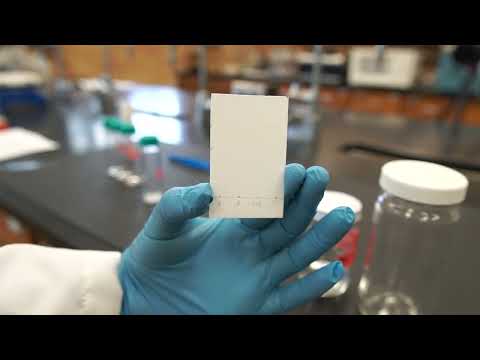
Performing Thin Layer Chromatography (TLC)
Professor Dave Explains
8m 15s1,403 words~8 min read
YouTube auto captions
Transcript source
YouTube auto captions
This transcript was extracted from YouTube's auto-generated caption track. The transcript below is server-rendered so it can be read, searched, cited, and shared without opening the original YouTube player.
Pull quotes
[0:00]This video is brought to you by Thermo Fisher Scientific, offering a wide range of reagents and materials.
[0:00]Thermo Fisher supports virtually every laboratory application from research to drug discovery and development to manufacturing.
[0:00]With over 80,000 laboratory chemicals now on one site, Thermo Fisher delivers choice, quality and supply assurance for all your chemical needs.
[0:00]Earlier in this series, we learned a few separation techniques, so let's learn another.
Use this transcript
Related transcript hubs
Watch on YouTube
Share
MORE TRANSCRIPTS


