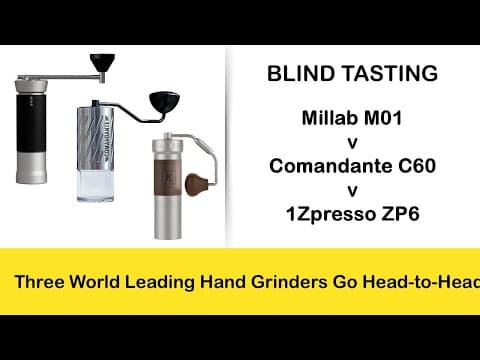
[0:00]Hi there, I'm Tom. Welcome to Tom's Grinder Lab. This is a video on a blind taste testing between the Tiemore Millab M01, the Comandante C60, and the EasyPresso ZP6, three world leading hand grinders going head-to-head.
[0:19]So these are the three grinders in question, the Millab M1, Comandante C60, and the EasyPresso ZP6. What I'm doing this is a follow-up to a review I did of the Millab M01, one of the world's best engineered and probably one of the world's best designed hand grinders. The special thing about it are these pineapple burs, which as you can see, compared to a normal bur you'd expect in a hand grinder of this size are much, much taller. The idea being that it introduces five distinct grinding stages, and this is from the marketing bloat from Tiemore. Piercing, then coarse cutting, and then large particle breaking, fine cutting, and finally grinding. So the idea is that it offers a lot of control over particle size, distribution, finds, and shape. The result, theoretically being enhanced sweetness, flavor complexity, balanced, vibrant cup, as I said that from the marketing blo. And I think they've hit the nail on the head with one caveat, which I will share with you towards the end of this video. First of all though, context and a conclusion. The content's being, this is just one person's opinion, the differences can be very subtle, and we're only using two beans and two roasts, so treat this as a guide. The bottom line is, don't think of this as the definitive conclusion of the differences between these three grinders, it's simply not an extensive enough sampling from different baristas or different bean types. But it will give you an indication, and as I said, one very important thing to remember with the Millab 01. So, let's have a look at our agenda. Essentially, what I'm going to do is I'm going to share with you the protocols behind the blind grind taste comparing, and then we'll have a look at the comparison of number one using a Colombian bean, and then comparison number two using an Ethiopian bean. So in terms of protocol, most of you will be aware that I have a, what I call a grinder lab. So one DE1 XL on one side of the bench, another DE1 XL on the other side of the bench, and that's how I can simulate comparing the coffee in the same sort of temperatures as you might enjoy it at home, not waiting till it's all cool to room temperature necessarily. So, you can see that's the setup there. And what we're doing essentially with this video is we're comparing the C60, the M01 and the ZP6. I'm just going to do a little pinch and zoom here, because if you're really observant, you'll notice that in one of the DE1s, we've got a filter 3.0 basket. And this is what I'm going to be doing the pours with for these three hand grinders. Now, the reason I mention this is that this is, for my money, this has been the most consistently enjoyable filter coffee experience I've had beyond other automatic machines and beyond certain my simple skill levels when it comes to V60 pour over. The reason I mentioned it though, is that it does require a coarser grind than you would normally grind if you were doing a V60 pour over or something like that. So just bear that in mind, that is different with the filter 3.0 developed by Scott Rao on, on the Decent espresso machine. And the other difference you might note is that I've actually mounted both the ZP6 and the C60 in these Madcap Scope X automatic grinding cradles, which are fantastic. Just Google search Madcap Scope S K O P E X, and you'll find these. So, here are the three contenders, the C60 on the left, we have the M01 in the middle, and we have the ZP6 on the right hand side. Each of them are have a cup designated to it, left, middle, and right. And that's reflected in the columns on the tasting log that I'll show you in a second. And if we go into the grinding lab, a video of the testing that was going on, just showing you that I actually checked the temperature to make sure that each coffee is within one degree of each other. Uh the first one's at 34.6, second one is 34.9, get in front of the camera Tom. Uh, and the third one, I believe was pretty close to exactly the same temperature, 34.9 again. There we go. So, not going to go through the whole video just for the sake of time. This is the log that we've used. I'm measuring each cup for acidity, sweetness, body, clarity, balance, and finally the preferred one or the winner for my taste buds at least. So, that's the protocols we're using. Let's have a look at comparison number one using a Colombian bean. This was the bean in question. Uh thank you to Monastery Coffee for sending these beans through. It was the Coroza from Colombia. Tasting notes, white grape, praline, cacao nibs. Process was anoxic water, whatever that means. I don't know. Uh, pillow natural, originally area in so on and so on, but it's a Colombian bean. It's the cinnamon roast, it's very, it's kind of lighter than light. I've just taken a photo of it in the scales there, so you can get a bit of an idea of of exactly how light it was. And on the dial for the M01, since this is primarily about the M01 and comparing it to other high-end hand grinders, I've had the dial at 6.6 for this particular exercise. So, ran it through all the grinding lab, did all the tests, got the results. So, tasting notes, uh the first grinder, the fruitiest, but then I changed my mind, so I put a line through that. It was actually the second grinder, it was the fruitiest. But the best balance between the body and the fruit notes coming through, was a notable feature, very, very well balanced. Second grinder, this was the grinder that gave the most subtlety. Uh, the most layered fruit notes, a very, very nice filter coffee. The third grinder, reveal you which one is which in a moment, uh was the weakest flavor in terms of flavor notes. It had a strong, punchy flavor, but it was kind of one dimensional, the most body, and the least fruit notes coming through. So, which was which? The ZP6 was my preferred, that was the one I gave the number one, that was the one with the subtle fruit flavors coming through. C60 was number two, which I regarded as having the best balance between body and fruit notes, and the M01 was third, and it was a coffee, I have to tell you, I didn't really enjoy. But, hold on to your horses before you cancel that pre-order. Let's go and have a look at comparison number two with the Ethiopian bean. So this was the Ethiopian bean again from Monastery Coffee. Tasting notes, blueberry, lemon, raw sugar, Ethiopian, and it was natural processing, elevation 2,100 meters above sea level. So for this bean, what I did is I just matched the ZP6, which was the winner from the first blind grind taste compare test against the M01, just for the sake of simplicity. And what I did is instead of leaving the dial at 6.6, is I really opened up the dial on the M1 to almost absolutely maximum. And remember, this is in the Filter 3.0, you won't need to do this with a pour over. In fact, if you use a pour over, you, I, I would say that you need to grind it a little coarser, but I'd suggest you start around the 6.6 mark and see and go from there, because that you might find you have to go up to 7.6, but that will be, I think the sweet spot for a traditional pour over. But for me, using it on the filter 3.0, which does require a coarser grind, I opened it all the way up, almost all the way up. I also opened up the grind setting on the ZP6, because Ethiopian beans give a lot more finds, and so if you don't open them up, then you're going to get some, some slower pour coming through. So, this was the taste notes. Let me just zoom this up a bit. This one, remember, blind taste testing, I don't know which grinder is which until I've done the tasting, and then I figure out it was the left or the right, and then I find out which was right. In this case, it was the M01. So this was my preferred coffee, quite a contrast, a stark contrast between having the grind too fine on the M01, where it came third, and it was a strong flavor, but it was flat, and there was no subtlety, uh and and not much in the way of fruit notes. To opening it right up, coarser, and it actually was my preferred grinder over the ZP6, which is one of my all-time favorite hand grinders. The notes, in this case, the ZP6 was too subtle. It was not like drinking water, but it was pretty close to it. The M01 by contrast was well balanced, more detective detectable flavor notes, and I have a note up here as well, more origin flavors. I had the feeling, the sense, the taste sensations that I was actually tasting what, or was more in the bean. So, the moral of the story is, if you're going to get the M01, make sure that you have a nice a coarser grinder than you would normally have for for the other hand grinders. That and then I think you'll find that it has the best of both worlds, the balance in the cup, uh a strong enough flavor, but not so strong that you're losing the subtlety of the layer. So, that's it. It lost the first blind grind taste compare test against the C60, uh and the ZP6, when I opened the grind up and used the Ethiopian beans, which need a larger grind size anyway, as I said, because they have more finds, uh then the M01 was the winner. Hope that helps. Remember, it's only one person's opinion with two beans and different grind sizes, and if you're interested in optimizing your espresso, then get yourself over to tomsgrinderlab.com and download the free espresso troubleshooting and optimization guide. Uh, and until I see you next time, enjoy your coffee. Cheers.


