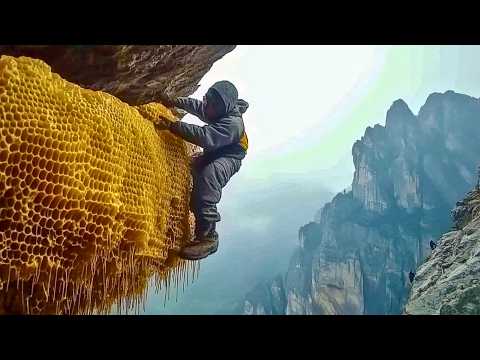
[0:00]High in the Himalayan wilderness, men dangle from towering cliffs, risking their very lives to harvest a rare crimson honey unlike any other.
[0:11]Just a single taste can induce powerful hallucinations, and its unique qualities make it highly sought after around the world.
[0:20]To claim this treasure, they must outsmart swarms of the largest bees on Earth, endure their relentless stings, and navigate sheer rock faces with nothing but bamboo ladders.
[0:33]Their window is tiny. This high stakes hunt happens only twice a year, making each harvest vital to their community's income.
[0:42]Can they secure their precious bounty or will the cliffs grant them only empty baskets?
[0:50]We are in Nepal, the land of mad honey, a rare and expensive treasure harvested under deathly conditions.
[0:59]But what could drive people to risk their life hanging on a cliff for honey?
[1:05]Beyond its deep cultural significance, mad honey can command prices of up to $500 US per kilogram in international markets.
[1:17]This sacred honey is hallucinogenic. Just two spoonfuls can induce vivid visions and euphoria.
[1:23]It is also revered in traditional medicine as a natural remedy, believed to alleviate joint pain, boost heart health, and enhance sexual vitality.
[1:37]For thousands of years, the art of mad honey hunting has been passed down from father to son.
[1:44]In the heart of the village, men prepare for the harvest by crafting bamboo ladders.
[1:51]A crucial tool that must support the full weight of the hunters and their precious bounty as they hang from deadly cliffs.
[2:04]Everyone takes part in the preparation phase, but the hunt itself is not for the faint-hearted.
[2:12]Only the most experienced honey hunters are chosen to scale the cliffs and strive for the treasure.
[2:20]One misstep could send them plunging hundreds of meters, a fall that means certain death.
[2:31]Mad Honey Hunter Nanda Lal Tamang stands at the forefront of the expedition.
[2:38]It's been many years that I've been doing this. Before I used to go with my grandparents and my father, but slowly they could no longer do it on their own, so I said, I will do it. Because why not?
[2:51]With a brave heart, I took the challenge and started hunting.
[2:55]Mad honey contains grayanotoxins, powerful compounds from the nectar of high-altitude rhododendron flowers.
[3:04]These toxins give the honey its hallucinogenic and medicinal properties.
[3:09]Only the Himalayan giant bee, the largest bee in the world, can reach these heights to produce this rare and precious nectar.
[3:22]The hunting season opens twice a year, and success means bringing back at least 15 liters of this golden treasure.
[3:33]The harvest is crucial for the village's economy, and everyone knows what's at stake.
[3:42]The question remains, will they return with their baskets full?
[3:49]The local priest prays to the gods and goddesses for a successful hunt and the safety of the hunting crew.
[4:00]The first challenge they face before reaching the cliffs where the hives hang is crossing an unstable, slippery river with all their equipment on their backs.
[4:11]But they are ready for this. With machetes in hand, they cut down trees to craft makeshift bridges, allowing them to cross the treacherous river.
[4:23]Everyone's role is essential. Without teamwork, the expedition could be over before it starts.
[4:36]The journey spans several hours on foot, but at last, the hunters reach the top of the towering cliffs.
[4:47]At this point, it's time to prepare the assault strategy.
[4:53]The expedition divides into three coordinated groups. The first stays at the top, securing the bamboo ladder and managing the ropes as they raise and lower the buckets.
[5:06]A second group waits at the bottom of the cliff, lighting fires to create smoke that calms the bees.
[5:14]Finally, the third group faces the most dangerous task, descending the ladder, dislodging pieces of the honeycomb with long sticks and guiding them into the baskets.
[5:29]Precision is critical. Any missed or shattered pieces may be recovered by the group below, but the impact with the rocks still means lost honey, and consequently, a smaller bounty.
[5:42]Some hunters prepare leaves to light the first fire. Their only defense against a swarm of thousands of giant bees.
[5:51]The rising smoke provokes a defensive reaction, causing many bees to abandon the hive. Those that remain are subdued by prolonged exposure to the smoke, which disrupts their communication and movement.
[6:08]Without this disorienting technique, the bees could launch a coordinated attack, and the result could be fatal.
[6:17]The hunters descend the ladder and approach the hive for the first time.
[6:27]The hive is swarming with bees, all in defensive mode. They cluster tightly on the exterior, covering the hive completely to appear as a single, larger animal.
[6:38]They even coordinate their movements, rhythmically swinging their abdomens in unison to intimidate intruders.
[6:47]Breaking the hive at this moment would be far too dangerous. The team decides to apply more smoke from a closer range.
[6:56]They tie burning leaves to the end of a rope and swing the smoldering bundle toward the hive, striking it directly to subdue the bees.
[7:16]The hunters above the cliff secure the ropes to the baskets, ready to lower them to the level of the hives.
[7:29]They must be careful. If a rope snaps or comes loose, the precious haul could fall and be lost.
[7:40]The smoke clears, and the two hunters descend the ladders for a second time. The hive appears calmer now, the perfect moment to take action.
[7:56]Extracting pieces of the hive requires extremely well-coordinated teamwork. While one hunter holds the basket beneath the hive, the other strikes with a stick to break off chunks filled with honey.
[8:12]Barefoot, high in the Himalayas, hanging from a deadly cliff hundreds of feet above the ground, with only a bamboo ladder and a stick in hand, and enduring relentless bee stings.
[8:28]But these hunters are hardened by experience, determined and unshakable. Nothing will stop them from claiming the honey that sustains their community.
[8:41]To achieve better stability, the most experienced ones use their feet, hardened by rough terrain that offer a sensitivity shoes cannot, giving them greater control in these precarious conditions, and helping them maneuver the long sticks with precision.
[9:04]As the hunters dislodge the honeycomb with their sticks, not every piece lands perfectly in the basket.
[9:11]Some fragments fall beyond reach, shattering on the rocks below.
[9:17]Each lost piece is a setback to their harvesting goal.
[9:23]They've been at it for a while now, and exhaustion sets in.
[9:30]This is the most critical moment. Their bodies ache, but their minds must stay sharp. One false step, one slip, and death is certain.
[9:43]The effort demanded of these men is immense.
[9:49]The group at the top of the cliff pulls up the baskets, heavy with chunks of hive. Once emptied, they lower them back down to be refilled.
[10:00]The hunters know the hives must not be completely destroyed. Enough must remain for the bees to rebuild.
[10:09]They are also aware that the population of Himalayan giant bees is in decline, threatened by climate change and deforestation.
[10:19]This fragility makes their honey even rarer and all the more valuable.
[10:24]What makes this endeavor even more remarkable is the simplicity of the hunter's gear. With only a basic face covering and ordinary clothes, they have little protection against the relentless stings of the Himalayan giant bees.
[10:43]These bees deliver far more venom than common bees. Yet the hunters press on, enduring the pain as they have countless times before.
[10:57]After many hours of work, the hunters have collected all the available honeycombs from the hives.
[11:08]The hunt is over, bringing an end to the most tense and dangerous moments.
[11:15]The first goal has been achieved. The precious honey has been harvested, and no one has been injured.
[11:25]Once the hunters climb back up, gathering the ladders and baskets, it's time to check their bounty and see just how successful the harvest has been.
[11:36]But before filtering the honey from the honeycombs, the hunters must remove the bees' stingers embedded in their skin.
[11:45]Some stingers even pierce their faces, slipping through the protective gear.
[12:03]They crush the honeycomb, allowing the sweet nectar to flow through coarse strainers made from local plants.
[12:12]These strainers trap remnants of beeswax, debris, and dead bees, leaving behind the precious golden liquid.
[12:22]Once purified, the honey is bottled and ready for commercialization.
[12:30]Mad Honey Hunter Nanda Lal Tamang checks the results of the harvest.
[12:37]Today's hives were small. We only managed to extract almost 5 liters.
[12:43]The outcome is far from what they aimed for.
[12:48]Beyond the challenges of this extremely complex work, in recent years, the number of hives has been reduced by half due to deforestation and climate change.
[13:02]Each day, it becomes harder for these experts to find cliffs with large numbers of hives.
[13:10]On top of that, globalization draws the younger generation to pursue other professions in the cities, far from the cliffs, putting this ancient tradition at even greater risk.
[13:33]To them, each climb is a test of courage, skill, and respect for nature.
[13:42]In their hands, mad honey is a connection to the wild cliffs, to their ancestors, and to the fragile balance with nature.
[13:54]Yet, as the cliffs grow quieter with each passing generation, one question lingers.
[14:02]How much longer can this ancient song echo in the mountains?


